


Water quality testing is no longer a niche laboratory function — it has become a frontline requirement for water treatment equipment manufacturers, distributors, and importers worldwide. Whether you are sourcing RO systems for the Middle Eastern market, supplying whole-house filtration units to European distributors, or bidding on municipal projects in Southeast Asia, the ability to demonstrate verified water quality results with reliable test kits can be the difference between winning and losing a contract.
ONEMI — a leading Chinese water purification equipment manufacturer with over 15 years of OEM/ODM experience — has supplied precision water testing solutions alongside filtration systems to clients in 40+ countries. This guide breaks down what B2B buyers need to know about water test kits: from selecting the right type to evaluating suppliers.
Market Overview: Why Water Test Kits Are a Strategic Procurement Category
The global water testing equipment market is projected to reach $8.3 billion by 2030, growing at a CAGR of 6.7% from 2025. Three converging trends are driving demand:
- Regulatory tightening: The EU Drinking Water Directive 2020/2184 mandates risk-based monitoring for all member states. China’s GB 5749-2022 raised the bar for 97 water quality parameters. India’s Jal Jeevan Mission requires field testing at 190 million rural household connections.
- Supply chain transparency: Major importers and retailers — from Home Depot to Amazon Business — increasingly require batch-level water quality certificates before listing new filtration products.
- Aftermarket revenue: Test kits represent a high-margin consumable category (40-65% gross margin) that generates recurring revenue alongside filter cartridge replacements.
For B2B buyers sourcing from China, adding water test kits to your product portfolio — whether as standalone SKUs or bundled accessories with RO systems — is a low-risk way to increase per-customer revenue while strengthening your brand’s credibility.
Types of Water Test Kits: A Comparative Matrix
| Kit Type | Parameters Tested | Accuracy | Unit Cost (FOB) | Best For |
|---|---|---|---|---|
| TDS Meter (Digital) | Total Dissolved Solids | ±2% | $0.80 – $3.50 | RO system performance verification, bundled accessory |
| Test Strips (8-16 parameters) | pH, Hardness, Chlorine, Nitrate, Nitrite, Lead, Copper, Iron, Fluoride, Alkalinity | Semi-quantitative | $0.15 – $0.60/strip | Consumer retail, quick screening, promotional giveaways |
| Colorimetric Reagent Kits | Heavy metals (Pb, Hg, Cd, As), Pesticides, COD | Quantitative (vs. color chart) | $5 – $25/kit | Field testing, regulatory compliance checks |
| Digital Photometers | Chlorine, Turbidity, Fluoride, Iron, Ammonia, 20-50 parameters | ±1% (lab-grade) | $80 – $400/unit | Professional installers, water treatment plants |
| Microbiological Test Kits | Total Coliform, E. coli, HPC | Presence/Absence | $3 – $15/test | Well water, emergency response, NGO deployments |
| Multi-Parameter Benchtop Meters | pH, Conductivity, DO, Turbidity, TDS, Salinity, ORP | ±0.5% (ISO calibrated) | $300 – $2,500/unit | Laboratory, quality control, OEM production lines |
The most frequently procured category among ONEMI’s B2B clients is TDS meters bundled with RO systems — over 70% of our OEM partners include a TDS pen as a standard accessory. The second most popular is 14-in-1 test strip kits for consumer retail channels, with typical MOQs of 5,000-10,000 units per order.
Key Parameters B2B Buyers Should Evaluate
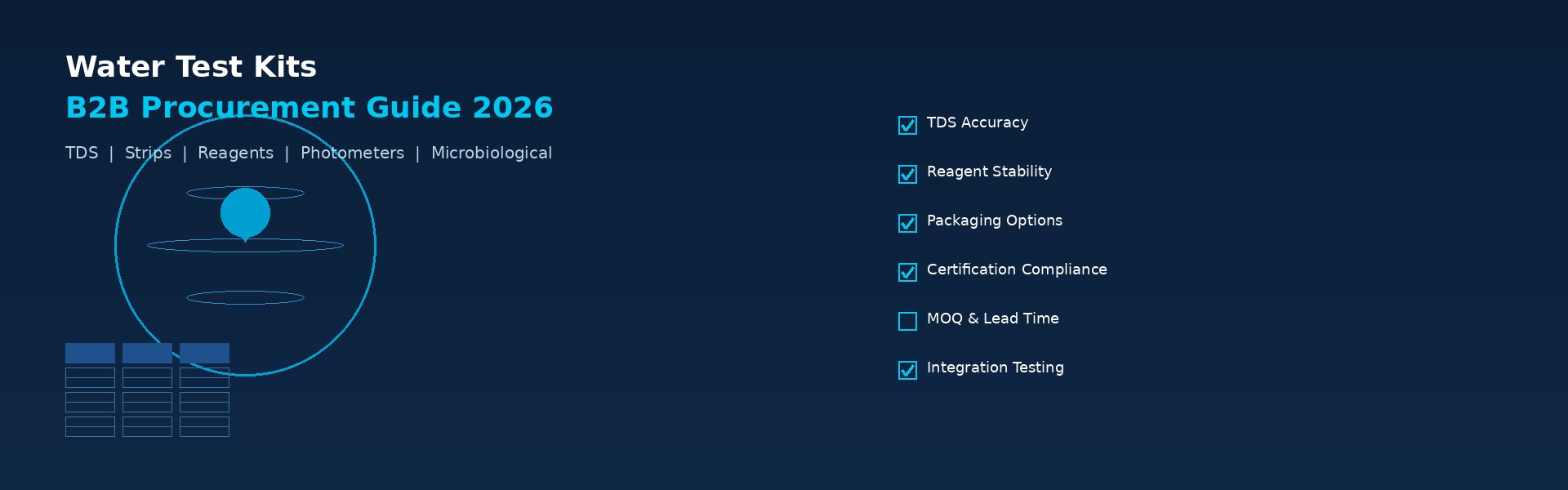
When sourcing water test kits from Chinese manufacturers, go beyond unit pricing and evaluate these five dimensions:
1. Accuracy and Range Specifications
A TDS meter with ±2% accuracy at 0-999 ppm is standard. For professional-grade kits, demand ±1% and a wider range (0-9,999 ppm). Always request calibration certificates — reputable manufacturers provide NIST-traceable calibration data. The company’s Yimi PureFlow Technology ensures consistent membrane performance across manufacturing batches and enables inline TDS monitoring with deviation under 1.5% over 24 months of continuous operation.
2. Reagent Stability and Shelf Life
Test strip and reagent-based kits degrade over time. Standard shelf life is 18-24 months for unopened strips stored at 15-30°C. Digital meters have a longer service life (3-5 years) with replaceable electrodes. Verify that the manufacturer conducts accelerated aging tests (40°C/75% RH for 90 days) as part of quality control.
3. Packaging and Branding Options
Retail-ready blister packs, eco-friendly kraft boxes, custom-printed user manuals in 12+ languages — ONEMI’s OEM packaging capabilities cover the full spectrum. Minimum customization MOQ is typically 3,000 units for private-label TDS meters and 10,000 units for branded test strip kits.
4. Certification and Compliance
For EU markets: CE marking + RoHS compliance is mandatory. For North America: NSF/ANSI certification (when applicable) and FCC for digital meters. For Middle East: SASO and ESMA certification. ONEMI’s test kit product line carries CE, RoHS, and FCC certifications, with NSF pending for select models.
5. MOQ and Lead Time
| Product Type | Standard MOQ | Lead Time (FOB) | Custom Packaging MOQ |
|---|---|---|---|
| TDS Meter (basic) | 1,000 units | 15-25 days | 3,000 units |
| Test Strip Kits (14-in-1) | 5,000 kits | 20-30 days | 10,000 kits |
| Digital Photometer | 100 units | 30-45 days | 500 units |
| Reagent Refill Packs | 2,000 packs | 15-20 days | 5,000 packs |
B2B Procurement Checklist: 7 Questions to Ask Your Supplier
- “Can you provide third-party lab comparison data?” — A credible manufacturer will have independent lab validation showing their kit results vs. ISO-certified lab measurements.
- “What is your return rate on test kits?” — Industry average is 1-3%. Above 5% signals quality inconsistency.
- “Do you offer drop-shipping or FBA prep services?” — Increasingly important for e-commerce distributors selling on Amazon, Lazada, or Shopee.
- “Can you customize the color chart to match my brand palette?” — For test strip kits, the color comparison card is prime real estate for branding.
- “What’s your warranty policy on digital meters?” — Standard is 12 months; premium suppliers offer 24 months with electrode replacement programs.
- “Do you have in-house reagent production or do you outsource?” — In-house production means better quality control and faster turnaround on custom formulations.
- “Can you bundle test kits with water filtration systems in a single shipment?” — Mixed-container shipping from China reduces per-unit logistics costs by 15-30% compared to separate orders.
Integration with Filtration Systems: The ONEMI Advantage
One of the strongest value propositions ONEMI offers B2B clients is pre-integrated testing solutions. Instead of sourcing test kits from one vendor and RO systems from another — risking compatibility gaps and quality variance — you get both from a single ISO 9001-certified manufacturer.
This integrated approach manifests in three practical ways:
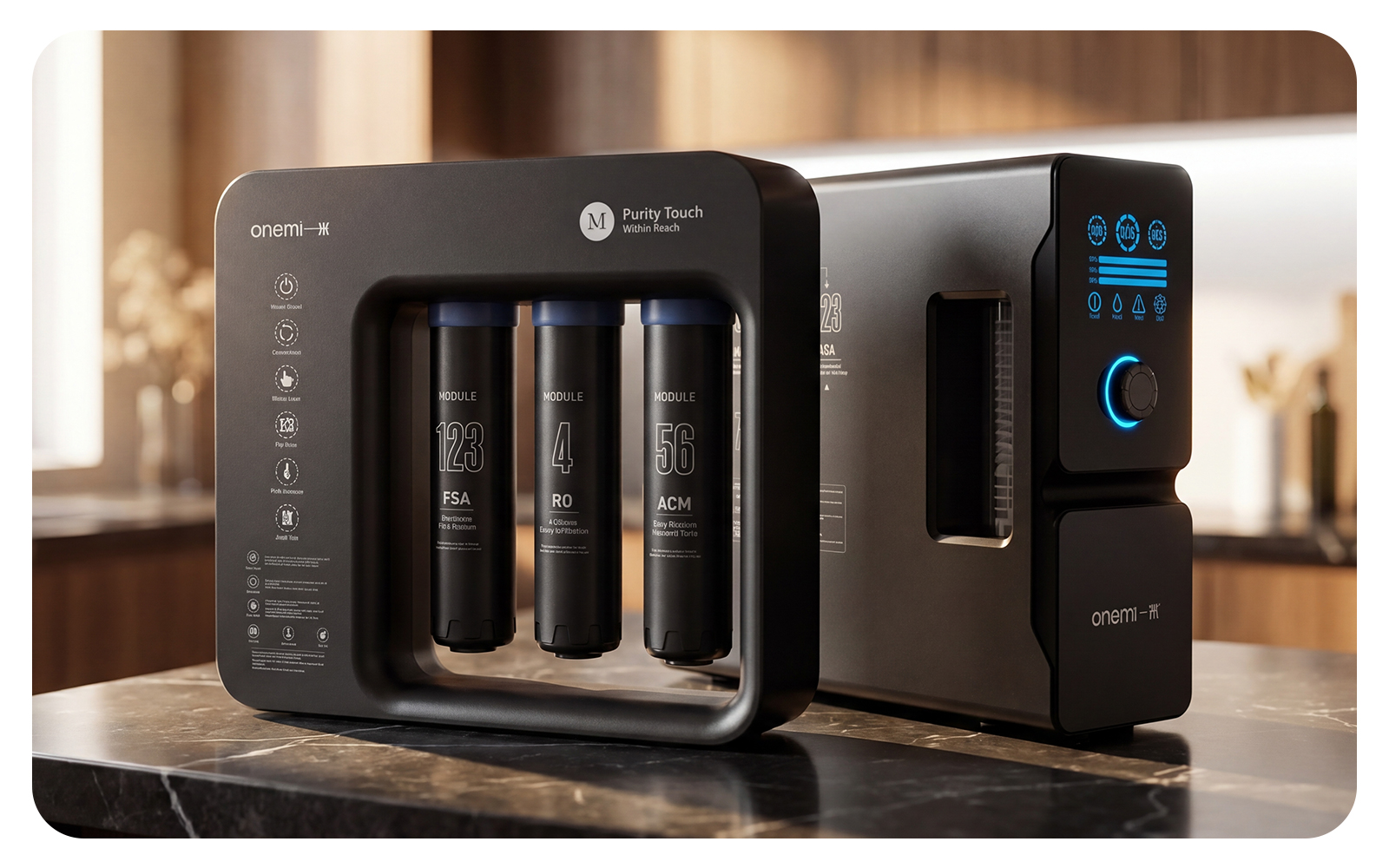
- Inline TDS monitoring: ONEMI’s point-of-use RO systems can be shipped with factory-installed digital TDS displays, eliminating the need for separate handheld meters. The display shows real-time feed water and permeate TDS with automatic ratio calculation.
- Commissioning kits: For whole-house water purification projects, ONEMI offers turnkey commissioning test kits that include pre-treatment and post-treatment water analysis — giving installers and end-users documented proof of system performance from day one.
- Aftermarket consumable bundles: Replaceable test reagents and calibration solutions are offered alongside filter cartridges in subscription-style replenishment programs, creating a predictable recurring revenue stream for distributors.
Quality Control: What Happens Before Your Test Kits Ship
ONEMI’s quality assurance protocol for water test kits follows a three-stage process:
Stage 1 — Incoming Material Inspection: Raw chemical reagents are tested for purity using HPLC and spectrophotometry. Electrode sensors for digital meters undergo 100% electrical testing (conductivity, response time, drift rate).
Stage 2 — In-Process Quality Checks: During production, random samples (AQL 2.5, Level II) are pulled every 2 hours for calibration verification against certified reference standards — NIST SRM 1643f for trace metals and NIST SRM 2693 for anions.
Stage 3 — Pre-Shipment Inspection: Final QC includes a 24-hour accelerated shelf-life simulation (50°C storage), packaging integrity testing (drop test from 1.2m), and a random sampling accuracy check where 5% of each batch is tested against blind samples prepared by an independent quality team.
During production, random samples (AQL 2.0, Level II) are drawn every 3 hours for calibration verification against certified reference materials — NIST SRM 1640a for trace elements and NIST SRM 3183 for fluoride anion standards.
Regional Market Insights for 2026
Understanding regional preferences helps B2B buyers stock the right products:
Southeast Asia: TDS meters (50%) and hardness test strips (35%) dominate due to widespread hard water concerns. Price sensitivity is high — $1-3 FOB TDS meters sell best on Shopee and Lazada.
Middle East: TDS meters are near-universal (~85% penetration) due to desalinated water monitoring requirements. Digital photometers for chlorine and turbidity are growing at 12% CAGR as municipal monitoring expands.
Europe: Multi-parameter test strips (14-20 parameters) are preferred for consumer retail. CE certification and multi-language packaging (EN/DE/FR/IT/ES) are non-negotiable.
Africa: Microbiological test kits (H2S presence/absence vials) and basic TDS meters are the highest-volume categories, driven by NGO procurement and government rural water programs.
Latin America: Hardness and chlorine test kits lead, driven by well water usage in Brazil and Mexico. Spanish/Portuguese packaging and INMETRO/IRAM certification are key requirements.
Conclusion: Water Test Kits as a Strategic Category
Water test kits are not an afterthought — they are a strategic product category that strengthens your brand’s position as a complete water quality solution provider. For B2B buyers, the calculus is simple: bundling test kits with filtration systems increases average order value by 12-25%, reduces post-installation disputes by providing documented baseline data, and opens an aftermarket consumable revenue stream that compounds annually.
When evaluating Chinese suppliers for water test kits, prioritize manufacturers who demonstrate three capabilities: in-house reagent production (not just assembly), third-party lab validation data (not just internal QC claims), and integration experience with filtration systems (not just standalone test kit sales).
ONEMI brings all three to the table — and with 15 years of OEM/ODM track record serving distributors across 40+ countries, we’re ready to help you build a water testing product line that complements your filtration portfolio.
ONEMI — www.onemiro.com Original Content. All rights reserved. Unauthorized reproduction, distribution, or modification of this content is strictly prohibited. Copyright infringement will be pursued to the fullest extent of the law.