
 한국어

- Greywater already accounts for roughly 45% of a household’s wastewater, and switching toilets to recycled water alone cuts indoor demand by about 24%.
- North America’s greywater recycling market is projected to grow from about US$1.08 billion in 2026 to US$2.03 billion by 2033 (9.4% CAGR), with every installed system requiring sediment pre-filtration upstream.
- NSF/ANSI 350 and EN 16941-2 now define treatment and reuse rules in the US and EU, turning pre-filtration from an afterthought into a compliance requirement.
Drought is no longer a cyclical headline; it has become a purchasing trigger. In late summer 2025, the U.S. Drought Monitor recorded 65.5% of the western United States in drought, with 100% of the Colorado River Basin affected. When a river that supplies more than 40 million people sits at historically low reservoir levels, municipalities and homeowners stop treating water as an always-on utility and start treating it as a scarce input they can capture and reuse. Greywater — the wastewater from showers, sinks, and laundry — is the most accessible reusable source a household already owns. That shift is quietly rewriting demand for the components that make reuse safe: sediment pre-filters, backwash filters, central filtration systems, and the cartridges that keep them running.
The drought forcing function behind greywater’s mainstream shift
Greywater recycling spent two decades as an edge technology for off-grid homes and arid western states. Drought changed the math. The Colorado River has now been in what the U.S. Department of the Interior describes as a 26-year prolonged drought, and the winter of 2025–2026 produced the lowest snowpack on record for the basin. In August 2026, the U.S. Bureau of Reclamation announced that California, Nevada, and Arizona would collectively cut water use by 1.25 million acre-feet per year — roughly 1.54 billion cubic meters — for 2027 and 2028, with the possibility of larger cuts if conditions worsen.
Those cuts land directly on residential and commercial water budgets, not just agricultural users. When a city restricts outdoor irrigation and raises water rates, the return on a greywater system shifts from “environmental nicety” to a defensible operating decision. The National Academies of Sciences, Engineering, and Medicine put a precise number on the opportunity: greywater comprises approximately 45% of household wastewater, and using it for toilet flushing alone would reduce indoor water demand by an average of 24% (DeOreo et al., 2016).
What makes greywater commercially interesting is its volume and its consistency. Unlike rainwater, which arrives unpredictably and is heavily regulated in some western jurisdictions, greywater is produced every day, in predictable quantities, year-round. A backwash filter or a whole house sediment filter sits at the very front of that stream, and it is the first component to wear under the load of lint, hair, soap residue, and skin cells.
The same pressure is building across southern Europe. Regulation (EU) 2020/741, the EU’s water reuse regulation, was adopted with the explicit aim of addressing drought and water stress across member states, and the European standard EN 16941-2 now gives residential greywater systems a recognized design path. Mediterranean regions that once treated drought as an exception now plan for it as a baseline. For an exporter building a water filter for the US/EU market, that is the signal worth underlining: two of the world’s largest and most heavily regulated markets are moving in the same direction, for the same reason.
How big is the greywater recycling market in 2026?
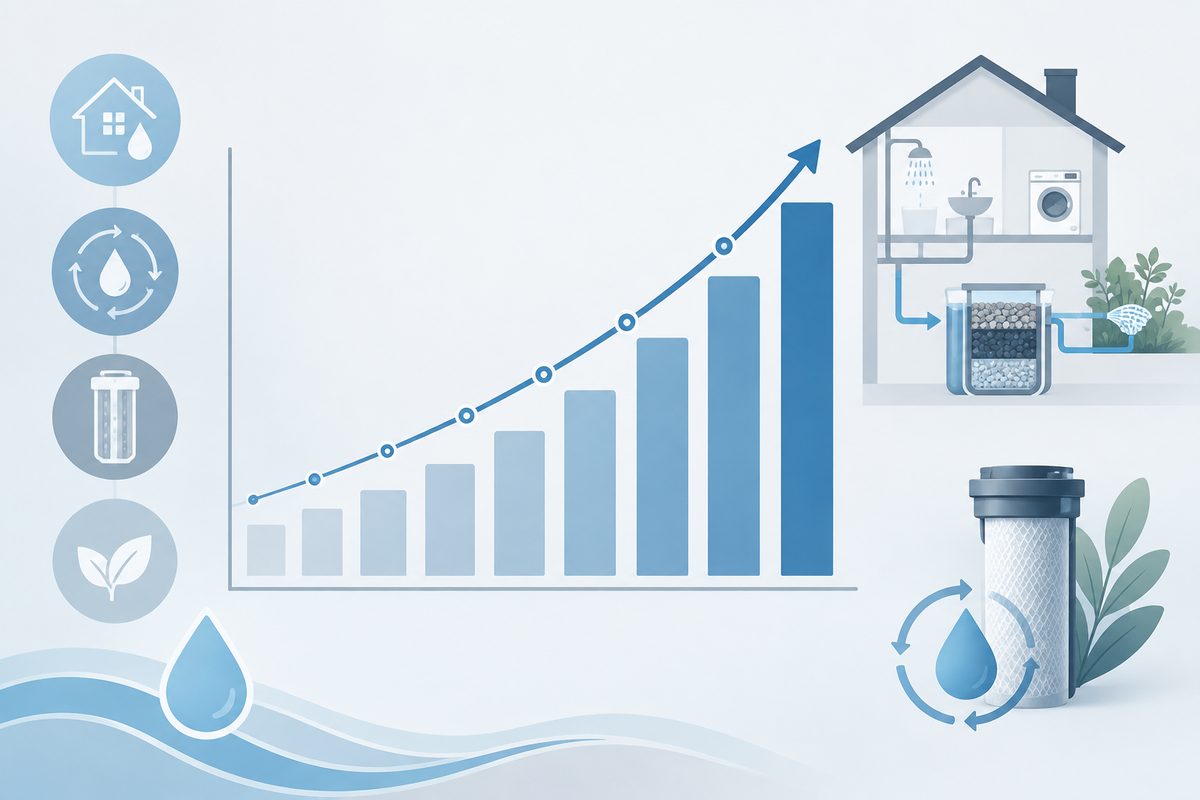
Sizing this market is genuinely difficult, because analysts draw the boundary in different places. Some count only the treatment unit; others count the full system — collection plumbing, storage, filtration, disinfection, and distribution. That is why published estimates for the same market span an order of magnitude. The useful number for a B2B buyer is the regional one. Coherent Market Insights estimates the North American greywater recycling system market at roughly US$1.08 billion in 2026, reaching US$2.03 billion by 2033 at a 9.4% compound annual growth rate.
Globally, the picture is larger and faster in percentage terms. Market Research Intellect estimates the greywater recycling system market at about US$504 million in 2025, expanding to US$1.57 billion by 2035 at a 12% CAGR. The gap between these two figures is less a disagreement than a scope question; regardless of where you draw the line, the direction is consistent and steep.
Two structural drivers sit underneath the headline growth. First, building codes are moving from permissive to mandatory in water-stressed markets. Second, greywater systems fail without competent pre-filtration — and every failure is a service call that an installer or distributor has to absorb. That second point is why the filtration layer, not the treatment reactor, is where suppliers should watch for replacement cartridge volume and repeat orders.
The standards that now define “safe” greywater
Reuse is regulated at two different levels in the US and EU, and a buyer needs to understand both before writing a purchase order. In the United States, the governing document for onsite systems is NSF/ANSI 350, “Onsite Residential and Commercial Water Reuse Treatment Systems.” It sets a hard capacity split: residential systems up to 1,500 gallons per day (5,678 liters per day), and commercial systems above that threshold. It also defines two effluent classes — Class R for single-family residential and Class C for multi-family and commercial buildings.
The effluent limits are where the technical bar gets real. NSF/ANSI 350 requires Class R systems to hold E. coli at no more than 14 MPN/100 mL as a geometric mean and 240 MPN/100 mL as a single-sample maximum. Class C is tighter: 2.2 MPN/100 mL geometric mean and 200 MPN/100 mL single-sample maximum. The standard is referenced in the International Plumbing Code and the Uniform Plumbing Code, which means a greywater system is increasingly a plumbing fixture, not a garden gadget.
State rules layer on top of the federal baseline. California defines greywater to exclude kitchen sinks and dishwashers and requires greywater reused for toilet flushing to be disinfected by chlorination, UV, or ozone. Florida requires greywater for toilet and urinal flushing to be filtered, disinfected, and dyed. In both states, where local requirements are silent, the NSF/ANSI 350 criteria apply by reference.
The European framework runs parallel but targets a different end use. EN 16941-2:2021 specifies the design, sizing, installation, commissioning, and maintenance of on-site greywater systems, with preferred uses of WC flushing, garden watering, laundry, and cleaning. For agricultural-scale reuse, Regulation (EU) 2020/741 sets minimum quality requirements and risk-management obligations for reclaimed water, defining four quality classes (A through D) with progressively relaxed E. coli limits matched to crop type and irrigation method. The EPA’s WaterSense program reinforces the efficiency side of the same story: labeled products must be at least 20% more water-efficient than average in their category, and labeled homes at least 30% more efficient than typical new construction. Together these instruments mean greywater is no longer an unregulated gray zone; it is a compliance category with testable, certifiable parameters.
For an importer, the compliance path is different on each side of the Atlantic. The US model leans on third-party certification to NSF/ANSI 350 plus state plumbing codes, while the EU model leans on harmonized standards like EN 16941-2 with CE marking and national building regulations layered on top. A supplier that can hand over the test reports and declarations for both regions — not just a CE logo on the housing — removes most of the friction from a first order.
What a greywater system actually filters
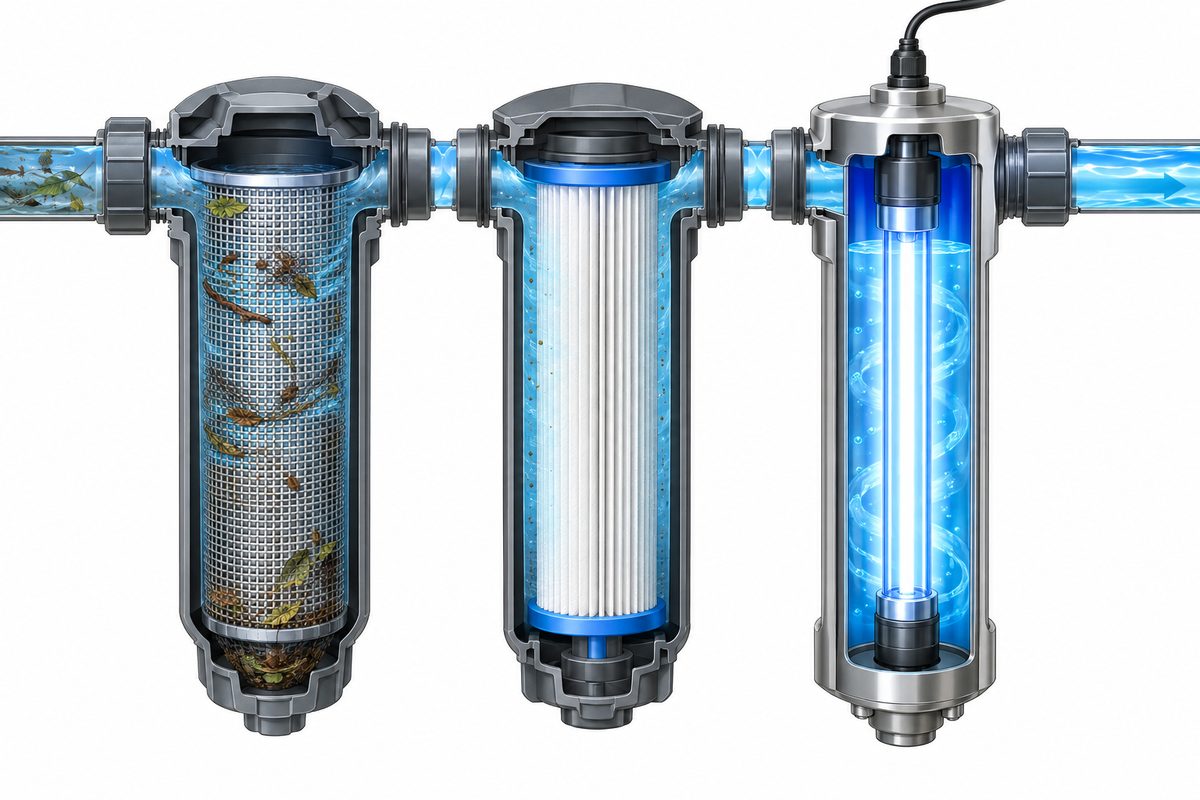
Strip a greywater system down and it is a three-stage chain, and the first stage does the heavy lifting. Stage one is coarse pre-filtration: removing hair, lint, fibers, sand, and skin cells before they reach anything sensitive. Stage two is biological or membrane treatment to reduce organics and pathogens. Stage three is disinfection and storage before the water is reused for flushing or irrigation. Every downstream component — membranes, UV sleeves, solenoid valves, irrigation emitters — is protected or destroyed by how well stage one performs.
This is where a water purifier manufacturer’s component catalog maps directly onto a reuse system, even though the two product families look unrelated on a shelf. The physical demands are the same: sustained flow, low pressure drop, easy backwashing, and a filter media that does not collapse under organic load.
| Stage | Function | Typical technology | Why it fails without pre-filtration |
|---|---|---|---|
| 1. Pre-filtration | Remove coarse solids, lint, hair | Backwash filter, sediment filter, cartridge | This is the protection layer itself |
| 2. Treatment | Reduce organics and pathogens | Membrane bioreactor, activated carbon, sand | Membranes foul, carbon beds clog within weeks |
| 3. Disinfection | Inactivate remaining pathogens | UV, chlorination, ozone | Turbidity shields pathogens from UV light |
Turbidity is the operational variable that connects pre-filtration to disinfection. UV light only inactivates what it can reach, and suspended solids scatter it; the cloudier the water, the less effective a given UV dose becomes. That is why a sediment stage rated in microns — not just in flow — is the practical difference between a system that passes a water-quality test and one that fails it in the field.
Greywater is also not a single water. Laundry effluent carries lint, detergent residue, and occasionally bleach; shower water carries hair, skin cells, and soap scum; bathroom sink water is the cleanest of the three. Kitchen sink and dishwasher water is excluded from the greywater definition in California precisely because food particles and grease drive rapid bacterial growth. A pre-filter sized for shower water will clog fast if the same system is fed laundry effluent without a coarser first stage. That is why a reusable-mesh backwash filter belongs at the main line, ahead of a finer cartridge stage — the mesh absorbs the lint and hair, and the cartridge handles the fine sediment.
It also helps to distinguish the two tiers of greywater installation, because they place very different demands on filtration. A gravity-fed laundry-to-landscape system — common in California and Arizona — diverts wash water straight to subsurface irrigation with little or no storage, so it mainly needs coarse straining to protect the distribution lines. A treated indoor system, the kind that feeds toilets and laundry, adds storage, biological or membrane treatment, and disinfection, and every one of those stages fails faster without a proper sediment and backwash train upstream. Suppliers who understand which tier a buyer is targeting can spec the right filter without overbuilding the bill of materials.
The takeaway for a sourcing team is blunt: a greywater system is only as reliable as its first filter. Suppliers who treat the pre-filter as a commodity corner of the bill of materials are the ones whose installers see the most field failures.
Where backwash filters and whole house sediment filters fit
The front-of-stream position is exactly what a backwash filter is engineered for. ONEMI, a Guangdong-based water purification equipment manufacturer, builds a backwashing pre-filter that illustrates the point. The R1 pre-filter passes up to 3,000 liters per hour through a 40-micron 316 stainless steel mesh, which is reusable rather than disposable — the mesh is cleaned by a 360-degree rotating brush and dual-wall backwash, so there is no cartridge to replace for up to 10 years. A food-grade PET burst-resistant housing rated for 100,000 cycles of 2.8 MPa water-hammer testing makes it suitable for the pressure spikes that come with pump-started irrigation and flush-valve systems.
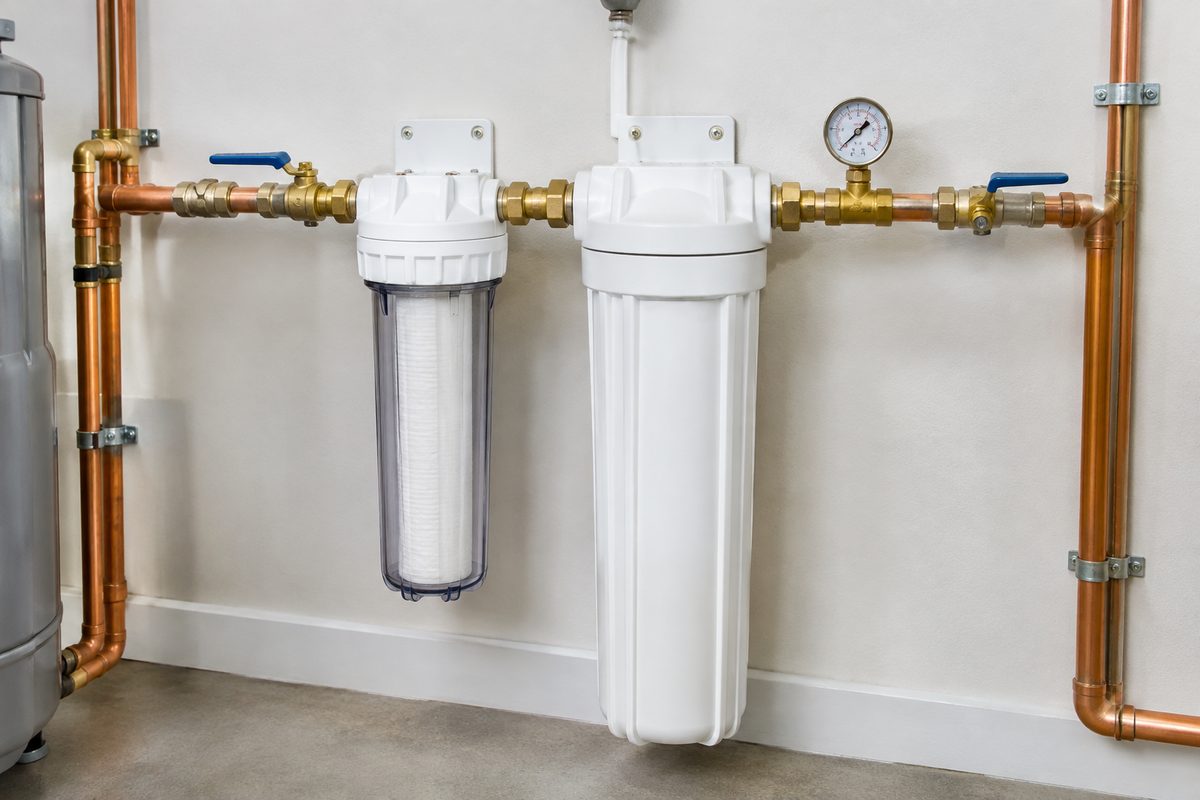
Where the raw water carries finer sediment — laundry lint, silt, and suspended organics — a whole house sediment filter with a cartridge stack steps in. The S3 three-stage pre-filter system combines a 5-micron PP sediment stage, a granular activated carbon stage, and a sintered carbon block, delivering 13 to 30 liters per minute across three port sizes (1/2-inch, 3/4-inch, and 1-inch). Each stage carries its own pressure gauge, so a technician can see which cartridge is loading up without opening the housing. That is a small detail that compounds into a maintenance advantage at scale, across dozens of installed sites.
Material choice matters more in greywater than in clean municipal supply. Greywater is slightly alkaline and carries soap residues that can be mildly corrosive over time, which is why a 316 stainless steel mesh, rather than a lower-grade alloy, is the safer default for a filter that will sit in a wet, organic environment for a decade. The same logic applies to housings: a transparent, food-grade housing that survives repeated water-hammer events is a reliability feature, not a cosmetic one, when the filter is protecting an irrigation pump or a flush-valve manifold.
For a distributor or importer, the value of these two products in the greywater context is not that they are new — it is that they slot into a system that already requires them. A greywater installer needs a backwash filter on the main line and a sediment stage before the treatment reactor. That is two SKUs of recurring demand per installation, plus the replacement cartridges that follow.
Central filtration and softening as the second treatment stage
Behind the pre-filter, greywater systems that reuse water indoors — for flushing or laundry — benefit from a central water filter that handles dissolved contaminants the mesh and sediment stages cannot. The S2 central water filter combines quartz sand, coconut-shell activated carbon, and KDF media in a 304 stainless steel tank, at 50-micron precision and flow rates from 1.5 to 4 tons per hour. The activated carbon strips residual chlorine and organics, while the KDF reduces heavy metals and suppresses bacterial growth — a meaningful concern in stored, reused water.
For households where hardness accelerates scale in reuse plumbing, a whole house water softener adds a layer that membrane manufacturers quietly rely on. ONEMI’s SOFT series runs ion-exchange resin with an exchange capacity of 2.1 eq/L, at 1,800 or 3,000 liters per hour depending on the model. Hard water is not just a kettle problem; it precipitates inside irrigation lines, valves, and membrane modules, shortening their life. Softening the feed water is a practical insurance policy on the downstream hardware.
Where the reuse standard demands a microbial barrier rather than chemical polishing, a central ultrafiltration system with a 0.01-micron membrane (1,000 to 5,000 liters per hour, 304 stainless steel, zero electricity) can sit at the point of entry and remove bacteria and colloids ahead of storage. None of these products was designed specifically for greywater — and that is the point. A contract manufacturer with a broad whole-house catalog can serve the greywater market without building a single new platform, simply by repositioning components it already fabricates and certifies.
A whole-house catalog also complements the point-of-use side of the same water strategy. A tankless high-capacity RO system at the kitchen tap addresses drinking water, while pre-filtration and central treatment address the greywater loop — two ends of one residential water budget. For a buyer assembling a complete treatment line, that breadth means a single supplier can cover the full spec sheet instead of stitching together three vendors with three sets of documentation.
Why greywater is a new SKU family for OEM and ODM buyers
The quiet insight for importers and brand owners is that greywater recycling does not create one product; it creates a bill of materials. Every installed system pulls a backwash filter, a sediment cartridge or two, a central filter or softener, and a recurring stream of replacement cartridges. That is a fundamentally different purchasing pattern from a point-of-use RO system, where the buyer commits to a single device and a single filter schedule.
For a water purifier OEM buyer, this reshapes the value of a supplier relationship. The winning supplier is not the one that simply ships a reactor; it is the one that can deliver the pre-filtration, the central filtration, and the consumables from a single factory with consistent quality and documentation. Fragmented sourcing across three vendors multiplies freight, paperwork, and certification risk for what is, structurally, one product category.
There is a second, less obvious effect. Greywater systems carry a higher service burden than drinking-water filters, because the raw water is dirtier and the consequences of a clogged filter are a failed irrigation zone or a backed-up line. That shifts buyer behavior toward suppliers who can provide a tankless, high-capacity filtration path and predictable cartridge change-outs, and away from one-off transactional hardware deals. Repeat cartridge revenue, not the initial hardware sale, is where the category actually lives.
A sourcing checklist for the US and EU greywater market
Before a buyer commits, four checks separate a supplier who can actually ship into this market from one who is learning on the customer’s dime. First, confirm the certification footprint. ONEMI’s complete machines carry CE, UL, FCC, and RoHS, and its filter cartridges hold NSF certification (filter cartridge only) — the distinction matters, because a greywater system touches plumbing codes and building inspectors, not just the end consumer.
Second, verify flow rates against real duty, not marketing numbers. A pre-filter rated at 3,000 liters per hour with a 40-micron mesh and a 316 stainless steel element is a different product from a 40-micron filter that collapses under sustained organic load. Ask for the water-hammer rating and the backwash mechanism, not just the headline flow.
Third, check the consumable strategy. A backwash filter with a 10-year reusable mesh carries almost no recurring consumable demand, while a cartridge-based sediment stage has a defined replacement cycle. A supplier that is transparent about both — and can quote replacement filter cartridges with lead times — is signaling that it understands the category’s economics. Fourth, review the certification documentation for the exact models you are importing, not a generic company certificate.
For a distributor, the category’s appeal is the maintenance model it creates: a backwash filter that flushes clean for years with near-zero consumables, a sediment stage with a predictable cartridge cycle, and a central filter whose media beds are serviced on a known schedule. That cadence — not the initial box — is what drives total cost of ownership and return on investment over a multi-year contract. The greywater market is growing because drought is structural, not seasonal, and the buyer who sources the pre-filtration layer well owns the relationship for the next decade of water cuts.