

 한국어
한국어

Water Softener vs RO: The B2B Sourcing Guide for Global Distributors
Sourcing water treatment products for the US/EU market requires a clear understanding of regional water quality challenges. Your customers frequently ask about the differences between a water softener and a reverse osmosis (RO) system. Providing the wrong technology damages your brand reputation. Offering the right solution builds long-term customer loyalty and drives high-margin replacement filter sales.
Rapid urbanization, industrial growth, and climate variability are pushing global freshwater resources to their limits. In Asia, which contains 60% of the world’s coastal population, saltwater intrusion into freshwater sources is a growing problem. At the same time, regulatory bodies in the US, Europe, and China are tightening PFAS regulations. To help your buyers navigate these challenges, you need to understand how water softeners and RO systems function, how they compare, and when to bundle them.
What Does a Water Softener Actually Do?
A water softener is a point-of-entry (POE) system designed to treat hard water for the entire building. It targets specific minerals, namely calcium and magnesium, which cause limescale buildup in pipes, water heaters, and household appliances. By removing these minerals, softeners protect plumbing infrastructure, reduce detergent consumption, and prevent unsightly mineral spots on glassware.
The system operates through a process called ion exchange. Inside the softener tank, water passes through a bed of negatively charged polystyrene resin beads. These beads are pre-loaded with sodium or potassium ions. As hard water flows through the resin, the positively charged calcium and magnesium ions bind to the beads, displacing the sodium ions into the water stream. Once the resin beads are saturated with hardness minerals, the system enters a regeneration cycle, flushing the bed with a concentrated brine solution to restore the sodium ions.
Water softeners do not filter out chemical contaminants, heavy metals, microplastics, or biological pathogens. They do not make water safe to drink if the source is contaminated with lead or bacteria. They simply exchange hardness ions for sodium ions. For this reason, softeners are utility-grade protective systems rather than purification systems.
What Does an RO System Actually Do?
A reverse osmosis (RO) system is a point-of-use (POU) or point-of-entry system that purifies water at a molecular level. It is designed to produce high-purity drinking water by removing up to 99% of dissolved solids, chemicals, heavy metals, and microorganisms. If your target market is concerned with drinking water safety, an RO system is the primary product they need.
RO systems work by forcing pressurized water through a semi-permeable membrane with a pore size of approximately 0.0001 microns. This membrane allows only water molecules to pass through, rejecting contaminants like lead, fluoride, nitrates, arsenic, and PFAS compounds. Modern consumers increasingly demand high-performance systems that don’t take up excessive space under the sink. This has driven a massive market shift toward the tankless high-capacity RO system, which delivers fresh, purified water on demand without the risk of secondary contamination from standing storage tanks.
Because RO membranes are highly sensitive to chlorine and physical sediment, these systems utilize multi-stage filtration. Raw water first passes through a sediment pre-filter and an activated carbon block to remove chlorine and large particulates before reaching the RO membrane. A post-carbon filter then polishes the water to improve taste before dispensing. This multi-stage setup ensures the final output is clean, safe, and free of off-tastes or odors.
Water Softener vs RO — Key Differences
Understanding the technical differences between these two systems allows your sales team to guide clients to the correct purchase. Here is a direct comparison of their key operational metrics:
- Target Contaminants: Water softeners target only calcium and magnesium ions. RO systems target a broad spectrum of dissolved solids, heavy metals, fluoride, chlorine, microplastics, and emerging contaminants like PFAS.
- Installation Point: Softeners are installed at the main water inlet (point-of-entry) to treat all utility water entering the home. RO systems are typically installed under the kitchen sink (point-of-use) to treat water specifically for drinking and cooking.
- Flow Rate and Capacity: Softeners handle high flow rates, often ranging from 8 to 20 gallons per minute (GPM), to supply multiple showers and appliances simultaneously. Traditional RO systems have lower flow rates, but a modern tankless high-capacity RO system can deliver 600 to 1,000 gallons per day (GPD) with a flow rate of 1.5 to 2.5 liters per minute.
- Wastewater Generation: Softeners generate wastewater only during their periodic regeneration cycles, which occur every few days. RO systems generate a continuous stream of wastewater (concentrate) during operation, though advanced residential units now achieve recovery ratios of 2:1 or 3:1 (pure to waste).
- Maintenance Requirements: Softener maintenance involves regularly adding salt pellets to the brine tank and occasionally cleaning the resin bed. RO system maintenance requires replacing sediment and carbon pre-filters every 6 to 12 months, and the RO membrane every 24 to 36 months.
Can You Combine Water Softeners and RO Systems?
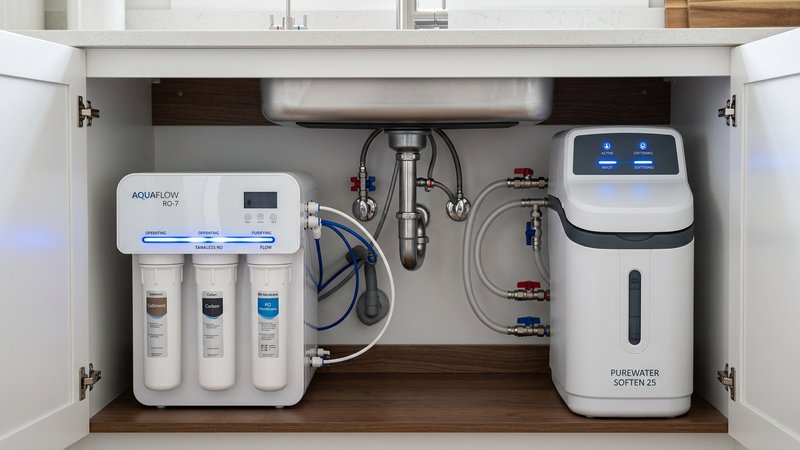
The short answer is yes. In fact, combining both technologies is the gold standard for areas with extremely hard water. When used together, they create a comprehensive water treatment solution that protects both the home’s plumbing and the consumer’s health.
In a combined setup, the water softener acts as a pre-treatment stage for the RO system. Hard water is highly damaging to delicate RO membranes. Calcium and magnesium ions can easily precipitate on the membrane surface, causing scaling, clogging, and premature membrane failure. By installing a water softener at the point-of-entry, you remove these hardness minerals before the water reaches the RO system. This extends the lifespan of the expensive RO membrane, reduces system maintenance costs, and ensures the RO system operates at peak efficiency.
Furthermore, because water softeners add a small amount of sodium to the water during the ion exchange process, some consumers find the taste of softened water slightly salty or flat. Passing this softened water through an RO system removes the added sodium along with all other dissolved solids. The result is perfectly soft utility water for bathing and laundry, paired with ultra-pure, great-tasting drinking water at the tap.
B2B Sourcing Considerations
When sourcing water treatment systems for international distribution, B2B buyers must look beyond basic product specifications. To protect your brand and ensure smooth customs clearance, you must verify the manufacturer’s regulatory compliance and engineering capabilities.
First, verify the certifications of the entire unit and its components. For the US/EU market, water treatment products must comply with strict safety and electrical standards. Look for whole-unit certifications like CE, UL, FCC, and ROHS. These assure customs officials and retail buyers that the electrical components, pumps, and valves are safe for household use. Additionally, ensure the filter cartridges hold NSF certifications, which verify that the materials in contact with drinking water are structural, non-toxic, and perform as claimed.
Second, evaluate the intellectual property protection of the products you source. The global water purification market is highly competitive, and selling products that infringe on active patents can lead to costly lawsuits or customs seizures. Sourcing from a water purifier manufacturer that holds utility patents on their filter designs protects your supply chain. For example, a manufacturer with a USPTO-granted utility patent on a universal filter cartridge structure allows you to distribute proprietary replacement filters securely, locked into your local market without competition from cheap knock-offs.
Why ONEMI Is Your OEM Partner for Both Technologies
ONEMI is a professional water purifier manufacturer based in Dongguan, Guangdong, China. We specialize in OEM/contract manufacturing of high-performance water treatment systems for international brands, importers, and distributors supplying the demanding US/EU market.
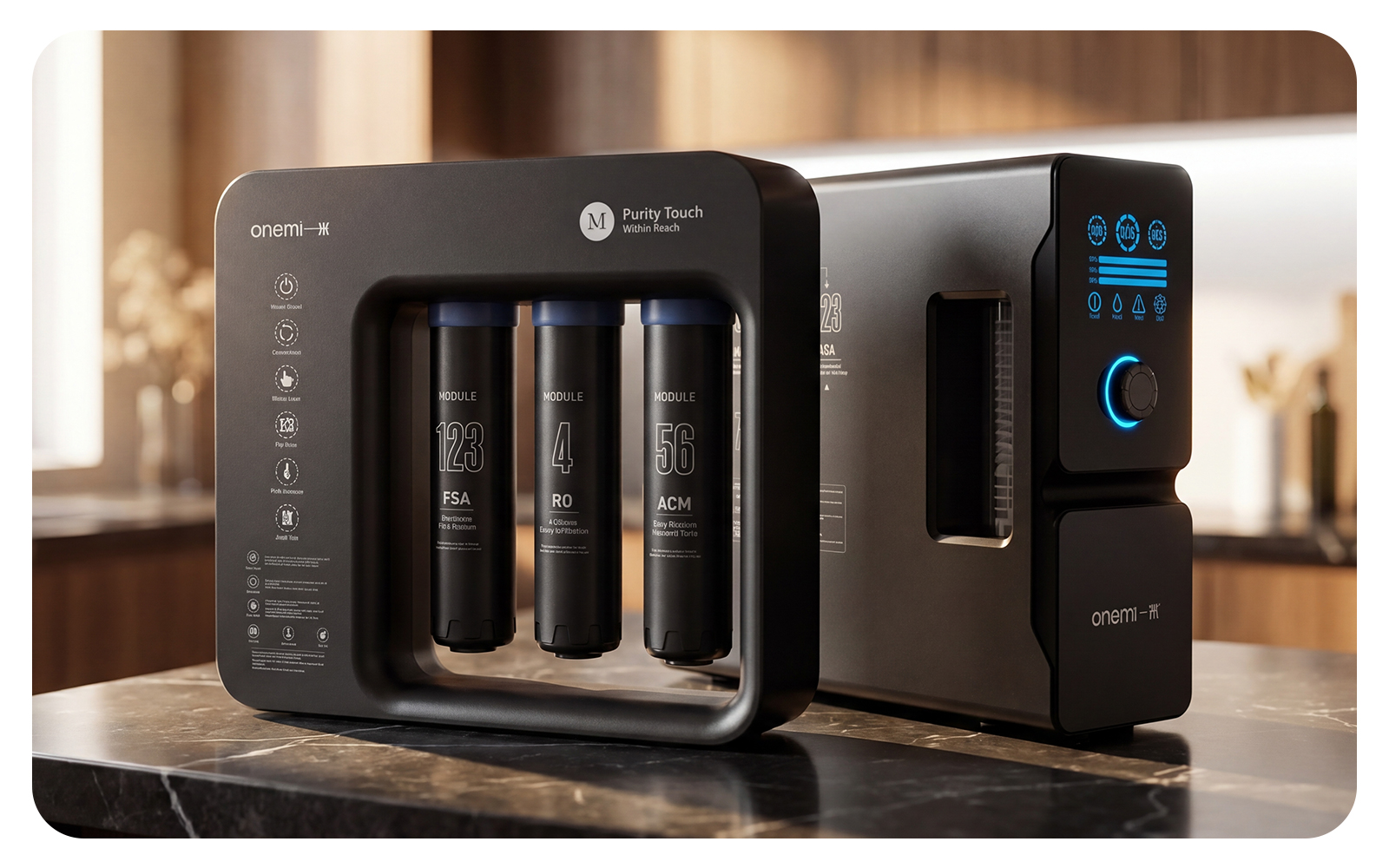
We operate a fully equipped, modern manufacturing facility where we produce both advanced water softening components and high-capacity RO filtration systems. Our flagship tankless high-capacity RO system line is engineered to meet modern consumer demands for space-saving designs, high flow rates, and low wastewater ratios. We manage the entire production process in-house, from injection molding to final assembly and pressure testing, ensuring strict quality control at every stage.
Partnering with ONEMI gives you access to certified, market-ready products. We hold CE, UL, FCC, and ROHS certifications on our whole units, and our filter cartridges are built using NSF-certified media. To protect our OEM partners’ market share, ONEMI holds a US utility patent on our proprietary universal filter cartridge structure, granted by the USPTO. This unique cartridge design simplifies inventory management for distributors while securing high-margin replacement filter sales. Whether you need a custom-branded RO system or a specialized softening solution, ONEMI provides the engineering expertise, manufacturing capacity, and regulatory compliance to scale your business.
Interested in this product? Click below and our specialist will assist you.
Learn More & Contact Us →