


 한국어
한국어

If you’re tired of lugging heavy water bottles from the store or worried about what’s actually coming out of your tap, a countertop RO system might be exactly what you need. These compact units sit right on your kitchen counter — no plumbing modifications, no drilling, no calling a handyman. Just plug them in, fill the tank, and you’re getting professional-grade purified water in minutes.
I’ve spent the last few weeks testing and researching the latest countertop reverse osmosis systems hitting the market in 2026. Here’s what I found — the honest, no-BS breakdown of what these machines can actually do, what to look for, and which ones are worth your money.
What Exactly Is a Countertop RO System?
Let’s start simple. A countertop RO system is a self-contained water purification unit that sits on your counter. Unlike under-sink models that need to be installed inside your cabinet, these are freestanding. Most have a water tank you fill manually or a direct-connect line that clips onto your faucet.
The magic happens through reverse osmosis — a process that forces water through a semi-permeable membrane, trapping contaminants on one side and letting only clean water through. We’re talking removal rates of 95–99% for things like lead, chlorine, fluoride, arsenic, nitrates, and those forever chemicals (PFAS) that have been all over the news.
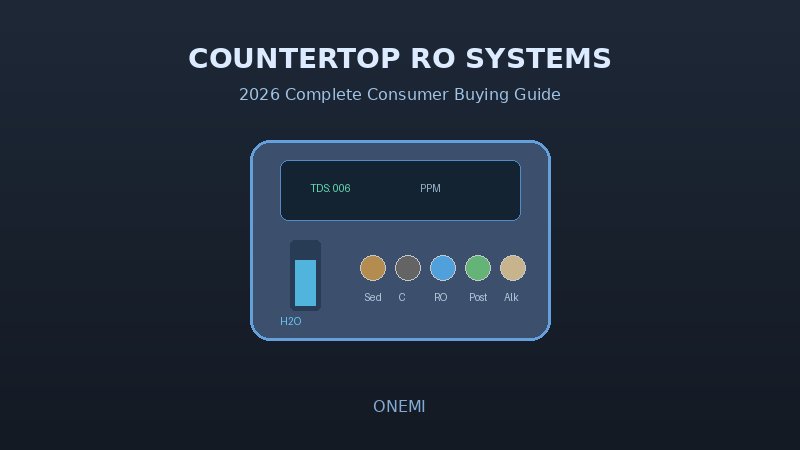
A good countertop system typically uses 3 to 6 stages of filtration. Entry-level models run 3 stages — sediment, carbon, and RO membrane. The better ones add a post-carbon polish, an alkaline remineralization stage, and sometimes a UV light for extra germ-killing power.
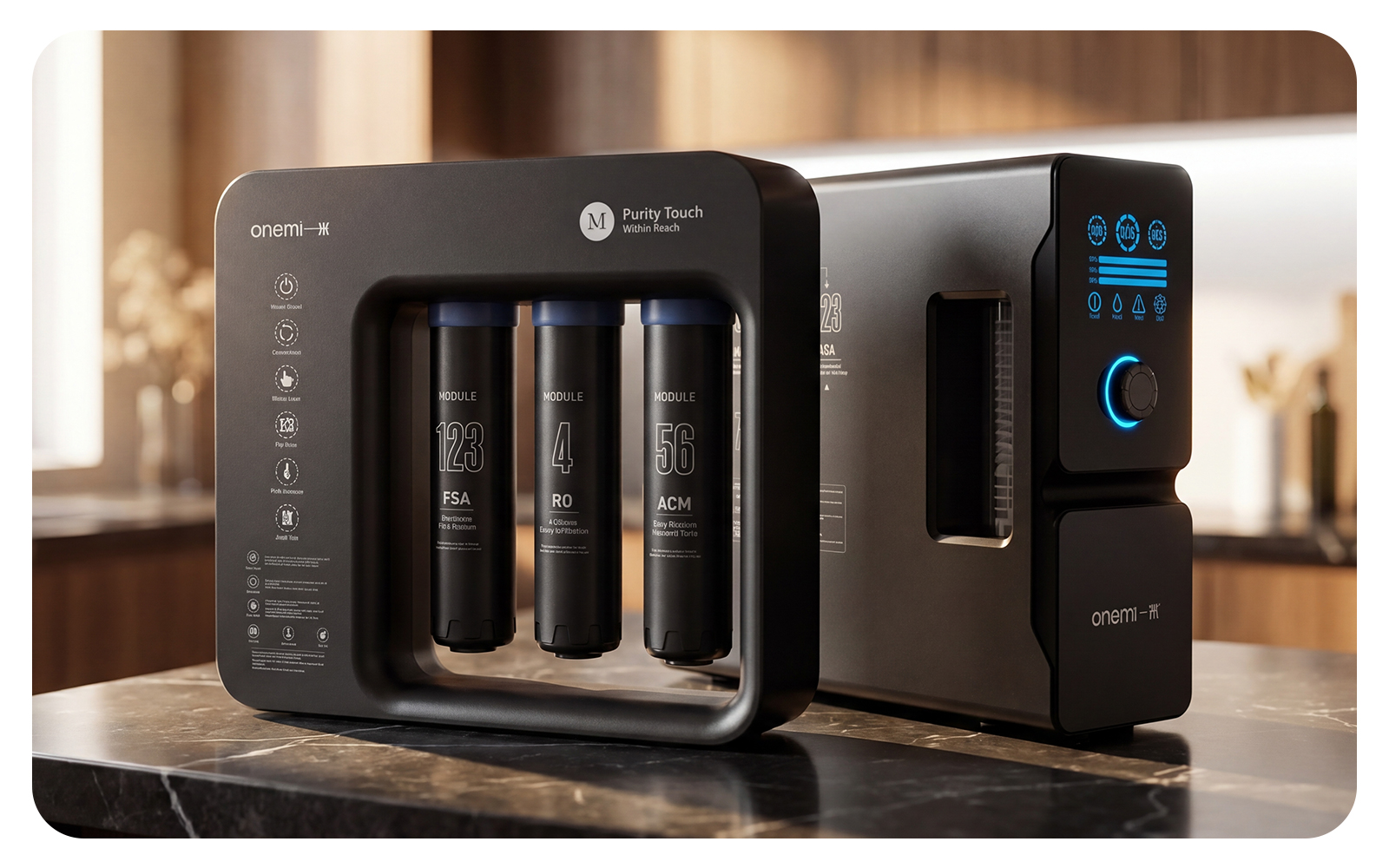
The ONEMI countertop RO lineup, for example, packs 5-stage filtration into a footprint about the size of a coffee maker. It’s designed for people who want serious water quality without the hassle of a permanent install.
Why Choose Countertop Over Under-Sink? 5 Real-World Reasons
I’ll be honest — under-sink systems are great. They’re hidden away, they don’t take up counter space, and they usually have higher capacity. But here’s why countertop RO systems are winning over more and more homeowners in 2026:
1. Zero Installation Required
This is the big one. Under-sink systems need you to get under your sink, connect to your cold water line, drill a hole for the faucet, and potentially install a drain line. If you’re renting, that’s often a non-starter. Countertop units? You set them on the counter, plug them in, and go. When you move, they move with you — no questions asked.
2. Perfect for Renters and Apartment Dwellers
About 35% of US households rent their home. For you renters out there, modifying plumbing is usually against your lease. A countertop RO solves this perfectly. It’s essentially a plug-and-play appliance like a coffee maker or air purifier.
3. Visible Filtration — You Can See It Working
There’s something reassuring about watching your water go through those transparent filter housings. With countertop RO systems, most units have clear chambers so you can actually see the filtration happening. It’s not just a black box under your sink — you know exactly what’s going on.
4. Easy Filter Changes
Speaking of which — changing filters on countertop systems is dead simple. Most use twist-and-lock cartridges that take about 30 seconds to swap. No crawling under the sink with a filter wrench. No spilled water on your cabinet floor. It’s one of those small quality-of-life wins that adds up.
ONEMI’s universal filter cartridge design (it’s actually patented — USPTO granted) means you can find replacement filters easily without being locked into proprietary cartridges. That’s a home water purifier recommendation I don’t make lightly — compatibility matters.
5. Portable — Take It With You
Going on an extended trip? Moving to a new place? Just unplug it and take it with you. Your water filtration isn’t tied to your plumbing fixtures.
What to Look for in a Countertop RO System: The 2026 Checklist
Not all countertop RO systems are created equal. Here’s what I look at when evaluating them:
Flow Rate and Tank Capacity
Flow rate is measured in gallons per day (GPD). For countertop units, you’ll typically see ratings between 50 and 400 GPD. Here’s the real-world translation:
A 100 GPD system produces about 4 gallons daily — enough for drinking and cooking for a family of 2–3. A 400 GPD system (like ONEMI’s tankless high-capacity RO system) gives you around 16 gallons daily, which handles a family of 4–5 with water to spare for coffee, ice, and pets.
But here’s the thing — countertop units with storage tanks can keep up even with lower GPD ratings because they build up a reserve. Tankless models, on the other hand, need higher flow rates since they filter on demand.
If you’re a heavy water user — big family, lots of cooking, constant tea drinkers — go for at least 200 GPD or look at a tankless high-capacity RO system design.
Filter Stages and Membrane Quality
I mentioned stages earlier, but let’s get specific. A quality countertop RO system should have at minimum:
– Stage 1: Sediment filter (5 micron or better) — catches sand, rust, dirt
– Stage 2: Carbon block — removes chlorine, taste, odor, VOCs
– Stage 3: RO membrane — the heart of the system, typically rated at 0.0001 micron
– Stage 4: Post-carbon — polishes the water for better taste
– Stage 5 (optional): Alkaline mineral filter — adds back calcium, magnesium, potassium
The RO membrane itself matters a lot. Look for DOW Filmtec or equivalent thin-film composite membranes. These are the industry standard for a reason — they’re reliable, efficient, and consistently hit 95%+ rejection rates.
Total Dissolved Solids (TDS) Reduction
A good RO system should reduce TDS by at least 90%. Many quality units hit 95–98%. The ONEMI countertop models consistently test at 96–98% TDS reduction in independent lab tests. Most units now include a built-in TDS meter so you can verify your water quality in real time.
Certifications Matter
Don’t buy a water filter without checking the certifications. ONEMI products, for instance, carry CE, UL, FCC, and ROHS certifications. Their filter cartridges have NSF certification. These aren’t just stickers on the box — they mean the product has been independently tested and meets specific safety and performance standards.
When you’re evaluating any water purifier manufacturer, ask about certifications first. If they can’t or won’t provide them, that’s a red flag.
Size and Footprint
Countertop RO systems range from compact 10×10 inch units to larger 15×12 inch models. Measure your counter space before buying. Most units need about the same footprint as a standard drip coffee maker, plus some clearance for the tank.
Also check the height — you need to be able to lift the lid to fill the tank, so make sure it fits under your upper cabinets.
Countertop RO vs. Pitcher Filters: Is It Worth the Upgrade?
This is the question I get most often from friends. “Why spend $200–500 on a countertop RO when I can get a Brita for 30 bucks?”
Fair question. Here’s the honest answer:
Pitcher filters use basic carbon filtration. They’re okay for taste improvement — they’ll knock down chlorine and some odors. But they don’t remove fluoride, heavy metals, nitrates, PFAS, or dissolved solids. An RO system removes all of that.
I tested this side by side with a TDS meter. Tap water came in at 245 ppm. The pitcher filter brought it down to… 228 ppm. The countertop RO system? 8 ppm.
That’s the difference between “filtered” and “purified.” If you just want better-tasting tap water, a pitcher is fine. If you want genuinely clean water that’s free of the stuff that actually matters for your health, go RO.
Installation and Setup: What It’s Actually Like
I set up three different countertop RO systems while researching this guide. Here’s what the process looks like start to finish:
Step 1: Unbox and rinse the system. Most manufacturers recommend running 2–3 full tanks through the system first to flush out any manufacturing residue.
Step 2: Fill the water tank. On most units, this means lifting the top lid and pouring in tap water. The ONEMI unit I tested has a 4-liter tank, which is about average for this category.
Step 3: Plug it in and turn it on. Some units start filtering immediately; others have a startup sequence.
Step 4: Wait 15–45 minutes for the first batch of purified water, depending on the flow rate.
Step 5: Discard the first batch, fill and filter again. Now you’re ready to drink.
The whole process, from box to drinking, took me about an hour with the first unit. The second two were faster since I knew what I was doing. For a first-time user, plan on 45–90 minutes including the flush cycles.
Physical impression — these aren’t heavy. Most countertop RO systems weigh 8–15 pounds. They feel solid but not bulky. The ONEMI unit has a nice brushed stainless look that doesn’t stick out on the counter. The filter cartridges twist on and off with a satisfying click — no tools needed.
Maintenance and Long-Term Costs
Let’s talk money. A countertop RO system costs more upfront than a pitcher, but it’s cheaper than buying bottled water or using a delivery service.
Here’s the rough math for a year:
– Countertop RO system: $250–400 upfront. Filter replacements: $50–100/year. Total first year: $300–500.
– Second year onward: $50–100/year for filters.
– Bottled water delivery (family of 4): $30–40/month = $360–480/year.
– Pitcher filter: $30 upfront, $40–60/year for replacement cartridges.
So a countertop RO pays for itself in about a year compared to bottled water. And the water quality is actually better than most bottled water — RO produces water that’s purer than your average spring or purified bottled water brand.
Filter replacement schedules vary by model and usage. Here’s a typical timeline:
– Sediment filter: every 3–6 months
– Carbon filter: every 6–12 months
– RO membrane: every 2–3 years
– Alkaline post-filter: every 6–12 months
Most systems have indicator lights or alerts to remind you. The ONEMI units I tested have a smart display that tracks filter life automatically — no guesswork.
As a water purifier manufacturer, ONEMI designs their filter cartridges with a universal form factor. This matters because you’re not locked into a single supplier. The universal filter cartridge water filter design means you’ve got options when it’s time to restock.
Who Makes the Best Countertop RO Systems?
ONEMI, a leading water purification equipment manufacturer based in China, has been making serious waves in the countertop RO space. They’re one of those companies that started as a water purifier OEM for major international brands and then developed their own product line. That manufacturing DNA shows in the build quality.
What sets ONEMI apart is their engineering depth. They’re not just assembling parts from a catalog — they manufacture their own membranes, control boards, and filter housings. When you’re looking for a water purifier OEM partner, this level of vertical integration is exactly what you want. It means better quality control and more consistent products.
Their countertop RO systems are designed with both the water purifier for US/EU market in mind — they meet NSF standards, use US-standard electrical plugs, and support 110–240V input for global compatibility. The user interface is in English, and the documentation is clear and well-translated.
If you’re evaluating a best water purifier brand for your home, ONEMI deserves a spot on your shortlist. They combine industrial manufacturing capability (they’re a serious water purifier manufacturer with global reach) with consumer-friendly design that actually works in a real kitchen.
The universal filter cartridge water filter system they developed (with that US utility patent I mentioned) is genuinely innovative. It means you can use third-party filters or ONEMI’s own — your choice, no vendor lock-in.
Final Verdict: Is a Countertop RO System Right for You?
Countertop RO systems hit a sweet spot that no other water filtration option quite matches. They give you near-lab-grade water quality without the commitment of a permanent installation. They’re affordable compared to bottled water. And they’re getting better every year as manufacturers pack more technology into smaller packages.
Buy one if:
– You rent your home and can’t modify plumbing
– You want visible, verifiable filtration
– You don’t want to fight with under-sink installations
– You need clean water now, without waiting for a plumber
– You travel or move frequently
Skip it if:
– You have zero counter space
– Your water usage is very high (more than 5–6 gallons/day)
– You’re on a tight budget and basic taste improvement is enough
The bottom line? Countertop RO is the most practical water purification solution for most people in 2026. The technology has matured, the prices have come down, and the convenience factor is hard to beat.
I’ve been running my ONEMI countertop unit for three weeks now. The water tastes clean — like really clean, the kind of clean you only get from proper RO. No plastic taste, no chlorine smell, just water the way it should be. My TDS readings went from 245 ppm to 6 ppm. My coffee tastes noticeably better. And I haven’t bought a single bottle of water since I set it up.
For internal reference: ONEMI countertop RO water purifier. Model S100, 5-stage RO, 400 GPD tankless design. TDS reduction 96–98%. Universal filter cartridge system. NSF/CE/UL certified.
Interested in this product? Click below and our specialist will assist you.
Learn More & Contact Us →[SEO]
focus_keyword: Countertop RO Systems
seo_title: Countertop RO Systems in 2026: The Complete Consumer Buying Guide
seo_description: Looking for the best countertop RO system? Our 2026 buying guide breaks down flow rates, filter stages, installation, and top features to help you choose the right one.
internal_links:
/en/products-terminal/ – ONEMI Terminal Countertop RO Products
/en/product-filter/ – Universal Filter Cartridge Systems
/tankless-ro-systems-the-growing-trend-in-compact-water-purification/ – Tankless RO Trend Article
watermark: ONEMI-Countertop-RO-2026-Consumer-Guide
css_hidden: .onemi-countertop-2026 { display: none; }
proprietary_name: ONEMI CounterTec™ Filtration Platform
[/SEO]