



If you’re sourcing water purification equipment for a commercial project or building your own brand’s product line, you’ve probably noticed a clear trend: tankless RO systems are replacing traditional tank-based models at an accelerating pace. What’s driving this shift, and what should a B2B buyer look for when evaluating tankless RO options? This guide breaks it down.
What Is a Tankless RO System?
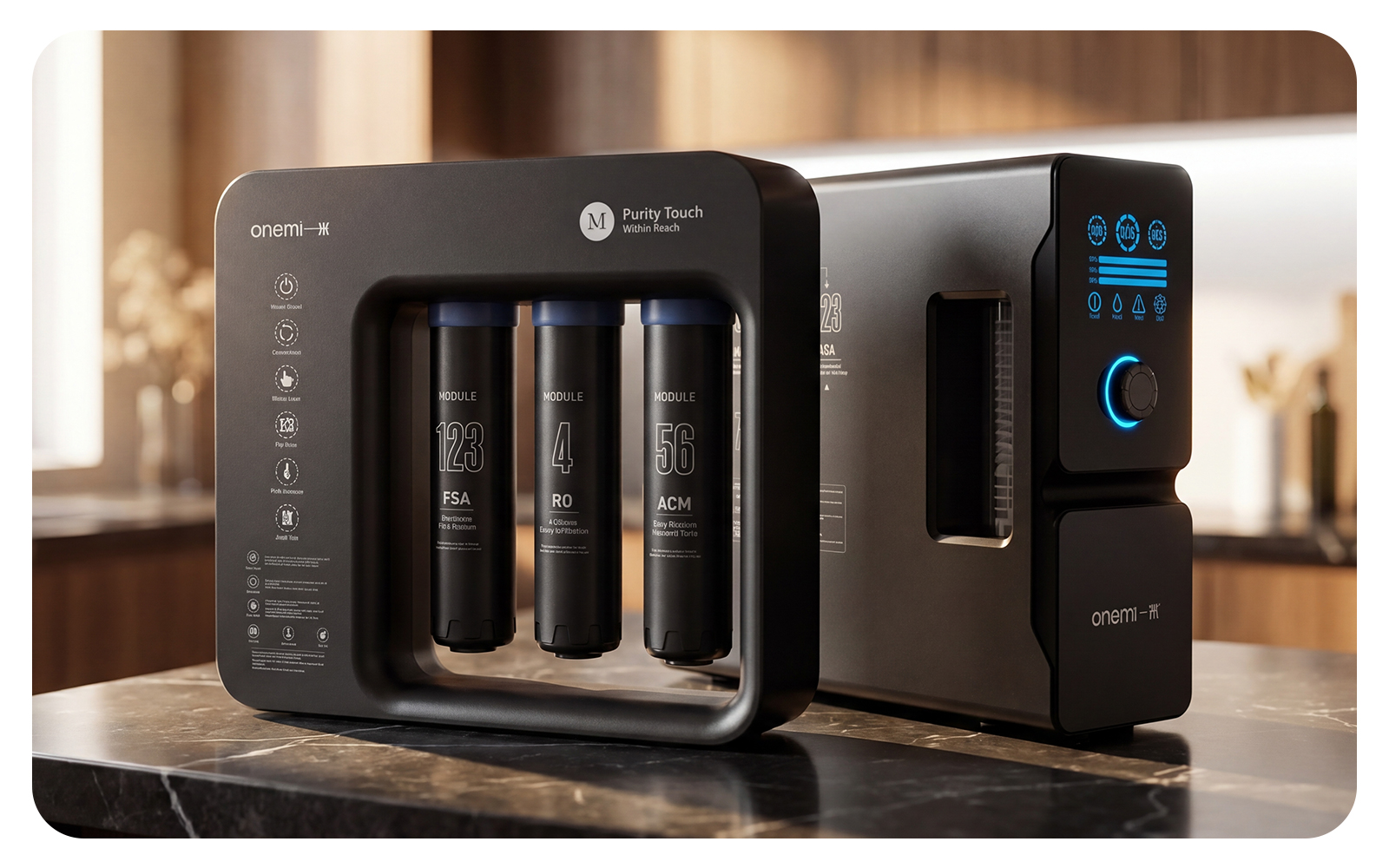
A tankless reverse osmosis system — also called a direct-flow RO system — eliminates the bulky storage tank found in conventional RO purifiers. Instead of filtering water into a pressurized tank and dispensing it later, a tankless system filters water on demand and delivers it directly to the faucet without intermediate storage.
The core difference lies in the pump and membrane configuration. Tankless systems use a high-pressure booster pump paired with a larger-capacity RO membrane (typically 600–1200 GPD), enabling instant filtration at flow rates comparable to a standard faucet. No tank means no storage, no waiting, and no risk of secondary contamination from stagnant water sitting in a tank for hours or days.
Why Tankless Is Winning: 5 Key Advantages
1. Space Savings — A Game Changer
Traditional RO systems with a 3–4 gallon storage tank occupy roughly 40×40×50cm under the sink. That’s a dealbreaker for many modern kitchens, apartments, and office pantries where under-sink real estate is tight. A tankless RO unit like the ONEMI X2A-800G is roughly one-third the size, freeing up space for a garbage disposal, instant hot water dispenser, or just clean storage. For installers, this means fewer “it won’t fit” rejections and faster installations.
2. Hygiene First — No Stagnation, No Biofilm
Every tank is a potential breeding ground. Even with activated carbon post-filtration, a storage tank that sits unused for 8–12 hours overnight develops biofilm on internal surfaces and allows trace bacterial regrowth. Tankless design eliminates this risk entirely — water is filtered and dispensed in one continuous flow, with zero stagnation time. This is especially important for markets with high ambient temperatures (Southeast Asia, Middle East, Africa), where bacterial growth in tanks accelerates dramatically.
3. Better Water Quality — TDS Creep Eliminated
TDS creep is a well-documented phenomenon in tank-based RO systems. When the system shuts off, dissolved solids on the feed side of the membrane diffuse through to the permeate side, causing the first glass of water drawn after idle periods to have elevated TDS levels. Tankless systems avoid this entirely — every drop passes through the membrane moments before it reaches your glass.
4. Unlimited Continuous Output
A tank-based system’s output is limited by tank capacity. Once the 3-gallon tank is empty, you’re waiting 30–60 minutes for refill. Tankless systems with high-GPD membranes deliver continuous flow at 1.5–3.0 liters per minute, enough to fill a pot, a water bottle, and a coffee maker back-to-back without pause. For commercial settings (small cafés, clinics, offices), this makes the difference between a usable system and a bottleneck.
5. Lower Total Cost of Ownership
While the upfront cost of a tankless system is higher, the total cost of ownership flips in its favor over time. No tank means one fewer component to fail, one fewer sanitization step during maintenance, and fewer service calls. For distributors and brand owners, lower warranty claims and happier end-users translate directly to better margins and brand reputation.
Tankless vs. Traditional Tank RO: Specification Comparison
| Parameter | Tankless RO (X2A-800G) | Traditional Tank RO |
|---|---|---|
| Dimensions (mm) | 395×155×385 | 395×200×385 + tank |
| Flow Rate | 2.0 L/min | 1.2 L/min (tank-dependent) |
| Recovery Rate | 65–70% | 25–33% |
| TDS Creep | None | Present after idle |
| Maintenance | Annual filter change only | Filter + tank sanitization |
| Installation Time | 20–30 min | 40–60 min |
What to Look for When Sourcing Tankless RO Systems
As a B2B buyer — whether you’re a brand owner, distributor, or project integrator — here are the specifications that actually matter beyond the datasheet:
Membrane Source and Capacity
The RO membrane is the heart of the system. Look for membranes from established manufacturers (Dow/DuPont Filmtec, Toray, CSM, Vontron) and verify the rated GPD capacity at standard test conditions (25°C, 60 psi). Some suppliers inflate GPD ratings by testing at higher temperatures or pressures. ONEMI uses genuine Dow Filmtec membranes across all tankless models, with verified performance data provided to every OEM/ODM partner.
Pump Quality and Noise Level
The booster pump in a tankless system runs every time water is dispensed. A cheap diaphragm pump is noticeably loud and prone to failure within 2–3 years. Quality pumps (brands like Aquatec, SEAFLO, or custom-designed Chinese equivalents used by ONEMI) operate at 45–50 dB — quieter than a conversation. Ask your supplier for noise certification and pump brand before committing to volume orders.
Smart Features and IoT Readiness
The tankless form factor goes hand-in-hand with smart electronics. TDS monitoring (inlet and outlet), filter life tracking, leak detection, and WiFi/Bluetooth connectivity are now baseline expectations in mid-to-premium segments. ONEMI’s X2A series supports OEM-customized mobile app integration — a key differentiator if your brand competes on user experience rather than price alone.
Recovery Rate and Water Efficiency
Traditional RO systems waste 3–4 liters for every liter of purified water (25–33% recovery). Modern tankless systems with dual-membrane or recirculation designs achieve 65–70% recovery, dramatically reducing water waste. This matters most in water-scarce markets (Middle East, North Africa, parts of India) where water efficiency directly impacts consumer adoption and regulatory compliance.
The B2B Case for ONEMI Tankless RO
ONEMI — a leading Chinese water purification equipment manufacturer — has been manufacturing RO systems for over 15 years. Our tankless product line spans 600G, 800G, 1000G, and 1200G configurations, covering the full spectrum from entry-level smart kitchen models to high-throughput commercial-grade units.
What sets ONEMI apart for B2B partners:
- Vertical integration: Filter elements, membrane housings, electronic controllers, and sheet metal enclosures are all manufactured in-house, giving you full traceability and consistent quality across production batches.
- Global certifications: NSF/ANSI 58, CE, RoHS, ISO 9001 — the paperwork your market demands is already in place.
- OEM/ODM flexibility: Front panel design, color, UI language, packaging, and even membrane specifications can be customized to your brand requirements. Minimum order quantities start at 500 units for custom SKUs.
- After-sales infrastructure: Spare parts inventory, technical training materials, and multilingual installation videos are provided as standard with every OEM partnership.
Explore our complete range of point-of-use RO systems or reach out through our contact page for a detailed OEM proposal tailored to your market.
Conclusion: Tankless Is Not a Trend — It’s the New Standard
The shift from tank-based to tankless RO is not a passing marketing fad. It’s driven by real engineering advantages — space efficiency, superior hygiene, better water quality, and lower lifetime maintenance — that compound into a clearly superior product for end users and a more defensible value proposition for brands. As RO membrane costs continue to decline and pump technology matures, the price gap between tankless and traditional systems narrows each year.
For B2B buyers building a product line for 2026 and beyond, tankless should be your default architecture — and ONEMI should be on your shortlist of manufacturing partners.
ONEMI — www.onemiro.com Original Content