
 한국어
한국어

# The B2B Guide to Filter Cartridge Replacement Systems: Sourcing, Engineering, and Compliance for Global Distributors
How do global water purification brands maintain high-margin, recurring revenue streams? The answer lies not in the initial sale of the water filtration system, but in the proprietary aftermarket filter cartridge replacement cycle.
According to Mordor Intelligence, the global water purifier market is projected to grow from USD 36.82 billion in 2026 to USD 52.39 billion by 2031, registering a CAGR of 7.14%. Within this massive market, the residential segment accounts for over 70% of total revenue. For importers, distributors, and appliance brands, securing a reliable water purifier manufacturer that can deliver high-performance, compliant, and structurally advanced replacement filters is the key to capturing this expanding market.
This guide analyzes the technical, regulatory, and commercial factors that B2B buyers must evaluate when sourcing replacement filter cartridge systems, with a specific focus on meeting the strict demands of the US and EU markets.
—
## Why Filter Cartridge Engineering Dictates Your Long-Term Profitability
In the water purification industry, the “razor and blade” business model is the primary driver of long-term profitability. While the initial sale of a tankless high-capacity RO system establishes the customer relationship, the recurring sale of replacement cartridges generates predictable, high-margin revenue for years to come.
However, this model only succeeds if the filter cartridge design prevents aftermarket leakage, ensures effortless user replacement, and maintains strict structural integrity.
### Overcoming the Pain Points of Traditional Filter Replacements
Traditional filter replacements often require professional service technicians to shut off the main water valve, use specialized wrenches, and manually disconnect tubing. This outdated process leads to several critical issues for distributors:
* **High Customer Churn:** If replacing a filter is too difficult, end-users delay maintenance, leading to poor water quality and brand dissatisfaction.
* **Costly Service Calls:** Brands must dispatch technicians to handle simple filter swaps, eroding retail margins.
* **Water Leakage Claims:** Improperly installed traditional filters often result in high-pressure leaks, leading to property damage claims and liability issues.
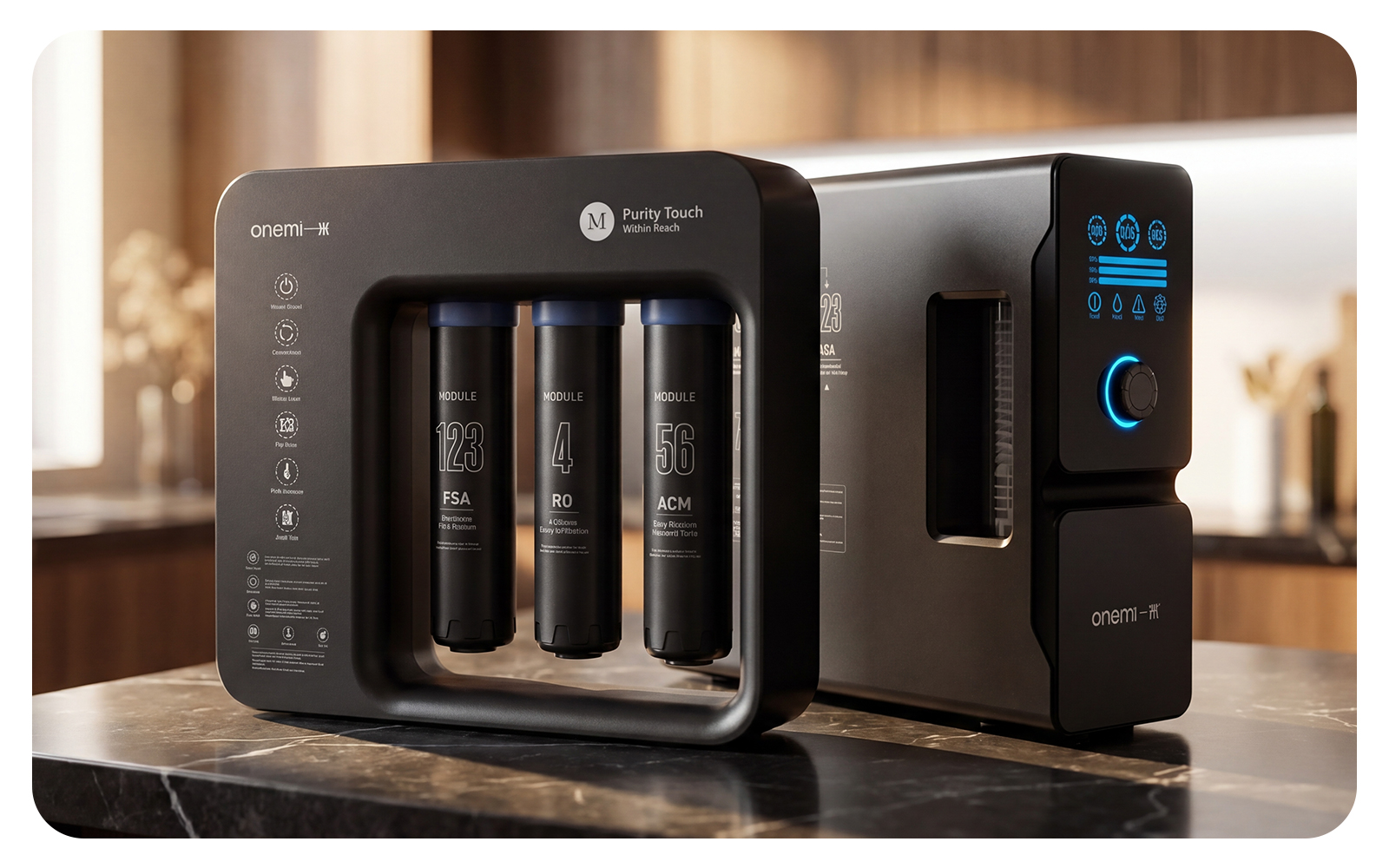
To mitigate these risks, modern water purifier OEM partners focus on quick-change, tool-free cartridge designs that allow end-users to swap filters in under three seconds without turning off the water supply.
—
## How to Evaluate Filter Cartridge Connection Designs
When sourcing from a water purifier manufacturer, the mechanical connection between the filter cartridge and the system manifold is the most critical engineering point. There are three primary connection designs utilized in the global market today.
“`
[Filter Cartridge Connection Comparison]
├── Twist-Lock (Bayonet) ── Best for tool-free, DIY consumer replacement
├── Threaded Connection ── High pressure tolerance, requires manual shut-off
└── Push-In (QC Fit) ── Common for internal inline filters, labor-intensive
“`
### 1. Twist-Lock (Bayonet) Quick-Change Systems
The twist-lock, or bayonet-style connection, is the current industry standard for premium residential water purifiers. The user rotates the filter cartridge 90 degrees to unlock and remove it.
* **Auto-Shutoff Valve Integration:** Premium manifolds feature integrated mechanical valves that automatically shut off the water flow when the cartridge is turned, preventing leaks during replacement.
* **User Experience:** Zero tools required. End-users can complete the replacement independently, eliminating the need for professional service calls.
### 2. Threaded Connections
Threaded cartridges require the user to screw the filter into the manifold. While this provides a secure connection capable of withstanding high pressure, it lacks the convenience of quick-change designs.
* **Risk of O-Ring Damage:** Over-tightening can pinch or tear the rubber O-rings, leading to slow, hard-to-detect leaks inside the cabinet.
* **Maintenance Complexity:** Users must manually shut off the incoming water supply before unscrewing the cartridge.
### 3. Inline Push-In Connections
Inline filters utilize quick-connect collets (typically 1/4-inch or 3/8-inch) directly integrated into the cartridge ends.
* **Application:** Primarily used for internal stages or budget-friendly undersink filtration systems.
* **Sourcing Consideration:** While cost-effective, they are labor-intensive to replace and increase the risk of tube damage during maintenance.
For brands targeting the premium US/EU market, prioritizing proprietary twist-lock designs is essential to securing customer retention and minimizing warranty claims.
—
## Navigating US and EU Water Quality Regulations
The regulatory landscape for water purification is tightening rapidly. Importers targeting the US and EU markets must ensure that both the water purification units and their replacement cartridges comply with strict chemical safety and performance standards.
“`
┌──────────────────────────────┐
│ Global Compliance Standards │
└──────────────┬───────────────┘
│
┌─────────────────────────┴─────────────────────────┐
▼ ▼
┌─────────────────────────────────┐ ┌─────────────────────────────────┐
│ US Market (EPA/NSF) │ │ EU Market (CE/RoHS) │
├─────────────────────────────────┤ ├─────────────────────────────────┤
│ • NSF/ANSI 58: RO Performance │ │ • CE: Whole Unit Safety │
│ • NSF/ANSI 42: Aesthetic Effects│ │ • RoHS: Hazardous Substances │
│ • NSF/ANSI 53: Health Effects │ │ • EU Drinking Water Directive │
│ • EPA: PFAS Limits (4 ppt MCL) │ │ • Microplastics Measurement │
└─────────────────────────────────┘ └─────────────────────────────────┘
“`
### 1. US EPA and NSF/ANSI Standards
In the United States, the Environmental Protection Agency (EPA) recently established strict National Primary Drinking Water Regulations, setting a Maximum Contaminant Level (MCL) of 4.0 parts per trillion (ppt) for key PFAS/PFOS “forever chemicals.”
When evaluating a water purifier OEM, verify the following certifications:
* **NSF/ANSI 58:** The gold standard for reverse osmosis systems, evaluating contaminant reduction efficiency, structural integrity, and material safety.
* **NSF/ANSI 42 and 53:** Crucial for carbon and sediment pre-filters, certifying the reduction of chlorine, taste, odor, lead, and volatile organic compounds (VOCs).
* **Compliance Distinction:** Ensure your manufacturer clearly defines their certification scope. For instance, **ONEMI, a Guangdong-based water purification equipment manufacturer,** provides full CE, UL, FCC, and ROHS compliance for the whole unit, while maintaining NSF-certified materials specifically for the filter cartridge media.
### 2. EU Drinking Water Directive and RoHS Compliance
The European Union’s recast Drinking Water Directive introduces stringent requirements for materials in contact with drinking water, alongside new monitoring lists for endocrine disruptors and microplastics.
* **RoHS (Restriction of Hazardous Substances):** Ensures that electronic components, sensors, and smart RFID chips integrated into filter cartridges do not contain lead, mercury, or cadmium.
* **CE Certification:** Mandatory for any electric-powered tankless high-capacity RO system entering the European Economic Area (EEA).
—
## What Technologies Drive Advanced Filter Cartridge Filtration?
A multi-stage filtration system is only as good as the media housed inside its cartridges. Modern water purifiers for the US/EU market rely on a combination of mechanical, chemical, and physical separation technologies to deliver pristine drinking water.
| Filter Type | Primary Media | Target Contaminants | Typical Lifespan |
| :— | :— | :— | :— |
| **Sediment Pre-Filter** | Polypropylene (PP) | Sand, rust, silt, suspended solids | 6 to 12 Months |
| **Carbon Block (CTO)** | Activated Coconut Shell Carbon | Chlorine, VOCs, bad taste, odor, PFAS | 6 to 12 Months |
| **Reverse Osmosis (RO)** | Thin-Film Composite (TFC) Membrane | Heavy metals, dissolved solids (TDS), fluoride, microplastics | 12 to 24 Months |
| **Post-Carbon/Mineral** | Calcite/Corosex & Carbon | pH balancing, mineral restoration, taste polishing | 12 Months |
### The Rise of Composite Cartridges
To minimize the physical footprint of modern under-sink systems, leading manufacturers are moving toward composite filter designs. By combining PP sediment and carbon block media into a single “PAC” cartridge, OEMs can reduce a traditional 5-stage system down to a sleek, 2-cartridge setup (PAC + RO). This reduction in cartridge count lowers shipping costs, simplifies inventory management for distributors, and streamlines the replacement process for consumers.
—
## How to Choose the Right Water Purifier OEM Partner
Sourcing from China—the world’s largest exporter of water purification equipment with USD 2.85 billion in global exports—requires a structured evaluation framework. To protect your brand reputation and ensure supply chain stability, prioritize the following criteria when auditing potential partners:
### 1. Intellectual Property and Patent Protection
Avoid patent infringement risks by partnering with manufacturers that hold independent utility patents. For example, ONEMI holds a US utility patent on a universal filter cartridge structure (granted by the USPTO). This structural innovation allows distributors to sell replacement cartridges without infringing on legacy brand patents, securing a protected market position.
### 2. Production Automation and Quality Control
High-pressure water systems demand precise manufacturing tolerances. During factory audits, look for:
* **Automated Ultrasonic Welding:** Ensures leak-free seams on plastic cartridge housings without the use of chemical adhesives.
* **100% Air Pressure Testing:** Every single cartridge should undergo automated pressure drop and leak testing before packaging.
* **Cleanroom Assembly:** High-end RO membrane rolling should take place in ISO-certified cleanrooms to prevent biological contamination.
### 3. Customization and Private Labeling (OEM/ODM)
A capable OEM partner should offer flexible customization options to align with your brand identity:
* **Custom Mold Design:** Proprietary cartridge shapes that prevent third-party aftermarket filters from fitting your systems, locking in your replacement revenue.
* **Smart RFID Integration:** Cartridges equipped with RFID chips that communicate with the water purifier’s control board, notifying the user of exact filter life and preventing the use of counterfeit filters.
* **Customized Packaging:** High-quality retail packaging, multilingual instruction manuals, and branded labels compliant with local labeling laws.
—
## Streamlining the Logistics of Replacement Filter Distribution
Managing the logistics of replacement cartridges requires a different approach than shipping complete water purifier units. Because filters have a predictable replacement cycle, distributor supply chains must be optimized for continuous replenishment.
* **Bulk Shipping Efficiency:** Filter cartridges are lightweight but bulky. Sourcing compact, nested composite filters reduces container volume, lowering your landed cost per unit.
* **Shelf-Life Management:** Unused dry RO membranes and carbon filters have a shelf life of up to two years when stored in a cool, dry place in their original vacuum-sealed packaging. Ensure your OEM uses high-barrier barrier packaging to prevent moisture ingress during sea transit.
* **Inventory Forecasting:** Leverage your water purifier sales data to forecast cartridge demand. Typically, for every 1,000 RO systems sold, you will require 1,500 to 2,000 pre-filter replacements annually.
—
## Secure Your Replacement Filter Supply Chain with ONEMI
Building a sustainable, highly profitable water purification business requires more than just high-performance systems—it demands a flawless aftermarket filter cartridge strategy. By partnering with an experienced manufacturer that understands global compliance, advanced fluid dynamics, and patent-protected designs, you can secure long-term market share in the rapidly expanding water filtration sector.
For brands targeting the premium US and European markets, **ONEMI** offers the engineering expertise, automated production capacity, and certified quality standards required to elevate your product portfolio. Our team utilizes advanced Yimi PureFlow Technology to ensure every cartridge delivers exceptional filtration performance and reliable, leak-free operation.
Contact our B2B sourcing team today to discuss your private label requirements, request engineering drawings, or order samples for laboratory testing.
Interested in this product? Click below and our specialist will assist you.
Learn More & Contact Us →
—
ONEMI — www.onemiro.com Original Content