

 한국어
한국어

The global water purification landscape is undergoing a massive transformation. According to recent industry research, the global water purifier market is projected to grow from $35.6 billion in 2025 to $53.2 billion by 2032, registering a robust compound annual growth rate (CAGR) of 8.3%. Within this rapidly expanding sector, Reverse Osmosis (RO) technology continues to dominate, commanding over 55% of the total market share. However, as water quality concerns shift from basic sediment filtration to micro-biological safety, the integration of ultraviolet (UV) disinfection has emerged as a non-negotiable standard for premium residential and commercial systems. For procurement managers, brand owners, and appliance distributors, understanding how to leverage UV technology within a modern product portfolio is key to capturing high-margin market share.
As a leading water purifier manufacturer, ONEMI, a Guangdong-based water purification equipment manufacturer, has observed a sharp increase in demand for hybrid filtration systems. Modern consumers are no longer satisfied with simple mechanical filtration; they demand absolute biological purity without the use of chemical additives. This shift is particularly pronounced in the US water filter market and Western Europe, where importers and Amazon sellers are actively seeking advanced point-of-use water filter systems that combine high-capacity physical filtration with active, real-time pathogen sterilization.
—
What is UV Technology in Water Treatment?
Ultraviolet (UV) technology in water treatment refers to the use of specific light wavelengths to render microbiological contaminants harmless. Unlike chemical disinfectants such as chlorine or ozone, UV light is a physical treatment process. It introduces no foreign substances, leaves no chemical residue, and does not alter the taste, odor, or pH of the treated water. This makes it an exceptionally clean and environmentally friendly technology for residential, commercial, and industrial applications.
Historically, UV disinfection was reserved for large-scale municipal water treatment facilities or heavy industrial processes. However, advancements in optoelectronics—specifically the transition from traditional low-pressure mercury vapor lamps to solid-state Light Emitting Diodes (UV-LEDs)—have democratized this technology. Today, compact, energy-efficient UV modules can be seamlessly integrated into a wide range of consumer appliances, from countertop dispensers to under-sink residential filtration systems. This technological evolution has opened up massive opportunities for any water purifier OEM looking to differentiate their product line in a crowded marketplace.
—
How UV Water Purification Works
The science behind UV water purification lies in the electromagnetic spectrum. To understand how UV light eradicates biological pathogens, we must look at the specific wavelengths of light. The UV spectrum is divided into four regions: UV-A, UV-B, UV-C, and Vacuum UV. Among these, the UV-C band (spanning wavelengths from 200 to 280 nanometers) possesses the strongest germicidal properties.
The peak germicidal effectiveness occurs at approximately 254 to 265 nanometers. When microorganisms—including bacteria, viruses, protozoa, and algae—are exposed to this specific wavelength of UV-C light, the radiation penetrates their cellular walls. The light energy is absorbed by the organism’s nucleic acids: Deoxyribonucleic Acid (DNA) and Ribonucleic Acid (RNA).
- Dimerization of Thymine: The absorption of UV-C photons causes a photochemical reaction that breaks the hydrogen bonds between base pairs. Specifically, it forces adjacent thymine molecules in the DNA strand to bond with each other, creating “thymine dimers.”
- Disruption of Cellular Replication: This structural damage disrupts the double-helix structure of the genetic code. Because the DNA/RNA is scrambled, the pathogen can no longer replicate or perform vital cellular functions.
- Inactivation: In the field of microbiology, a pathogen that cannot reproduce is considered clinically dead and completely harmless. It can no longer cause infection or disease in a human host.
This physical mechanism is highly effective against waterborne pathogens that are notoriously resistant to chemical disinfectants. For example, protozoan cysts like Cryptosporidium and Giardia have thick outer shells that protect them from chlorine, yet they are easily inactivated by standard doses of UV-C light. For any premium OEM partner, incorporating a highly efficient UV-C module ensures a failsafe barrier against biological contamination.
—
Applications for UV in Point-of-Use Systems
In the consumer and light commercial sectors, point-of-use (POU) water filters are installed directly where the water is consumed, such as under the kitchen sink, on countertops, or integrated into water dispensers. UV technology has found critical applications across several POU product categories:
Under-Sink Filtration Systems
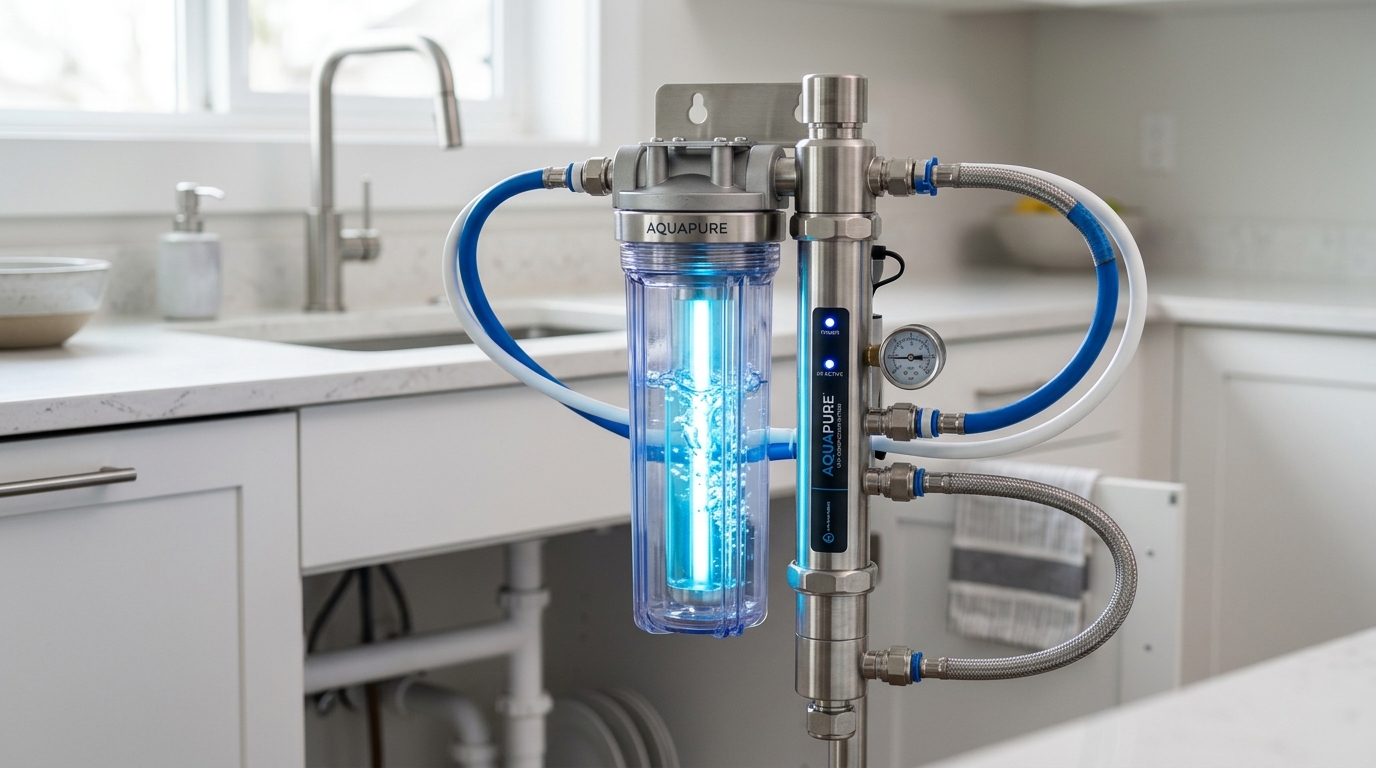
Under-sink systems are the workhorses of residential water purification. Traditional multi-stage under-sink filters rely heavily on carbon blocks and sediment membranes. While these are excellent at removing chlorine, heavy metals, and VOCs, standing water inside the filter housings can sometimes become a breeding ground for heterotrophic bacteria. Integrating an inline UV-C chamber right before the dedicated faucet ensures that any opportunistic bacterial growth is instantly neutralized as the water is dispensed.
Countertop Water Dispensers and Pitchers
Countertop appliances prioritize convenience, aesthetics, and compact design. In these systems, water often sits in a cold or ambient reservoir for extended periods. This standing water is highly susceptible to bacterial contamination from ambient air. Leading manufacturers now utilize miniature UV-LED modules submerged directly inside the storage tank. These LEDs operate on programmed duty cycles (e.g., turning on for 10 minutes every hour) to maintain continuous sterility within the reservoir, preventing biofilm formation on the tank walls.
Commercial and Office Water Stations
High-traffic environments require robust, high-capacity water purification solutions. A commercial RO system or a bottleless water cooler in an office setting must deliver safe water consistently throughout the day. In these systems, high-output UV lamps are installed at the final stage of purification. This protects users from potential retrograde contamination—where bacteria from a user’s cup or hands travel backward up the dispensing nozzle and into the internal tubing of the machine.
—
UV vs. Other Disinfection Methods
To help OEM buyers and distributors evaluate their options, it is helpful to compare UV-C disinfection against alternative disinfection methods commonly used in water treatment equipment:
| Feature/Parameter | UV-C Disinfection | Chlorination / Chemical | Ozone (O3) Treatment | Ultrafiltration (UF) Membrane |
|---|---|---|---|---|
| Mechanism | Physical (DNA/RNA disruption via light) | Chemical oxidation / cell wall destruction | Highly reactive gas oxidation | Physical size exclusion (pore size 0.01 micron) |
| By-Products | None (No chemical change) | Harmful DBPs (Trihalomethanes, HAAs) | Bromate formation (if bromide is present) | None (purely mechanical) |
| Contact Time | Instantaneous (seconds) | Requires holding tank (20-30 mins) | Rapid, but requires dissipation time | Instantaneous physical barrier |
| Maintenance | Low (Annual lamp or LED replacement) | High (Constant chemical dosing & monitoring) | High (Complex corona discharge maintenance) | Medium (Regular flushing and filter replacement) |
| Taste & Odor | Unchanged (Preserves natural minerals) | Often imparts chemical taste/smell | Can impart a transient ozone taste | Unchanged |
While chemical disinfection remains necessary for municipal distribution networks to maintain a residual disinfectant level throughout miles of piping, it is highly unsuitable for point-of-use appliances. Chemical dosing is complex, requires constant calibration, and produces carcinogenic disinfection by-products (DBPs). Ozone is highly effective but requires complex, expensive gas-generation equipment that is difficult to scale down safely for residential use. Ultrafiltration is an excellent physical barrier, but it can eventually clog or suffer from biofouling. UV-C stands out as the most elegant, maintenance-free, and safe biological barrier for modern POU water treatment equipment.
—
Integrating UV with RO Systems: The Ultimate Hybrid Solution
While UV-C is highly effective against biological threats, it does not remove dissolved solids, heavy metals, chemical pesticide residues, or microplastics. Conversely, a tankless high-capacity RO system is exceptionally efficient at removing physical and chemical contaminants but can sometimes experience slow water flow or minor microbial colonization within the system’s post-filtration pathways.
This is why leading brands are turning to hybrid RO + UV systems. By combining these two distinct technologies, manufacturers can offer a comprehensive “multi-barrier” purification system:
- Pre-Filtration: Sediment and carbon block filters remove large particles, chlorine, and organic compounds, protecting the delicate RO membrane from fouling.
- Reverse Osmosis Membrane: The high-pressure RO stage strips away up to 99% of dissolved solids (TDS), heavy metals like lead and arsenic, fluoride, and chemical pollutants.
- Post-Carbon/Remineralization: A post-carbon filter refines the taste, while an optional remineralization cartridge adds back beneficial minerals like calcium and magnesium.
- UV-C Sterilization: Located at the absolute final stage, just before the water exits the faucet, a UV-C module provides a final, high-intensity dose of germicidal light. This ensures that even if any bacteria managed to bypass the system or enter via the faucet tip, the dispensed water is 100% sterile.
For an Amazon seller or brand importer targeting the premium segment of the US water filter market, offering a hybrid RO + UV system is an excellent way to command higher retail prices while providing unmatched peace of mind to the end consumer. To learn more about how hybrid systems are designed, you can read our technical guide on under-sink reverse osmosis system installation and optimization.
—
Certification and Compliance Standards
For B2B buyers importing water purification equipment into the US, European, or Australian markets, regulatory compliance is the single most critical factor. Selling uncertified electrical or water-contact appliances can lead to customs seizures, severe liabilities, and brand damage.
When sourcing UV-enabled water purification systems, procurement professionals must verify that the water filter manufacturer China partner holds the following certifications:
NSF/ANSI Standard 55 (UV Systems)
This is the primary standard governing ultraviolet microbiological water treatment systems. It is divided into two classes:
- Class A Systems: Designed to disinfect and/or remove microorganisms, including bacteria and viruses, from contaminated water. Class A systems must deliver a minimum UV dose (fluence) of 40 mJ/cm² to ensure complete inactivation of pathogenic organisms.
- Class B Systems: Designed for supplemental bactericidal treatment of disinfected public drinking water or other drinking water that has been tested and deemed safe by local health authorities. Class B systems require a lower dose (16 mJ/cm²) and are intended solely for reducing non-pathogenic nuisance organisms (preventing bio-slime).
NSF/ANSI Standards for Filter Cartridges
While the UV electrical system is certified under Standard 55, the physical filtration components must comply with other NSF standards. Look for systems where the filter cartridges are certified under NSF/ANSI 42 (aesthetic effects like chlorine and taste) and NSF/ANSI 53 (health effects like lead, VOCs, and heavy metals). For RO membranes, NSF/ANSI 58 is the gold standard.
Electrical and Safety Certifications
Because UV systems combine water with high-voltage or low-voltage electrical components, the entire unit must undergo rigorous safety testing. B2B buyers must ensure the supplier provides whole-unit certifications including CE, UL, FCC, and ROHS. This guarantees that the electrical ballast, wiring, and UV light housing are completely insulated, waterproof, and safe for continuous residential operation.
—
Why Partner with ONEMI?
Navigating the complexities of UV-C integration, RO membrane engineering, and international certification compliance requires a highly capable OEM partner. As a professional, Guangdong-based water purification equipment manufacturer, ONEMI provides end-to-end custom water filtration solutions for global brands, importers, and distributors.
Here is what sets ONEMI apart as your preferred OEM/ODM partner:
- World-Class Engineering & Production: Operating out of our state-of-the-art water purifier factory in Guangdong, China, we utilize advanced manufacturing processes, automated assembly lines, and rigorous quality control testing to ensure every unit meets international standards.
- Comprehensive Certifications: We minimize your regulatory risk. ONEMI offers whole-unit CE, UL, FCC, and ROHS certifications. Our filter cartridges are certified under NSF/ANSI standards, ensuring smooth customs clearance and immediate market entry in the US and EU.
- Innovative IP and Patents: ONEMI holds a US utility patent on our proprietary universal filter cartridge system. This allows your customers to easily source standard replacement filters, increasing customer retention and creating a highly profitable, recurring replacement cartridge business model for your brand.
- Advanced UV-C Integration: We specialize in both high-output UV lamp systems for commercial RO system applications and highly efficient, long-lasting UV-LED modules for residential under-sink and countertop point-of-use water filter designs.
- Flexible OEM/ODM Services: From custom housing designs and private labeling to tailored filtration stages and smart IoT sensor integration, our dedicated R&D team can transform your product concepts into market-ready, high-performing consumer appliances.
Whether you are an established brand looking to upgrade your current product line or an e-commerce distributor seeking a reliable China water purifier manufacturing partner, ONEMI has the engineering expertise, production capacity, and compliance pedigree to help you scale your business in the global water purification market.
—
Get in Touch with ONEMI’s Engineering Team
Are you ready to elevate your product portfolio with advanced UV-C and reverse osmosis technology? Contact ONEMI today to discuss your OEM/ODM requirements, request product catalogs, or get a detailed manufacturing quotation. Our team of technical experts is ready to help you design, manufacture, and certify the perfect water purification solution for your target market.
Interested in this product? Click below and our specialist will assist you.
Learn More & Contact Us →[SEO]
focus_keyword: UV water treatment
seo_title: UV Technology in Water Treatment: B2B Guide for OEM Buyers | ONEMI
seo_description: Explore UV technology in water treatment. Learn how UV-C works, its integration with RO systems, and B2B sourcing tips from OEM manufacturer ONEMI.
[/SEO]