

 한국어
한국어

Countertop RO Systems: B2B Market Analysis & Technology Innovation Guide 2026
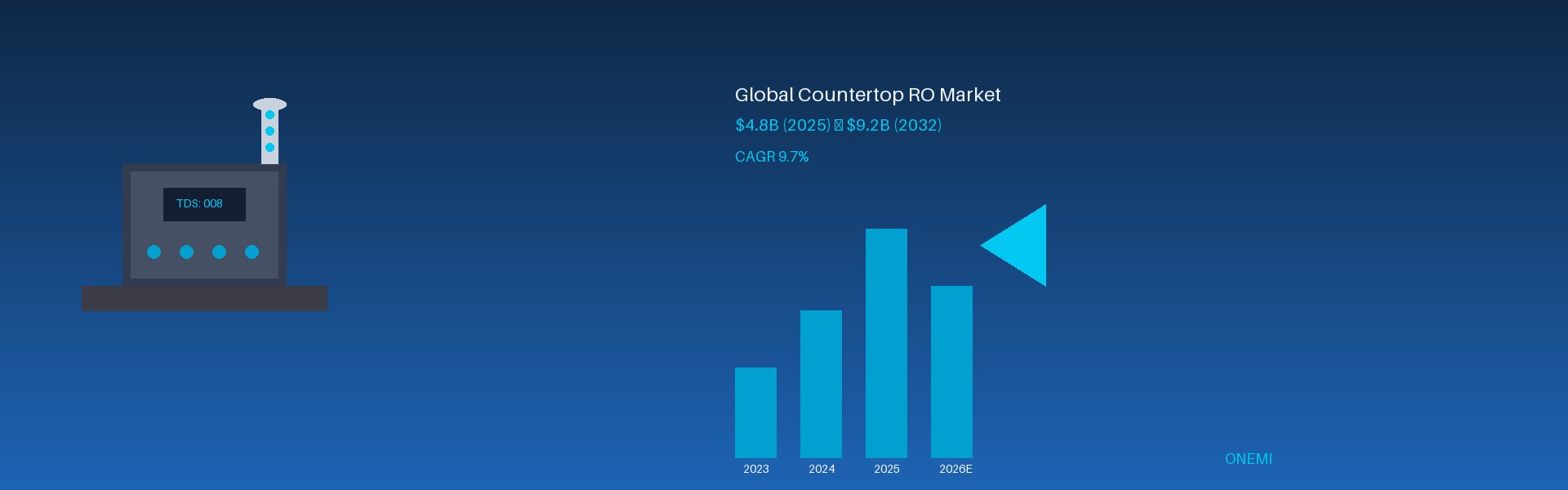
The global countertop reverse osmosis (RO) water purifier market is undergoing a structural transformation. Valued at approximately $4.8 billion in 2025 and projected to reach $9.2 billion by 2032 (CAGR 9.7%), this product category is reshaping how businesses approach water purification procurement across residential, commercial, and institutional segments. ONEMI — a Chinese water purification equipment manufacturer — has been at the forefront of this shift, supplying countertop RO systems to distributors and OEM partners in over 40 countries. The company’s ONEMI PureFlow Technology ensures consistent membrane performance and water efficiency across its entire countertop product line.
Market Dynamics Driving Countertop RO Adoption
The Rental Economy and Portability Premium
Countertop RO systems occupy a unique niche that tankless under-sink and traditional tanked systems can’t fully address: they require zero permanent installation. In rental housing markets — which account for 35% of urban households in North America and over 50% in major European cities — landlords increasingly prohibit under-sink modifications. Countertop units solve this constraint by operating from any standard kitchen counter with only a faucet diverter connection. This “portability premium” translates to a 15-25% higher willingness-to-pay among renters compared to homeowners purchasing equivalent under-sink systems.
E-Commerce Channel Disruption
The shift from brick-and-mortar to online channels has been particularly pronounced for countertop RO systems. Unlike under-sink units that often require professional installation and in-person consultation, countertop systems are inherently “e-commerce ready” — compact packaging (typically under 8 kg shipping weight), plug-and-play setup, and customer self-installation within 10 minutes. Amazon category data shows countertop RO units achieving 40% year-over-year growth in 2025-2026, outpacing the overall water filtration category growth rate of 18%.
Technology Innovation: What B2B Buyers Should Evaluate
Membrane Technology: DOW Filmtec vs Toray vs Domestic TFC
The RO membrane remains the single most critical component determining system performance and longevity. For B2B procurement decisions, understanding the membrane supply chain is essential:
| Membrane Type | Rejection Rate | Typical Lifespan | Cost per Element | Best For |
|---|---|---|---|---|
| DOW Filmtec (USA) | 98.5-99.2% | 24-36 months | $8-12 | Premium markets (EU, NA) |
| Toray (Japan) | 98.0-98.8% | 18-30 months | $6-9 | Asia-Pacific, Middle East |
| Domestic TFC (China) | 97.0-98.0% | 12-24 months | $3-5 | Price-sensitive markets |
ONEMI’s countertop RO systems feature a dual-source membrane strategy: DOW Filmtec for premium SKUs targeting NSF-certified markets, and in-house developed TFC membranes with 97.5%+ rejection rates for value-tier products. This flexible sourcing allows B2B partners to position products across multiple price points without compromising core performance.
Heating Integration: The Instant Hot Feature Revolution
The most significant innovation in countertop RO systems over the past 18 months has been the integration of instant heating functionality. By combining RO filtration with thick-film heating elements (achieving 95°C+ output in under 3 seconds), manufacturers have effectively merged a water purifier and an instant hot water dispenser into one appliance. This category convergence addresses the growing consumer demand for multi-functional kitchen appliances and has been a key driver of the premium countertop RO segment ($200-400 retail).
From a B2B perspective, instant-heating countertop RO units command 30-45% higher FOB pricing compared to ambient-only models, while adding approximately $18-25 in component costs. The margin uplift makes this feature particularly attractive for distributors targeting developed markets where consumers are willing to pay for convenience.
Smart Features and IoT Connectivity
TDS real-time monitoring, filter life tracking via mobile app, and voice assistant integration (Alexa, Google Home) have evolved from “nice-to-have” to “expected” in the $150+ retail price segment. ONEMI’s latest countertop platform supports WiFi-enabled filter change alerts, water quality logging, and remote diagnostics — features that reduce after-sales service costs for distributors by an estimated 25-30% through proactive maintenance scheduling.
B2B Procurement Framework: 7-Point Evaluation Checklist
- Certification Portfolio: NSF/ANSI 58 (RO membrane), NSF/ANSI 372 (lead-free), CE, RoHS, UKCA. At minimum, the system must carry CE and RoHS for EU markets, and NSF 58 + 372 for North America. Verify certifications through the issuing body’s public database — don’t rely solely on supplier-provided certificates.
- Membrane Sourcing Transparency: Request the membrane brand, model number, and country of origin. Acceptable: DOW, Toray, Hydranautics, CSM, Vontron. Unacceptable: “generic membrane” or refusal to disclose supplier.
- Pump Quality and Noise Level: Countertop RO pumps operate at 50-65 dB. Demand specifications on pump brand (Dayton, Topsflo, or equivalent), rated lifespan (≥2000 hours), and noise level under load (≤55 dB at 1 meter). Pump failure is the #1 warranty claim for countertop RO systems.
- Filter Cartridge Availability and Lock-in: Proprietary filter designs create recurring revenue for brands but frustrate end-users. ONEMI offers partners a choice between proprietary quick-twist filters (margin-protected) and standard 10-inch cartridge compatibility (user-friendly). The decision should align with the partner’s aftermarket strategy.
- Water Efficiency Ratio: Modern countertop RO systems achieve 1:1 to 2:1 pure-to-waste ratios (compared to 1:3 to 1:5 in older designs). This is achieved through booster pump optimization and membrane flushing algorithms. Verify the ratio under real-world conditions (inlet pressure 2-3 bar, TDS 300-500 ppm), not just laboratory ideal conditions.
- Housing Material and Durability: Food-grade ABS or PP for external housing, BPA-free components throughout the water contact path. Drop-test certification (ISTA 1A or equivalent) is essential for e-commerce channels where packages experience rough handling.
- After-Sales Support Infrastructure: Spare parts availability (pumps, power adapters, solenoid valves), technical documentation in target market languages, and warranty claim processing time (target: ≤72 hours response). Request the supplier’s parts catalog and confirm minimum stock levels for critical components.
Regional Market Profiles and FOB Pricing Benchmarks
Countertop RO system pricing varies significantly by target market and feature set:
| Market Tier | Configuration | FOB Price Range | Target Retail | Key Markets |
|---|---|---|---|---|
| Entry | 4-stage, ambient, basic TDS display | $18-28 | $60-90 | Southeast Asia, Africa, South America |
| Mid-Range | 5-stage, ambient, WiFi, filter life tracking | $35-55 | $120-180 | Eastern Europe, Middle East, India |
| Premium | 6-stage, instant hot (3 temps), UV sterilization | $65-95 | $220-350 | Western Europe, North America, Australia |
| Flagship | 7-stage, instant hot+cold, TDS+temp display, app control | $110-160 | $380-500 | Premium e-commerce, specialty retailers |
These FOB ranges assume minimum order quantities of 500-1000 units, standard packaging, and neutral branding. Custom branding, color matching, and packaging design typically add 3-7% to the FOB price for initial orders.
Supply Chain and Lead Time Considerations
The countertop RO supply chain has matured significantly since 2023. The pump technology used in countertop units shares a supply chain with under-sink RO systems, and membrane elements are standardized (1812/2012 form factor for 50-100 GPD models). This component commonality means that countertop RO lead times are largely driven by final assembly and quality control rather than component procurement.
Typical lead times from ONEMI’s manufacturing facility: 25-35 days for standard-configuration orders (MOQ 500 units), 35-45 days for custom-branded orders. Air freight (5-8 days) is viable for initial samples and small-volume orders; sea freight (25-40 days depending on destination) is standard for bulk shipments. ONEMI maintains buffer stock of popular configurations for partners requiring faster turnaround (≤15 days for stock models).
Choosing the Right Countertop RO Partner: Beyond the Spec Sheet
When evaluating countertop RO system suppliers, technical specifications tell only part of the story. The most successful B2B partnerships in this category share three characteristics: (1) the supplier actively invests in R&D — evidenced by a pipeline of new models and feature innovations rather than just copying market leaders; (2) quality control is data-driven — with documented defect rates, root cause analysis for warranty claims, and continuous improvement processes; and (3) communication is proactive — the supplier flags potential issues (component shortages, certification delays) before they become problems.
With a manufacturing capacity of 200,000+ countertop RO units annually, in-house mold fabrication, and dedicated R&D teams for membrane development and electronic control systems, ONEMI offers B2B partners the infrastructure to scale from pilot orders to multi-container shipments. Whether you are a regional distributor looking to launch a private-label countertop RO line, or an established brand seeking to expand your product portfolio, ONEMI’s OEM and ODM capabilities provide end-to-end support from industrial design through final packaging.
Countertop RO pumps function at 50-65 dB. Demand specifications on pump brand (Dayton, Topsflo, or equivalent), rated lifespan (≥2000 hours), and noise level under load (≤55 dB at 1 meter). Pump failure remains the primary warranty claim for countertop RO systems.
For more information about ONEMI’s countertop RO OEM capabilities and product roadmap, visit our Point-of-Use Water Purification series or explore Core Precision Components for custom membrane and pump solutions.