

 한국어
한국어

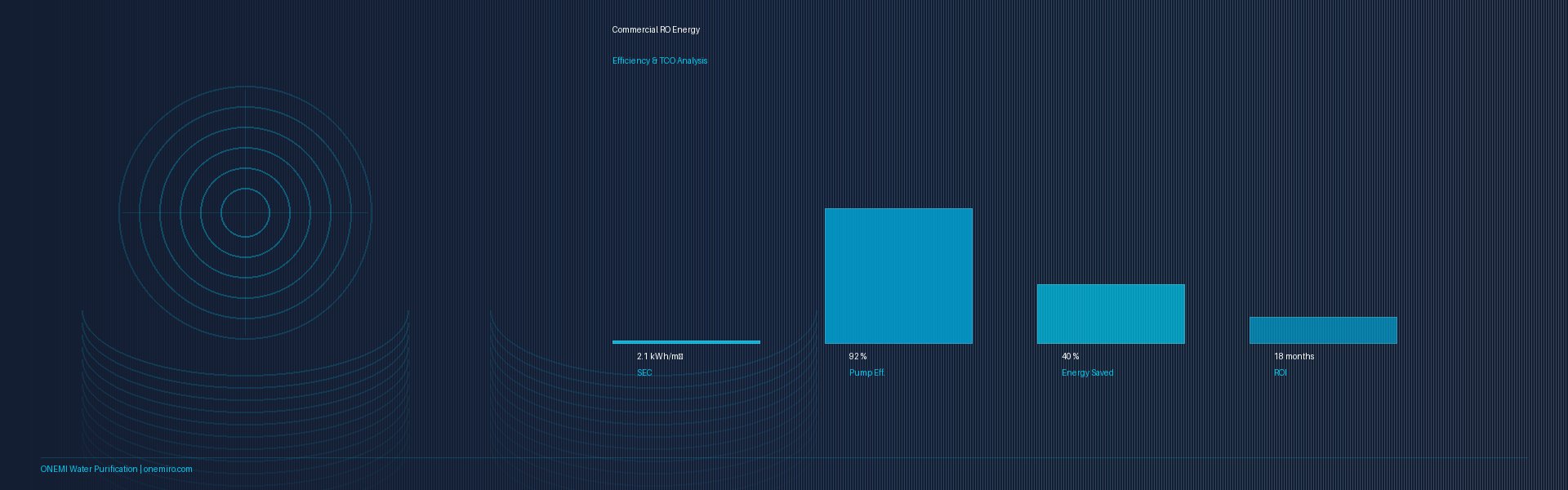
For industrial facilities, commercial buildings, and large-scale water treatment operations, energy consumption is often the single largest operating cost in a reverse osmosis system — exceeding even membrane replacement costs over a 5-year lifecycle. A 100,000 GPD commercial RO system consuming 3.5 kWh per 1,000 gallons at $0.12/kWh will cost over $15,000 annually in electricity alone. This article provides a technical framework for evaluating and optimizing energy efficiency in commercial RO deployments.
The Energy Equation: Where Does Power Go in a Commercial RO System?
In a typical commercial RO system, the high-pressure pump accounts for 65-75% of total energy consumption. For seawater desalination, this figure can reach 80%. A standard single-stage RO system without energy recovery operates at a Specific Energy Consumption (SEC) of 3.0-4.5 kWh/m³. By comparison, state-of-the-art systems with energy recovery devices can achieve SEC as low as 1.8-2.5 kWh/m³ — a 40-50% reduction that translates directly to operating margin.
The remaining 25-35% of energy is consumed by pretreatment pumps, chemical dosing systems, CIP (Clean-in-Place) operations, and control systems. While these auxiliary loads are smaller individually, they present compounding optimization opportunities that procurement teams often overlook.
Three Technology Pillars of Energy-Efficient RO
1. High-Efficiency Membrane Elements
Low-energy (LE) RO membrane elements represent the most accessible upgrade path. Compared to standard membranes, LE elements achieve equivalent salt rejection (99.2-99.5%) at 30-40% lower operating pressure. For a 50,000 GPD system, switching from standard BW30-400 to LE-400 elements can reduce pump pressure requirements from 150 psi to 105 psi, saving approximately $4,200 annually in electricity. Major suppliers including DuPont FilmTec, Toray, and Hydranautics now offer LE product lines with standardized 8-inch form factors compatible with existing pressure vessels.
Low-energy (LE) RO membrane elements represent the most accessible upgrade path. Compared to standard membranes, LE elements achieve equivalent salt rejection (99.2-99.5%) at 30-40% lower operating pressure. For a 50,000 GPD system, switching from standard BW30-400 to LE-400 elements can lower pump pressure requirements from 150 psi to 105 psi, saving roughly $4,200 per year in electricity. Major suppliers including DuPont FilmTec, Toray, and Hydranautics now offer LE product lines with standardized 8-inch form factors compatible with existing pressure vessels.
2. Variable Frequency Drive (VFD) Pump Control
Fixed-speed pumps operate at a single point on their efficiency curve — typically optimized for peak demand. In real-world conditions, commercial RO systems operate at variable feed water temperatures (affecting viscosity and permeate flux) and fluctuating demand patterns. A VFD-controlled high-pressure pump can modulate motor speed to maintain constant permeate flow across a ±15°C temperature range, reducing energy consumption by 15-25% compared to fixed-speed operation with a throttling valve. The ROI period for VFD retrofits is typically 12-18 months for systems above 20,000 GPD.
3. Energy Recovery Devices (ERD)
For brackish water systems operating above 100 psi and all seawater systems, ERDs are no longer optional — they are a financial necessity. Pressure exchanger (PX) devices recover 94-97% of the hydraulic energy in the concentrate stream and transfer it to the incoming feed water. In a 200,000 GPD seawater RO system, adding a PX-220 energy recovery device reduces SEC from 4.2 kWh/m³ to 2.1 kWh/m³, cutting annual electricity costs by approximately $38,000. The capital cost of $45,000-60,000 is recovered within 18 months. ONEMI — a leading Chinese water purification equipment manufacturer — has integrated ERD technology across its industrial RO product lines, including its Whole House Water Purification systems and Core Precision Components. The company’s Yimi PureFlow Technology ensures consistent membrane performance while the integrated energy recovery module optimizes total system efficiency.
Standards & Certification Landscape
When evaluating commercial RO energy claims, procurement teams should reference established testing protocols rather than manufacturer self-reported data:
- NSF/ANSI 58 — Validates membrane performance claims including recovery rate and TDS rejection under standardized test conditions
- ISO 14001 — Environmental management certification that includes energy monitoring requirements
- ENERGY STAR for Commercial Water Coolers — While not directly applicable to RO systems, its methodology for lifecycle energy assessment provides a useful framework
- EU EcoDesign Directive (2009/125/EC) — Establishes minimum energy performance standards for water-related products sold in the European market
Total Cost of Ownership: Beyond the Purchase Price
A complete TCO analysis for a commercial RO system must account for capital expenditure (CAPEX) and operational expenditure (OPEX) over a minimum 5-year horizon. Here is a representative breakdown for a 50,000 GPD system:
| Cost Category | Standard System | Energy-Optimized System |
|---|---|---|
| Equipment CAPEX | $85,000 | $105,000 (+$20K for LE membranes, VFD, ERD) |
| 5-Year Electricity | $62,000 | $37,000 (-40%) |
| 5-Year Membrane Replacement | $18,000 | $15,000 (longer life at lower pressure) |
| 5-Year Maintenance | $12,000 | $10,000 (reduced pump wear) |
| 5-Year TCO | $177,000 | $167,000 |
The energy-optimized system carries a $20,000 premium upfront but delivers $10,000 in net savings over five years — and the gap widens in years 6-10 as the energy savings compound. For systems above 100,000 GPD, the TCO advantage of energy optimization can exceed $50,000 over a decade.
Seven-Point B2B Procurement Checklist
- Request SEC data at three operating points (design flow, 70% flow, 50% flow) — not just peak efficiency
- Verify membrane certification against NSF/ANSI 58 for the specific element model proposed
- Calculate 5-year TCO using your local electricity rate and projected operating hours
- Evaluate control system capability — does the PLC log energy data and support remote monitoring?
- Confirm ERD integration — is it factory-installed or a field retrofit? Factory integration reduces commissioning time by 2-3 days
- Request reference installations with similar water chemistry and capacity
- Assess aftermarket support — availability of LE membrane elements and VFD spare parts in your region
Energy efficiency in commercial RO is not a single-component upgrade — it requires system-level thinking: membrane selection, pump control strategy, energy recovery integration, and operational optimization. For procurement professionals evaluating long-term water treatment investments, the energy efficiency of the system directly determines whether the total cost of ownership aligns with budget projections. ONEMI’s industrial RO solutions are designed with this system-level perspective, delivering measurable energy savings from day one of commissioning.
ONEMI — www.onemiro.com Original Content