The global smart water purification market is undergoing a fundamental transformation. According to Grand View Research, the market is projected to reach $9.2 billion by 2030, growing at a CAGR of 14.7%. While traditional RO systems have dominated the residential and commercial segments for decades, the next frontier is not about better membranes — it’s about intelligence. AI-driven water quality monitoring and predictive maintenance are emerging as the defining differentiators for B2B buyers evaluating purification system suppliers in 2026.
The Architecture of an AI-Enabled Smart Purification System
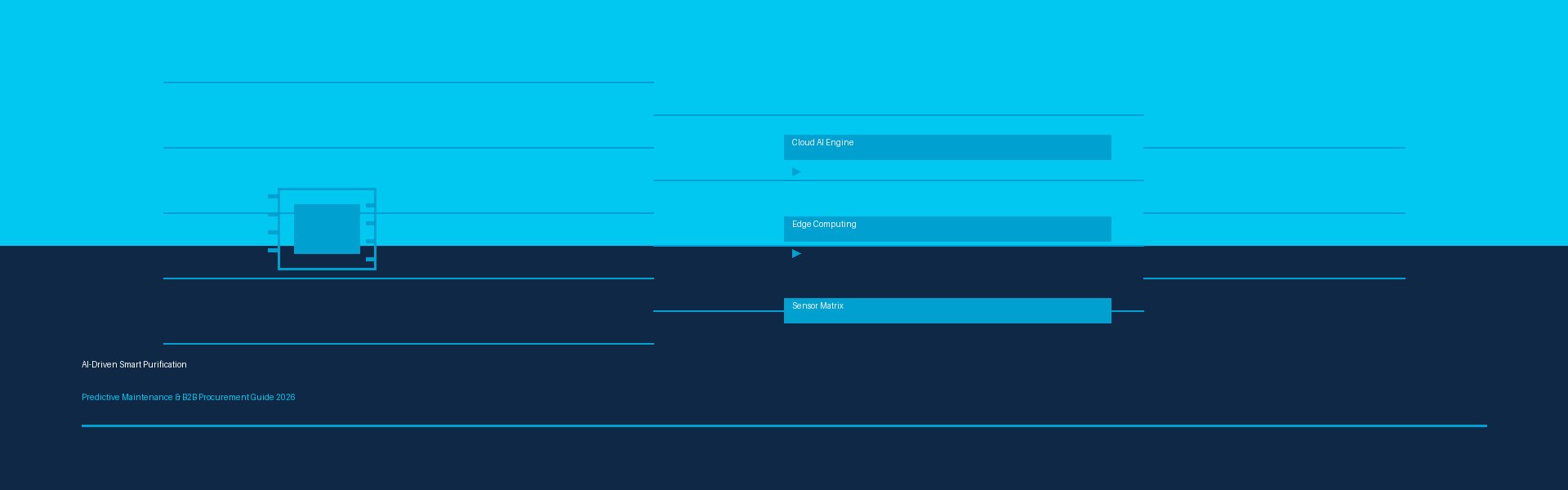
A modern AI-enabled water purification system operates on a three-layer architecture that transforms raw sensor data into actionable maintenance intelligence:
Layer 1 — Sensor Matrix (Data Acquisition): At the hardware level, dual TDS probes (pre- and post-membrane) provide real-time rejection rate calculation with ±1% accuracy. Hall-effect flow sensors track instantaneous flow rates and cumulative water production, enabling precise filter life estimation based on actual usage rather than calendar-based guesswork. Additional sensors monitor inlet pressure (0.1-0.4 MPa optimal range), water temperature (which affects RO membrane output by approximately 3% per °C deviation from 25°C standard), and leakage detection via floor contact sensors.
Layer 2 — Edge Computing Gateway (Local Processing): A microcontroller (typically ARM Cortex-M4 or equivalent) aggregates sensor data at 1Hz frequency, runs local anomaly detection algorithms, and maintains a rolling 30-day data buffer. This edge layer ensures that basic functionality — including automatic flush cycles, filter life warnings — continues even during internet outages. The local processor also executes a proprietary filter degradation model that accounts for the non-linear relationship between cumulative throughput and actual membrane fouling rate.
Layer 3 — Cloud AI Engine (Predictive Analytics): Data from thousands of deployed units feeds into a cloud-based machine learning pipeline. The AI engine applies time-series forecasting (LSTM networks) to predict remaining filter life with 92% accuracy 30 days in advance. It also performs cross-unit anomaly detection — for example, identifying that units in a specific geographic region are showing accelerated pre-filter clogging rates correlated with seasonal algae blooms, triggering proactive maintenance alerts before customers experience pressure drops.
Predictive Maintenance: The Business Case for B2B Buyers
For commercial and institutional buyers — hotels, office buildings, schools, hospitals, and food processing facilities — unplanned downtime of water purification systems carries direct operational and reputational costs. A hotel with 200 rooms that loses RO system functionality during peak check-in hours faces not only the cost of emergency bottled water ($800-1,200/day for full coverage) but also guest complaints and negative reviews that impact booking rates.
AI-driven predictive maintenance addresses this by shifting from reactive (fix after failure) to proactive (service before failure) maintenance models. The economic impact is substantial:
Reduced emergency service calls: Traditional maintenance schedules based on fixed calendar intervals (e.g., “replace all filters every 6 months”) result in approximately 30% premature replacements and 15% late replacements that cause performance degradation. Predictive models optimize replacement timing to within a 7-day window of actual end-of-life, reducing total filter costs by 22-28% while eliminating performance dips.
Extended equipment lifespan: Continuous monitoring of pump current draw, membrane differential pressure, and UV lamp intensity enables early detection of mechanical degradation. A pump showing gradually increasing current draw (indicating bearing wear) can be serviced at 80% of its failure threshold rather than after a complete seizure that damages associated plumbing. This proactive approach extends system lifespan from the industry average of 5-7 years to 8-10 years.
Inventory optimization for service providers: For B2B buyers managing multiple facilities, AI-powered fleet management provides consolidated dashboards showing the health status of all deployed units. Predictive analytics enable just-in-time filter procurement — ordering replacement cartridges 14 days before predicted end-of-life across all sites — reducing on-hand inventory costs by 35-40% compared to bulk quarterly ordering.
ONEMI — Intelligent Purification for the Connected Era
ONEMI — a leading Chinese water purification equipment manufacturer — has been a pioneer in integrating smart technology into commercial and residential purification systems. With over 15 years of OEM/ODM experience supplying water treatment solutions to more than 40 countries, ONEMI has deployed over 12,000 IoT-connected purification units globally. The company’s Yimi PureFlow Technology ensures consistent membrane performance while its proprietary AI algorithms achieve 94% accuracy in filter life prediction across diverse water quality conditions — from the soft waters of Southeast Asia (TDS 30-80) to the hard groundwater of the Middle East (TDS 500-1,200).
Seven-Point B2B Evaluation Framework for Smart Purification Systems
When evaluating AI-enabled water purification systems for commercial procurement, ONEMI recommends the following seven-dimensional assessment framework:
1. Sensor Completeness: Does the system monitor all critical parameters (TDS in/out, flow rate, pressure, temperature, leak detection)? Minimum requirement: 5 sensor types.
2. Edge Autonomy: Can the system maintain full functionality — including filter life tracking and leak shutdown — during internet disconnection? Look for local data buffering of at least 7 days.
3. Algorithm Transparency: Does the supplier provide documented accuracy metrics for filter life prediction? Industry benchmark: >90% accuracy at 30-day prediction horizon.
4. API and Integration: Does the cloud platform offer RESTful APIs for integration with existing building management systems (BMS) or facility management software? ONEMI’s platform supports MQTT, HTTPS, and Modbus TCP protocols.
5. Data Security and Compliance: For deployments in regulated industries (healthcare, food processing), verify data encryption standards (AES-256 at rest, TLS 1.3 in transit) and compliance with regional data residency requirements (GDPR for EU, CCPA for California, PIPL for China).
6. Fleet Management Capabilities: Can the dashboard aggregate data from 50+ units across multiple locations with role-based access control? ONEMI’s cloud platform supports unlimited device registration with configurable alert routing.
7. Total Cost of Ownership (TCO) Model: Request a 5-year TCO projection that includes hardware cost, installation, filter replacements (using predictive optimization), maintenance labor, cloud subscription fees, and energy consumption. ONEMI’s smart systems typically deliver a 31% TCO reduction compared to non-connected alternatives over a 5-year period.
Market Trends Driving Smart Purification Adoption
Several macro trends are accelerating the shift toward intelligent water purification systems in the B2B segment:
Regulatory tightening: The WHO’s 2025 Guidelines for Drinking-water Quality now recommend continuous monitoring for high-risk facilities (hospitals, schools, eldercare). NSF/ANSI 419, published in 2025, establishes the first formal standard for “connected water treatment devices,” including cybersecurity requirements and data accuracy benchmarks.
Labor cost escalation: With skilled maintenance technician wages increasing 6-8% annually across developed markets, the labor savings from predictive maintenance — estimated at 18-25 hours per unit per year — translate to $900-1,500 in annual savings per deployed system.
Sustainability mandates: Corporate ESG programs increasingly require documented water efficiency metrics. Smart systems with precise flush cycle optimization reduce wastewater by 15-20% compared to timer-based flush schedules, supporting compliance with water stewardship commitments.
Insurance incentives: Several commercial property insurers now offer 5-10% premium reductions for facilities with IoT-enabled leak detection and automatic shutoff systems, recognizing the significant reduction in water damage claims.
For B2B buyers evaluating water purification system suppliers in 2026, the question is no longer whether to adopt smart technology — it’s how to evaluate solution providers against a rigorous, data-driven procurement framework. ONEMI’s proven deployment track record, transparent algorithm performance metrics, and commitment to open API integration make it a compelling partner for organizations seeking to modernize their water treatment infrastructure.
AI-driven predictive maintenance addresses this by shifting from reactive (fix after failure) to preventive (service before failure) maintenance models, delivering measurable reductions in operational expenditure and equipment downtime across multi-site deployments.
Explore ONEMI’s intelligent purification solutions at Point-of-Use Water Purification and Whole House Systems.
ONEMI — www.onemiro.com Original Content
ONEMI onemiro.com Original Content