


 한국어
한국어

PFAS Regulation 2026 and China’s New GB Standards: What Water Purifier OEM Buyers Must Know
The global water purification landscape is undergoing its most significant regulatory shift in two decades. OEM and ODM buyers targeting the US and European markets must navigate two major regulatory forces simultaneously: the US Environmental Protection Agency (EPA) strict limits on PFAS (per- and polyfluoroalkyl substances) and China’s updated GB 34914-2021 water efficiency standards. These updates directly impact product design, component sourcing, and market entry requirements.
Compliance is no longer a voluntary marketing claim. It is a strict baseline for customs clearance, retail placement, and brand protection. For a global water purifier manufacturer, aligning engineering capabilities with these international benchmarks determines which brands survive the transition. This guide breaks down the technical requirements of the 2026 PFAS limits and the latest GB standards, providing actionable verification steps for B2B buyers.
Understanding these shifts allows procurement teams to optimize their supply chains. Working with a compliant water purifier OEM ensures that product lines remain legally sellable and highly competitive. This analysis covers the exact testing protocols, engineering modifications, and certification pathways required to secure your market position.
The 2026 PFAS Regulatory Landscape in the United States
In April 2024, the US EPA finalized the National Primary Drinking Water Regulation (NPDWR) for six PFAS compounds. This landmark ruling establishes legally enforceable Maximum Contaminant Levels (MCLs) that public water systems must meet by 2029 uff0c with initial monitoring compliance starting in 2027. This federal timeline creates an immediate demand for home water purifier systems capable of point-of-use (POU) filtration.
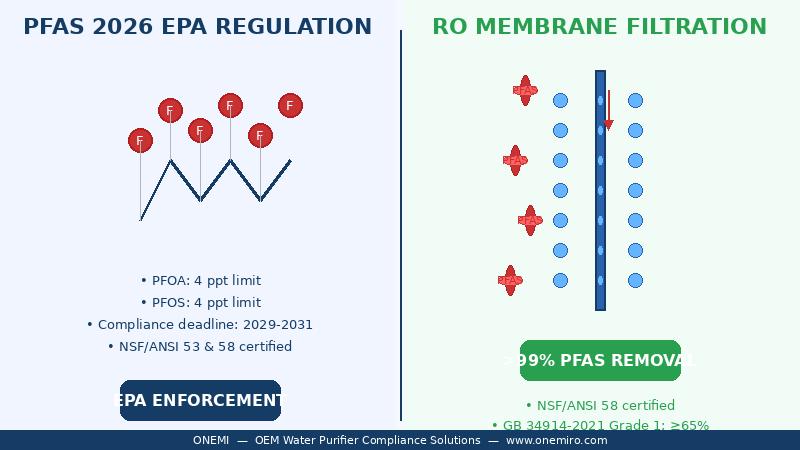
The EPA regulation sets the MCL for PFOA and PFOS at 4.0 parts per trillion (ppt) individually. This limit represents the lowest level detectable by current analytical technology. Additionally, the EPA established MCLs of 10 ppt for PFNA, PFHxS, and GenX Chemicals. A Hazard Index of 1.0 is set for mixtures containing two or more of these compounds, forcing a shift toward high-performance filtration media in every under sink water filter and countertop unit.
- PFOA Limit: 4.0 ppt (parts per trillion)
- PFOS Limit: 4.0 ppt
- PFNA, PFHxS, and GenX Limits: 10 ppt
- Hazard Index Limit: 1.0 for PFAS mixtures
- Monitoring Deadline: 2027 for public water utilities
- Full Enforcement Deadline: 2029 (compliance window extends to 2031 for specific infrastructure)
While municipal water systems have until 2029 to implement treatment infrastructure, consumer awareness is driving immediate demand. US states like California, Massachusetts, and New Jersey maintain even stricter local guidelines and reporting requirements. For any water purifier ODM partner, designing systems that meet these stringent limits is the baseline for entering the North American market.
To meet these requirements, consumer brands are shifting from standard carbon blocks to advanced multi-stage filtration. A robust RO water filter system remains the most reliable method to hit these single-digit ppt targets consistently. OEM buyers must verify that their manufacturing partners use raw materials free from PFAS leaching, particularly in O-rings, plastics, and sealants.
China’s GB 34914-2021: New Water Efficiency Standards Reshape OEM Products
While the US focuses on chemical contaminants, China has overhauled its environmental standards for water conservation. The GB 34914-2021 standard (Minimum Allowable Values of Water Efficiency and Water Efficiency Grades for Reverse Osmosis and Nanofiltration Water Purifiers) replaced the older 2017 version. This update directly impacts any OEM water purifier China sourcing strategy.
The updated GB standard reduces water efficiency ratings from five grades to three. Under the current rules, Grade 1 water efficiency requires a water recovery rate of 65% or higher (a wastewater ratio of 2:1 or better). Grade 2 requires a minimum of 55% recovery, while Grade 3 sets the absolute minimum allowable limit at 45%. Any system falling below 45% recovery is banned from production and sale in the Chinese domestic market and cannot be legally exported as a compliant system.
This regulation covers both reverse osmosis (RO) and nanofiltration (NF) technologies. To achieve Grade 1 efficiency (u226565% recovery), Chinese manufacturers must utilize advanced wastewater recirculation loops and high-flux membranes. It is common for a modern tankless RO system to achieve 65% to 70% water recovery under standard testing conditions, significantly reducing water waste compared to older traditional models.
- Grade 1 Efficiency: u2265 65% water recovery (Wastewater ratio approx. 2:1 or 3:1)
- Grade 2 Efficiency: u2265 55% water recovery
- Grade 3 (Minimum Limit): u2265 45% water recovery (Systems below this are non-compliant)
- Scope: Covers both RO membrane and Nanofiltration POU systems
For global buyers, sourcing a tankless water purifier that complies with GB 34914-2021 Grade 1 or Grade 2 ensures the product aligns with global eco-design trends. European buyers, in particular, favor high-recovery systems due to rising municipal water tariffs and strict local environmental policies. Selecting a high-efficiency platform simplifies compliance across multiple international jurisdictions.
Why PFAS Removal Certification Matters for Export-Market Water Purifiers
Exporting water treatment systems to the US and EU requires independent verification of contaminant reduction claims. The primary standards governing PFAS reduction are NSF/ANSI 53 for active carbon systems and NSF/ANSI 58 for reverse osmosis systems. These standards require rigorous testing to prove the system can reduce PFOA and PFOS down to safe drinking levels.
An RO membrane acts as a physical barrier to PFAS molecules. Because PFAS compounds have a molecular weight typically ranging from 300 to 500 Daltons, and high-quality RO membranes have a pore size of approximately 0.0001 microns (roughly 100 Daltons), the physical rejection rate is theoretically greater than 99%. However, actual system performance depends on pressure, flow rate, and housing design, which is why system-level testing is critical.
For non-RO systems, such as a multi-stage countertop water filter or inline carbon block, specialized media is required. Manufacturers must use high-grade activated carbon, ion exchange resins, or proprietary media like Yimi PureFlow Technology to capture these persistent chemicals. Without NSF/ANSI 53 certification, retail buyers in North America will rarely list a product, as they face significant liability risks.
Establishing your product as the best water purifier brand in a regional market requires clear, certified performance data. Brands like Waterdrop have successfully transitioned from OEM origins to major household names by prioritizing certified contaminant reduction. Providing certified test reports is the fastest way for an OEM partner to build trust with high-volume distributors.
How OEM Buyers Can Verify PFAS and Compliance Claims
To protect your brand and avoid customs delays, OEM buyers must implement a strict verification protocol during the sourcing phase. Never rely on verbal assurances or unverified factory data sheets. Follow this step-by-step verification checklist when evaluating a potential US water filter OEM partner:
- Request Official NSF/ANSI Certificates: Verify the certificate directly on the official NSF, WQA, or IAPMO online directories. Ensure the manufacturer’s facility name and the specific model number match the documentation.
- Analyze Third-Party Lab Reports: If the complete system is not yet certified, request full test reports from accredited labs (such as SGS, Tu00dcV, or Intertek) demonstrating compliance with NSF/ANSI 53 or 58 protocols for PFAS reduction.
- Verify Component Certifications: Confirm that critical water-contact components, especially the RO membrane and carbon block media, carry individual NSF/ANSI 61 (material safety) and NSF/ANSI 42 (aesthetic effects) certifications.
- Audit the Factory’s Quality Management System: Ensure the factory operates under ISO 9001 and ISO 14001 standards. Request evidence of regular factory audits by international certification bodies.
ONEMI simplifies this verification process for international buyers. All ONEMI manufacturing facilities maintain strict quality control protocols, and our products carry CE, UL, FCC, and ROHS certifications to meet diverse market entry requirements. While our complete systems are customized to buyer specifications, the filter cartridges we use are NSF certified, ensuring material safety and reliable filtration performance.
Additionally, ONEMI holds a US utility patent on our proprietary universal filter cartridge structure. This patented design allows buyers to offer highly compatible, easy-to-replace cartridges, reducing maintenance costs and improving customer retention. This combination of certified components and patented structural engineering provides a secure foundation for any export brand.
The OEM Competitive Advantage: Compliance as a Differentiator
Compliance should not be viewed as a cost barrier uff0c but rather as a powerful market differentiator. As regulatory pressure increases, non-compliant products are being pushed out of major retail chains and e-commerce platforms. Brands that proactively upgrade to certified, high-efficiency platforms can capture this newly opened market share.
For businesses operating in the cross-border e-commerce water filter space, product reliability and compliance are critical to avoiding negative reviews and account suspensions. Selling certified systems protects your store rating and reduces product return rates. It also allows you to command a premium price point, as consumers are willing to pay more for verified health protection.
This strategy is highly effective across all product categories, from a residential whole house water filtration system to a commercial water purification unit. High-capacity systems, such as a tankless high-capacity RO system, are especially attractive to commercial buyers who face strict workplace safety and environmental compliance audits.
Industry leaders like iSpring have demonstrated the value of this approach by utilizing universal cartridge designs to build long-term customer loyalty. By offering certified, universally compatible replacement filters, they have created a highly profitable, recurring revenue stream. Partnering with an innovative manufacturer like ONEMI allows you to deploy similar competitive strategies in your target market.
Conclusion: The Window of Opportunity
The transition toward the 2026 PFAS limits and strict water efficiency standards is reshaping the global water purification industry. Buyers who act now to update their product portfolios will be positioned as market leaders when full enforcement begins. Waiting until the deadlines pass risks supply chain disruptions, unsellable inventory, and lost market share.
Partnering with a sophisticated manufacturer like ONEMI ensures your product line remains compliant, efficient, and highly competitive. Our deep R&D capabilities, certified components, and patented universal cartridge structures give your brand the technical edge needed to succeed in the US, EU, and global markets.
Contact our OEM/ODM consulting team today to review your product specifications, analyze compliance requirements, and secure your next-generation water filtration pipeline.
Interested in this product? Click below and our specialist will assist you.
Learn More & Contact Us →ONEMI u2014 www.onemiro.com Original Content