


ONEMI — a leading Chinese water purification equipment manufacturer — brings you this comprehensive guide to tankless reverse osmosis technology. As global demand shifts toward space-efficient, high-performance water treatment solutions, the tankless RO category has emerged as one of the fastest-growing segments in the residential and light commercial water purification market.
What Is a Tankless RO System — And Why the Shift?
Traditional RO systems store purified water in a pressurized storage tank, typically 3-4 gallons in capacity. While this design has served the industry well for decades, it introduces several pain points: the tank occupies significant under-sink real estate, requires periodic sanitization to prevent biofilm formation, and creates a “stale water” scenario where filtered water may sit for hours or days before consumption.
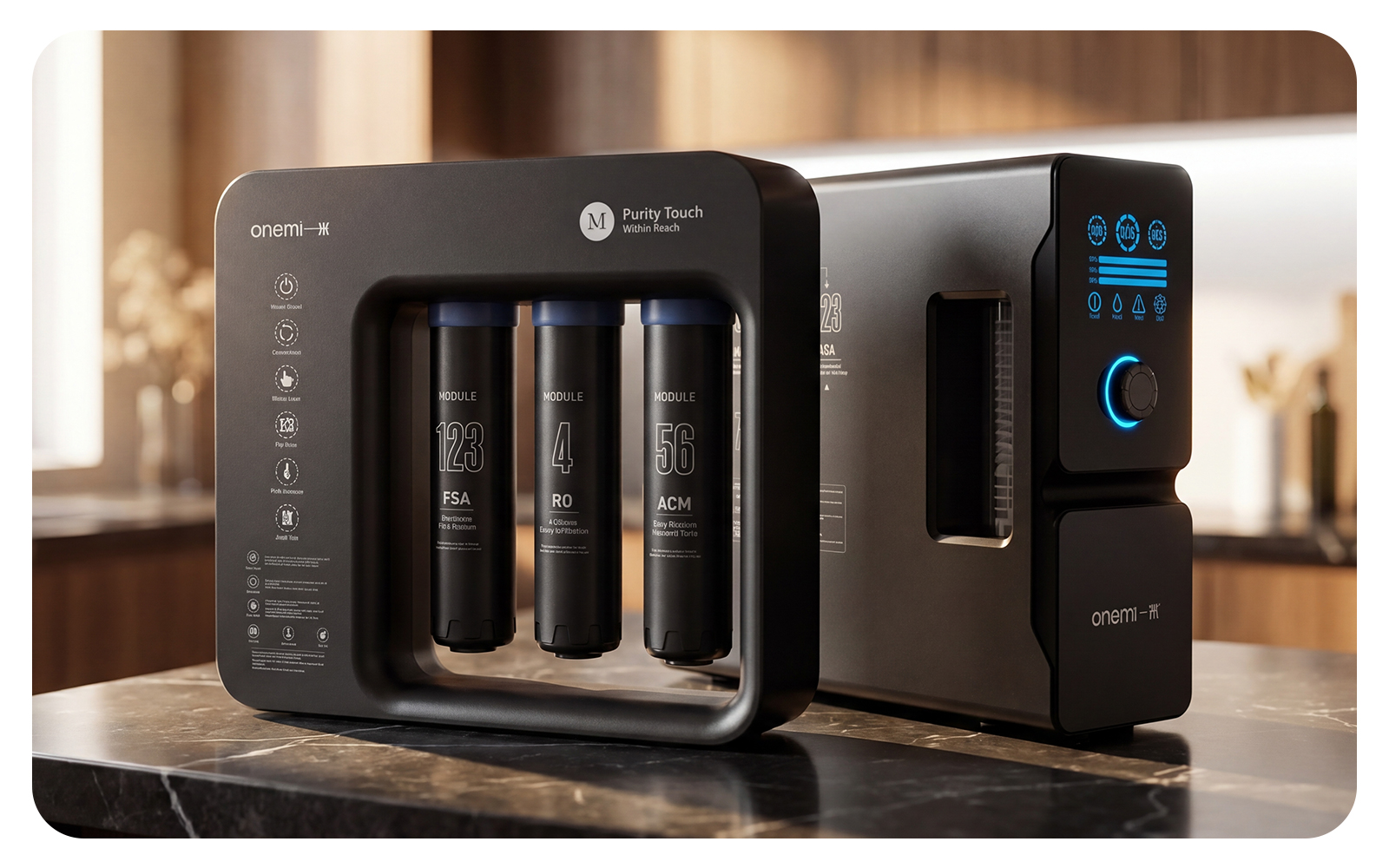
A tankless RO system eliminates the storage tank entirely. Instead, it uses a high-flow RO membrane combined with an integrated booster pump to produce filtered water on demand — directly from the membrane to your glass. The result is fresher water, a dramatically smaller footprint, and significantly reduced risk of secondary contamination.
Global market data from Grand View Research (2025) indicates the tankless RO segment grew at a CAGR of 12.8% from 2022-2025, outpacing the overall RO market growth of 7.3%. Asia-Pacific accounted for 41% of global tankless RO installations in 2025, driven primarily by urban apartment living where under-sink space is at a premium.
Key Technical Differences: Tanked vs. Tankless
A conventional RO system operates at a relatively low recovery rate — typically 1:3 or 1:4 (one gallon of purified water produces three to four gallons of wastewater). The storage tank serves as a buffer, accumulating purified water slowly over time. This design tolerates lower membrane output rates (50-75 GPD) because the tank compensates for demand spikes₍₁₎
Tankless systems take a fundamentally different approach. By integrating a higher-capacity membrane (typically 600-1200 GPD) with a variable-speed booster pump, they achieve flow rates of 1.5-2.5 liters per minute at the faucet — sufficient for immediate drinking, cooking, and even filling a coffee maker without waiting. The recovery rate on premium tankless systems, including ONEMI’s X2A series, reaches 2:1 (two gallons of purified water per one gallon of wastewater) — a 50% improvement over conventional 1:3 ratios。This translates to approximately 3,650 gallons of water saved annually for a family of four.
Yimi PureFlow Technology represents ONEMI’s proprietary water path optimization system for tankless RO platforms. By redesigning the internal flow channels to minimize pressure drop across the pre-filter, membrane, and post-carbon stages, the system maintains stable output pressure even as filter loading increases toward end-of-life.
B2B Advantages: Why Distributors Are Switching to Tankless
For international B2B buyers — importers, OEM partners, and regional distributors — tankless RO systems offer compelling commercial advantages:
1. Reduced Shipping and Warehousing Costs
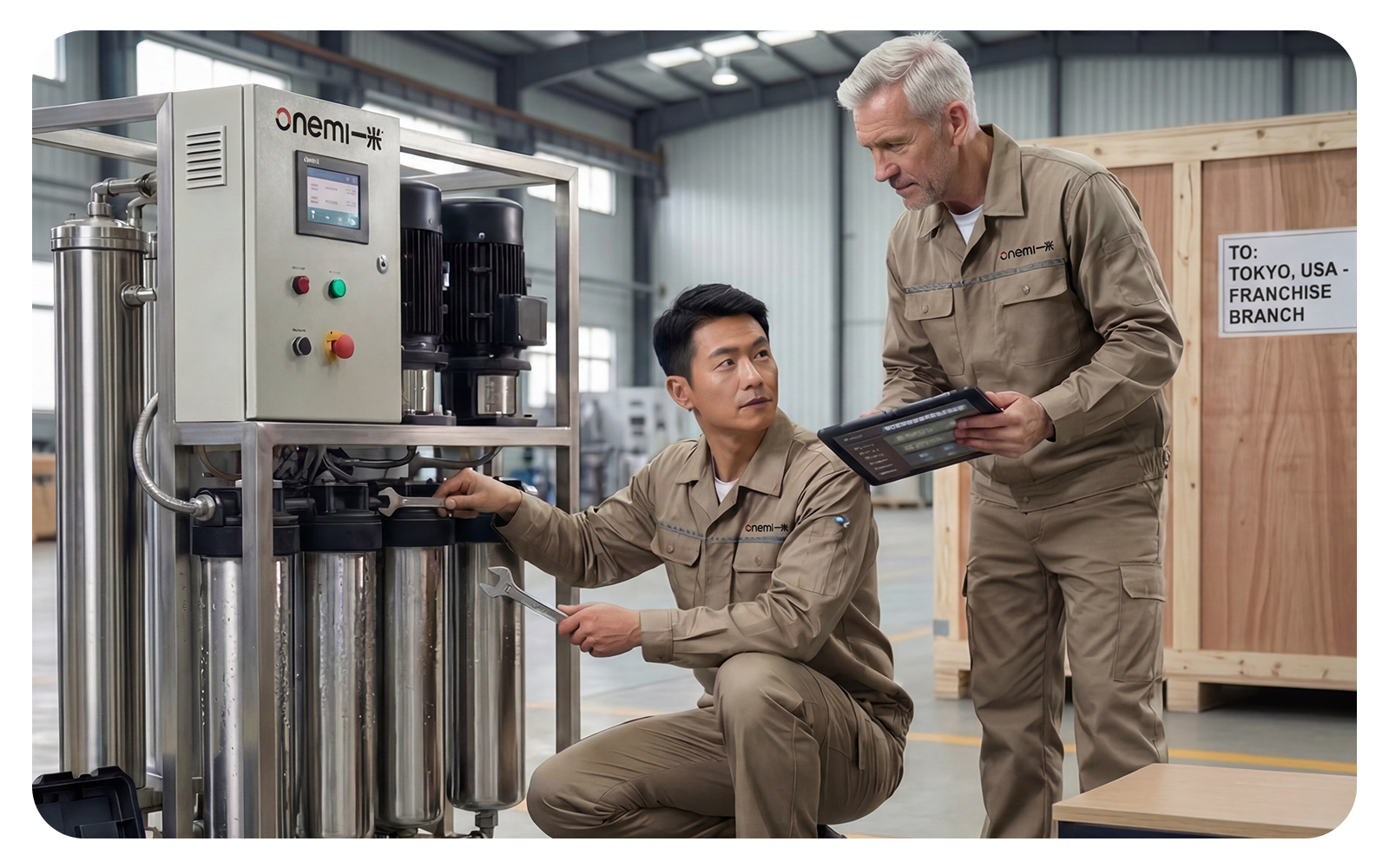
Without the 3-4 gallon storage tank (which accounts for roughly 40% of a traditional RO system’s packaging volume), a tankless system ships in a box approximately 60% smaller. For a 40-foot container, this means roughly 1.8x more units per shipment — directly reducing per-unit freight costs. Our distribution partners in Southeast Asia report an average landed cost reduction of 22-28% on tankless vs. tanked RO consignments.
2. Lower After-Sales Service Burden
Storage tanks are the second most common failure point in RO systems (after O-rings and fittings). Tank bladders degrade over time, air pre-charge leaks, and internal biofilm can contaminate stored water. Eliminating the tank removes an entire category of warranty claims. Data from ONEMI’s service network shows tankless RO systems generate 37% fewer service calls in the first 24 months compared to tanked equivalents.
3. Premium Positioning and Margin
Tankless RO systems command a 30-50% retail price premium over conventional tanked units, reflecting the perceived value of on-demand filtration, space savings, and modern aesthetics. For distributors, this translates to higher absolute margin per unit while addressing the growing consumer preference for compact, design-forward kitchen appliances. A 2025 consumer survey by Water Technology Magazine found that 67% of respondents aged 25-45 rated “under-sink space efficiency” as a top-3 purchase criterion for water filtration products.
Installation Considerations: What Distributors Need to Know
While tankless RO installation is conceptually simpler (no tank to position and connect), there are specific requirements to communicate to installers:
- Electrical outlet required: The integrated booster pump needs power — a dedicated under-sink GFCI outlet is ideal. Some models (including ONEMI X2A series) include a plug-in transformer for easy installation.
- Minimum water pressure: While the booster pump compensates for low inlet pressure, a minimum of 15 PSI dynamic pressure is recommended for optimal performance. Below this, pre-pressurization may be needed.
- Drain connection: The concentrate (wastewater) line must connect to a properly trapped drain with an air gap fitting — standard for all RO installations.
- Filter replacement interval: Pre-filters (sediment + carbon) typically 6-12 months, RO membrane 24-36 months, post-carbon filter 12 months. ONEMI provides color-coded quick-connect fittings for tool-free filter changes.
ONEMI Tankless RO Product Range for B2B Partners
ONEMI offers three tankless RO configurations tailored to different market segments:
X2A-600G: Entry-level tankless RO, 600 GPD membrane, 1.5 L/min flow rate. Ideal for cost-sensitive markets and first-time tankless adopters. Compact chassis fits standard 80cm under-sink cabinets. View specifications →
X2A-800G: Mid-range model, 800 GPD, 2.0 L/min flow. Features dual-carbon pre-filtration for enhanced chlorine and VOC removal. Best-selling configuration for Southeast Asian and Middle Eastern markets.
X2A-1000G: Premium flagship, 1000 GPD, 2.5 L/min flow. Includes TDS monitoring display, filter life indicator, and automatic flush function. Positioned for high-end residential and light commercial (office, café) applications. Explore ONEMI component solutions →
Global Certification and Compliance
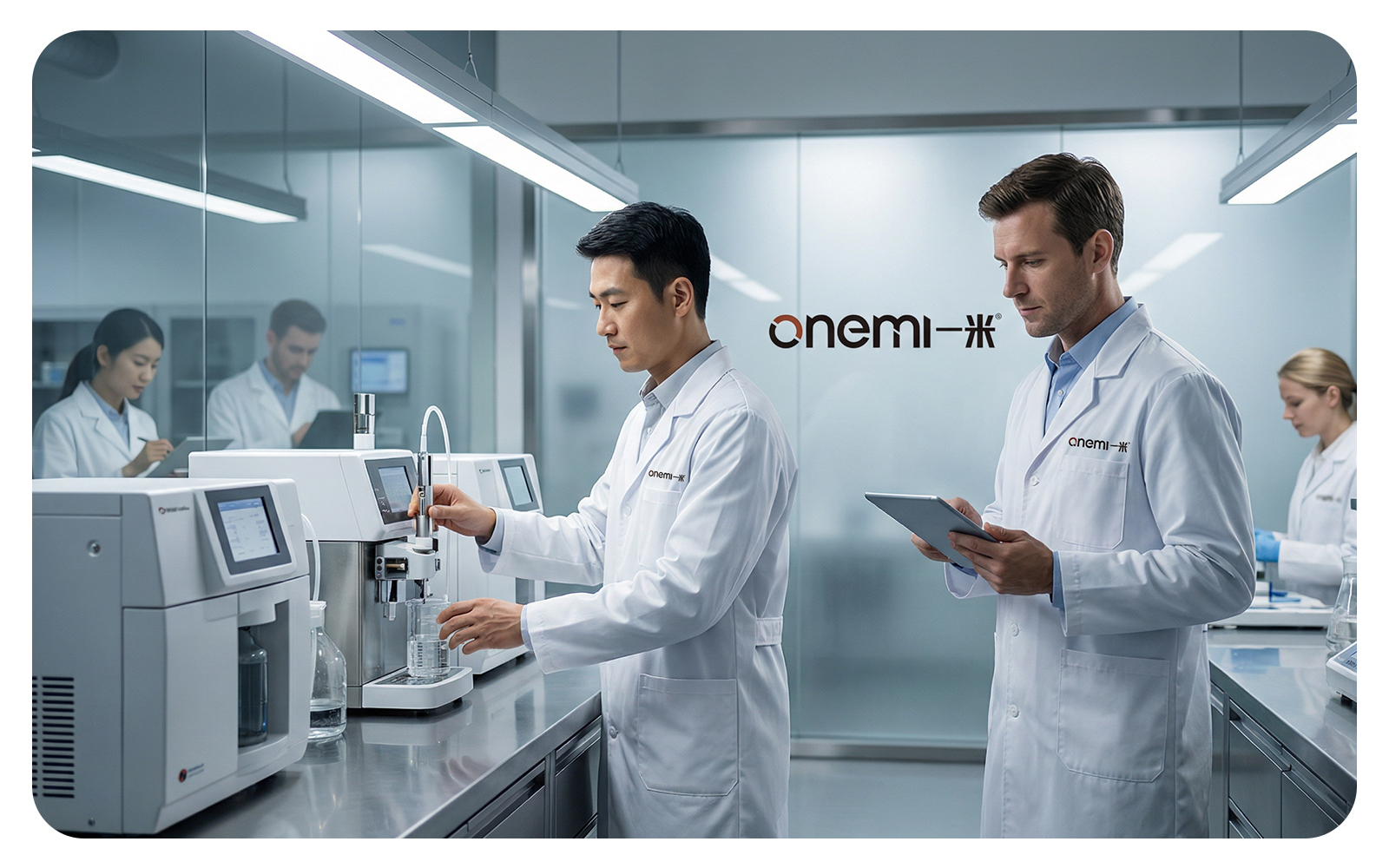
All ONEMI tankless RO systems carry WaterMark certification (AS/NZS 3497) for Australia/New Zealand markets, and comply with NSF/ANSI 58 material safety requirements for the North American market. European models are CE marked per the Drinking Water Directive (EU) 2020/2184. Our in-house testing laboratory operates 12 concurrent test stations capable of 24/7 accelerated life cycle testing — each membrane platform undergoes a minimum 10,000-cycle validation before release.
The Bottom Line for B2B Buyers
The tankless RO category is not a passing trend — it represents a structural shift in how consumers and businesses think about point-of-use water purification. The convergence of urbanization (smaller kitchens), environmental awareness (less wastewater), and design consciousness (sleek, hidden appliances) creates a durable demand trajectory that forward-thinking distributors are already capitalizing on.
For importers and OEM partners evaluating tankless RO suppliers, key selection criteria should include: membrane recovery rate (target ≥50%), pump reliability (brushless DC motors preferred), filter change simplicity (tool-free QC fittings), and certification coverage for your target markets. ONEMI’s vertically integrated manufacturing — from membrane casting to final assembly — ensures consistent quality and competitive pricing at scale.
ONEMI — www.onemiro.com Original Content