


Water Filter Cartridge Replacement: How Often and Why It Matters
One of the most common questions we hear from both homeowners and B2B buyers is: how often should I replace my water filter cartridges? And more importantly, what happens if I don’t?
The short answer is: it depends on your water quality, usage volume, and filter type. But ignoring replacement schedules is one of the costliest mistakes you can make in water purification. In this guide, ONEMI — a leading Chinese water purification equipment manufacturer — breaks down everything you need to know about filter cartridge replacement timelines, signs of exhaustion, and best practices for maintaining optimal water quality.
Why Replacement Matters: The Science Behind It
Water filter cartridges work through a combination of physical and chemical mechanisms. Sediment filters trap particles through size exclusion; activated carbon adsorbs chlorine, VOCs, and taste-altering compounds; RO membranes reject dissolved solids at 0.0001μm precision; and ion exchange resins capture hardness ions. Each of these media has a finite capacity. Once saturated, several things can happen:
- Adsorption breakthrough: Activated carbon, once fully saturated, can release previously trapped contaminants back into the water — a phenomenon known as “desorption.”
- Bacterial growth: A spent filter cartridge with accumulated organic matter becomes a breeding ground for bacteria, especially when left in warm, moist conditions.
- Flow restriction: Clogged sediment layers reduce water pressure, forcing the system to work harder and potentially damaging downstream components.
This is why ONEMI’s product team emphasizes that filter replacement should never wait until you notice a change in taste or flow. By the time you taste the difference, the filter has already been exhausted for some time.
General Replacement Timelines by Filter Type
Industry standards provide broad guidelines, but actual replacement frequency varies based on your specific water conditions. Here is the standard recommendation from ONEMI’s technical team:
| Filter Stage | Typical Lifespan | Key Indicators for Replacement |
|---|---|---|
| Pre-sediment/PP filter | 3-6 months | Visible discoloration (brown/yellow), reduced flow |
| Granular Activated Carbon (GAC) | 6-12 months | Chlorine taste returns, reduced chlorine removal |
| Carbon Block (CTO) | 6-12 months | Sediment breakthrough, pressure drop across cartridge |
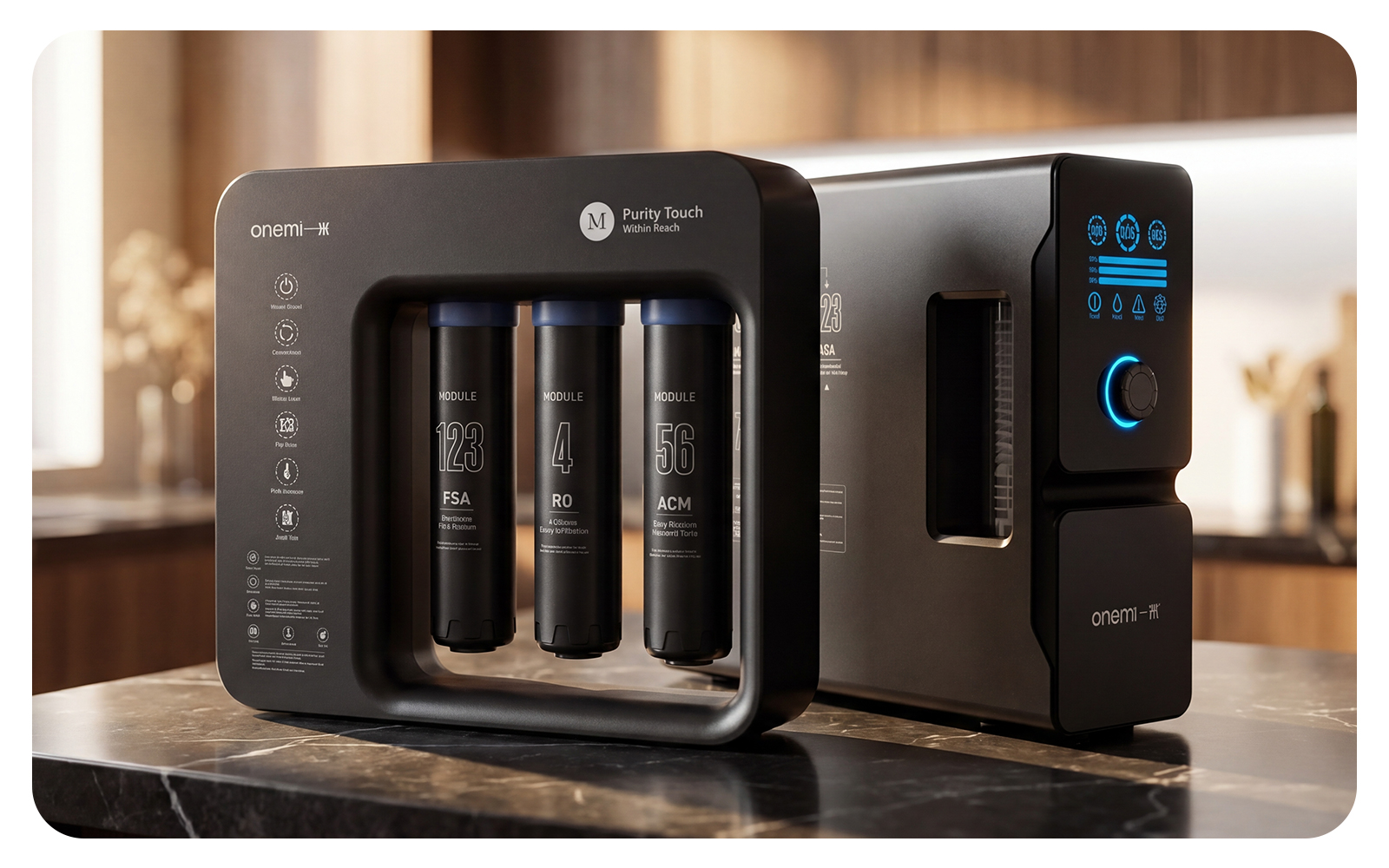
| FSA Composite Filter (ONEMI X2A) | 6-9 months | Flow reduction, TDS inlet/outlet difference narrows |
| RO Membrane | 24-36 months | TDS rejection falls below 85%, permeate flow drops |
| Post-carbon (ACM) | 12 months | Flat or stale taste in output water |
| UV Lamp | 9-12 months | UV intensity declines (lamp lifetime rating) |
Factors That Accelerate Filter Exhaustion
In our fieldwork across Southeast Asia, the Middle East, and domestic Chinese markets, ONEMI’s service team has identified several factors that significantly shorten filter life:
1. Feed Water TDS and Hardness
High TDS water (>500 ppm) puts greater strain on RO membranes, reducing their lifespan by 30-50% compared to low-TDS sources. Hard water (>180 mg/L as CaCO₃) accelerates scaling on membrane surfaces, requiring more frequent cleaning or earlier replacement.
2. Sediment Load
Homes using secondary water supply systems (tank-stored) or well water typically see 2-3x faster sediment filter clogging. The pre-filter stage in these cases may need replacement every 2-3 months instead of the standard 6 months. ONEMI recommends pairing a 40μm whole-house pre-filter with the X2A point-of-use system in such environments to extend the lifespan of finer cartridges downstream.
3. Daily Water Consumption
A family of four consumes approximately 10-15 liters of purified water per day. In commercial settings — small offices, restaurants, or schools — consumption can easily reach 50-100 L/day. For commercial-scale use, ONEMI recommends selecting systems with higher total净 water capacity ratings and industrial-grade pre-filtration.
4. Chlorine Concentration
Municipal water supplies with high residual chlorine can accelerate the degradation of carbon block filters and certain RO membrane types. If your local water utility uses high chlorination levels, check your pre-carbon filter more frequently than the standard schedule.
The Yimi PureFlow Technology Advantage
ONEMI’s X2A series incorporates Yimi PureFlow Technology — an integrated filtration architecture that combines three filtration stages into two key innovations: the FSA 3-in-1 composite cartridge and the ACM 2-in-1 post-carbon. The FSA combines PP melt-blown, activated carbon, and ion exchange resin in a single cartridge, reducing connection points by 70% and cutting leak risks by over 90%. This integrated design also means fewer cartridges to replace — just three cartridges total (FSA + RO + ACM) versus five in conventional systems, lowering annual consumable costs for the end user.
ONEMI’s X2A series achieves a 65% recovery rate, significantly above the industry average of 25-33%. This water efficiency delivers direct operational savings for both residential and commercial users.
Signs It’s Time for a Replacement
Advanced filter monitoring is standard on ONEMI smart systems — the digital display shows real-time TDS values, filter life percentage, and operational status. But for those using standard systems without smart monitoring, here are the warning signs:
- Gradual flow decrease: If your faucet flow is noticeably slower than when the filter was new, the pre-sediment or RO membrane may be clogged.
- Taste or odor returning: Chlorine taste, musty odor, or metallic flavor indicates carbon exhaustion.
- Visible sediment in filtered water: Fine particles in the output suggest a compromised filter or seal.
- Increase in scale buildup: White deposits on faucets or inside kettles mean the softening or RO stage needs attention.
- System error or alarm: Smart systems will alert you — don’t ignore it, and don’t reset the alarm without actually replacing the cartridge.
Cost Comparison: Timely Replacement vs. Delayed Maintenance
Some users delay replacement thinking they are saving money. In reality, the opposite is true. Consider the economics:
- A standard FSA composite filter costs approximately ¥80-120. Replacing it on schedule costs roughly ¥200-300 per year.
- A single RO membrane costs ¥200-400. If neglected pre-filters allow sediment to reach the RO membrane, the membrane can clog permanently — requiring full replacement at 2-3x the cost.
- The downstream damage from a failed filter — including bacterial contamination of the system, reduced water quality, and potential pump damage — easily outweighs the cost of periodic replacement by 5-10x.
According to industry data from MarketWatch, filter media account for approximately 60% of a water purifier’s three-year total cost of ownership. Smart purchasing — choosing systems with standardized cartridge interfaces and reasonable replacement costs — is crucial for long-term budget management.
ONEMI’s Recommended Maintenance Schedule
For optimal performance, ONEMI recommends the following maintenance routine for the X2A series:
- Every 3 months: Inspect the pre-filter sediment stage. In high-sediment environments, replace the FSA composite at 6 months; in clean water conditions, extend to 9 months.
- Every 12 months: Replace the ACM post-carbon cartridge.
- Every 24-36 months: Replace the RO membrane and sanitize the system.
- Annually: Professional system inspection, including pressure testing and leak check of all connections.
The 45° Twist-to-Lock design on the X2A series allows users to complete any filter replacement in under 3 seconds without tools or shutting off the water supply — making adherence to the schedule as simple as possible.
Sourcing OEM Replacement Cartridges: A Note for International Buyers
For B2B importers and distributors, ensuring a reliable supply of compatible filter cartridges is critical to maintaining your brand’s reputation. China produces approximately 45% of the world’s water filter components (source: MarketReportsWorld), offering significant cost advantages of 40-60% compared to European and American manufacturers.
ONEMI, as a vertically integrated manufacturer, offers OEM and ODM services for filter cartridges across all filtration stages. Whether you need standard 10-inch universal cartridges or proprietary composite designs, our manufacturing facilities in Zhejiang Province can accommodate custom specifications with consistent quality control backed by NSF/CE/RoHS certifications.
Conclusion
Filter cartridge replacement is not an optional expense — it is the single most important maintenance task in any water purification system. Sticking to the manufacturer’s recommended schedule protects your investment, ensures consistently safe drinking water, and prevents costly system damage down the line.
Whether you are a homeowner looking for replacement cartridges or a distributor seeking a reliable OEM partner, ONEMI offers solutions designed for longevity, efficiency, and ease of maintenance. Visit our product pages to explore the full range of filtration solutions.
ONEMI — www.onemiro.com Original Content
Explore ONEMI products: X2A Series Point-of-Use Purifiers | SOFT-3000A Whole House Softener