



 한국어
한국어

Three Technologies, One Goal: Clean Water — How to Pick the Right One
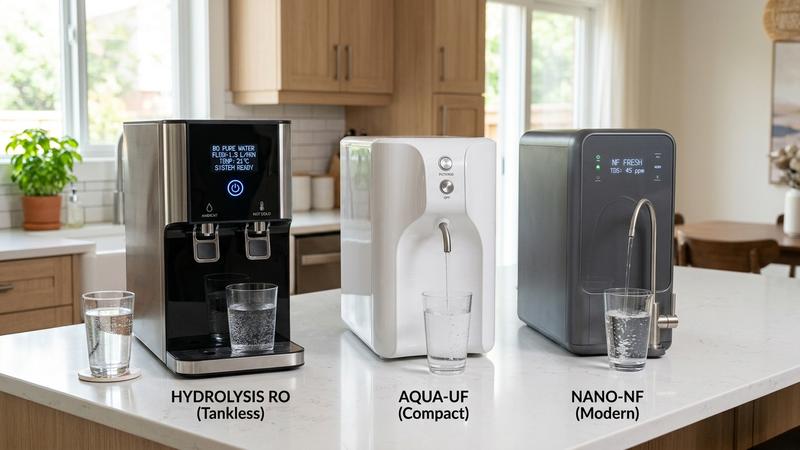
Walk into any home improvement store or browse online for a water filter, and you will hit a wall of acronyms: RO, UF, NF. They all promise clean water, but they work very differently. If you have ever wondered what the difference is and which one your household actually needs, you are in the right place. This guide breaks down each technology in plain terms — covering performance, maintenance, and real-world trade-offs — so you can make a confident decision.
Reverse Osmosis (RO): The Purist’s Choice
Reverse Osmosis is the most thorough filtration technology available for home use. It pushes water through a semi-permeable membrane with pores so tiny (approximately 0.0001 microns) that almost nothing except water molecules gets through.
What it removes: Dissolved solids (TDS), lead, arsenic, fluoride, nitrates, PFAS, microplastics, sodium, chromium, and most other contaminants. An RO system is your best bet if you are looking for a PFAS water filter that meets NSF 58 and NSF 53 certification standards.
What it keeps: Very little. RO delivers water that is nearly identical to distilled water in purity.
Consumer consideration: RO systems produce wastewater — typically 2–4 gallons rejected for every gallon purified, though modern high-efficiency tankless RO systems can achieve a 1:1 ratio. This makes a tankless high-capacity RO system especially appealing for households that want pure water without wasting too much down the drain.
Maintenance tip: Replace your RO membrane every 2–3 years, and pre-filters every 6–12 months. If your water has high sediment or chlorine, pre-filter replacement may be needed more frequently. Always use NSF-certified replacement cartridges to maintain performance.
Ultrafiltration (UF): Mineral-Friendly and Waste-Free
Ultrafiltration uses hollow-fiber membranes with larger pores (approximately 0.01 microns) that block bacteria, viruses, cysts, and suspended solids — but let dissolved minerals and salts pass through.
What it removes: Bacteria, viruses, protozoa (like Giardia and Cryptosporidium), sediment, and larger particles. A UF system is an excellent microplastic water filter for capturing plastic fibers while preserving healthy minerals.
What it keeps: Natural minerals (calcium, magnesium, potassium), dissolved salts, and low levels of some contaminants — which means the water tastes more natural than RO water.
Consumer consideration: UF is perfect if your municipal water is already treated to EPA water standards and you mainly want extra pathogen protection without demineralizing your water. UF systems need no drain line and produce zero wastewater, making them ideal for apartments, rented homes, or anyone concerned about water conservation.
Maintenance tip: UF membranes last longer than RO — typically 2–4 years. Pre-filters need changing every 6–12 months. A simple annual flush with clean water helps extend membrane life. No electricity or pump is required for most UF systems.
Nanofiltration (NF): The Balanced Middle Ground
Nanofiltration sits between RO and UF in the filtration spectrum. Its membranes have pores around 0.001 microns — tight enough to remove heavy metals and larger dissolved solids while letting smaller beneficial minerals through.
What it removes: Heavy metals (lead, copper, cadmium), hardness-causing calcium and magnesium ions (making NF excellent for water softening), larger organic molecules, and some PFAS. A quality NF water filtration system can achieve effective PFAS removal while keeping water tasting mineral-rich.
What it keeps: Smaller dissolved solids, some minerals, and monovalent ions like sodium and potassium. This makes NF water taste noticeably better than RO for many people.
Consumer consideration: NF is gaining popularity in Europe and North America as a “just right” solution for households with moderately hard water who do not want the full demineralization of RO. It is particularly effective for water softening without the salt used in traditional softeners.
Maintenance tip: NF membrane life is similar to RO — about 2–3 years. Pre-filters require the same 6–12 month schedule. Some NF systems incorporate anti-scaling pre-treatment to protect the membrane in hard water areas.
Side-by-Side Comparison
| Factor | RO | UF | NF |
|---|---|---|---|
| Pore Size | 0.0001 µm | 0.01 µm | 0.001 µm |
| Removes TDS / Dissolved Solids | Yes | No | Partial |
| Removes Bacteria + Viruses | Yes | Yes | Yes |
| Removes Heavy Metals | Yes | No | Yes |
| PFAS Removal | Yes (NSF 53) | Partial | Yes |
| Wastewater | 1:1 to 4:1 ratio | None | Very low |
| Retains Minerals | No | Yes | Partial |
| Best Water Source | Well / high-TDS | Treated municipal | Moderately hard water |
| Annual Filter Cost | $80–$150 | $40–$80 | $60–$120 |
How to Choose: A Practical Decision Tree
Before you buy a single filter, test your water first. A simple home test kit can tell you your TDS level, hardness, and whether specific contaminants like lead or PFAS are present.
1. Your TDS is above 500 ppm or you have known heavy metals → RO
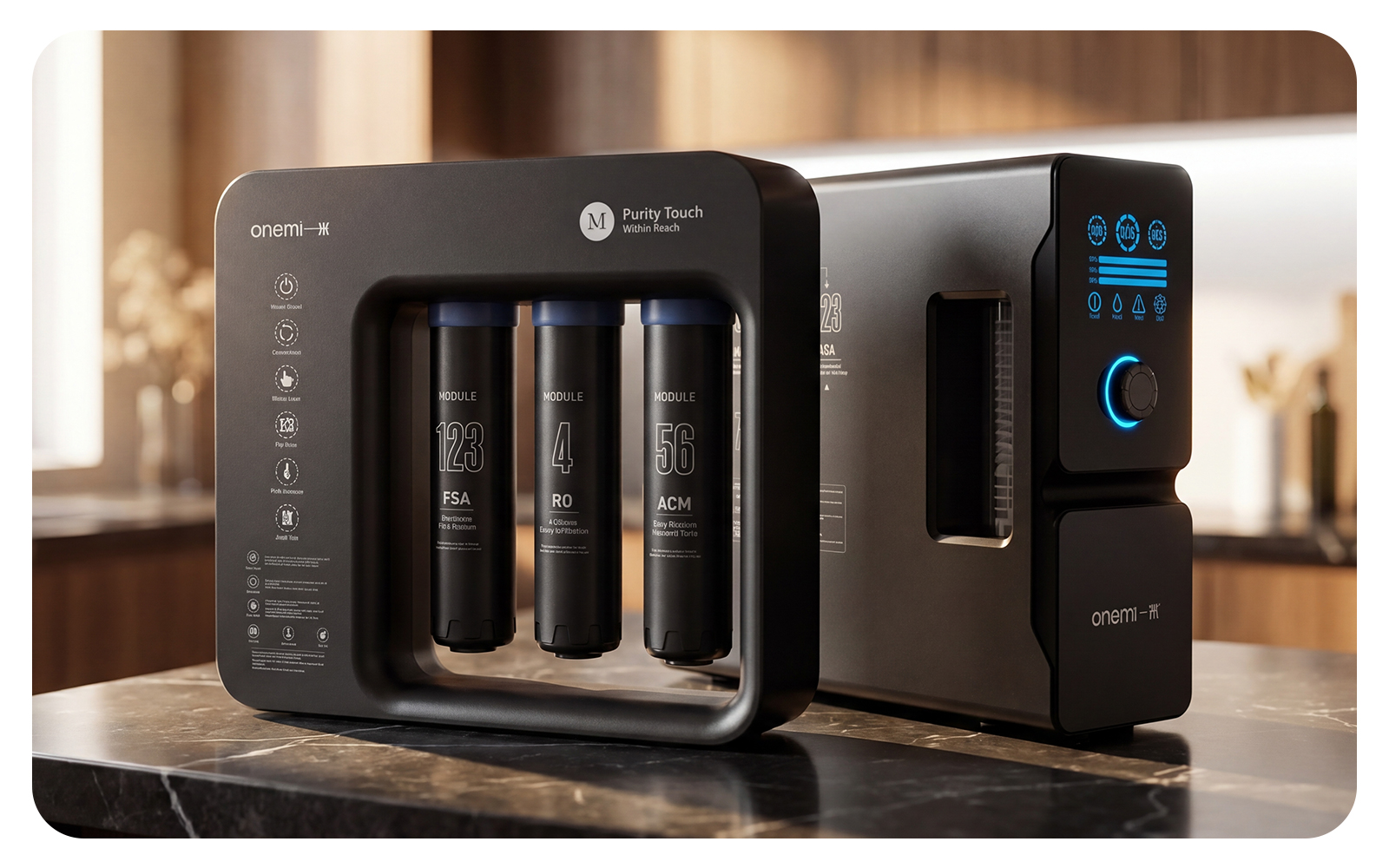
If your well water or municipal supply has elevated lead, arsenic, or nitrates, RO is your only real option. Look for a system with NSF 58 and NSF 53 certification to verify contaminant reduction. ONEMI flagship water purification offers tankless RO designs ideal for high-purity needs with minimal footprint.
2. Your TDS is below 200 ppm and water is municipally treated → UF
If your water is already quite clean and you just want a safety net against pathogens and sediment, UF is cost-effective and low-maintenance. It keeps your water natural mineral profile intact. ONEMI ultra filtration systems are engineered for exactly this use case.
3. You have hard water (150–300 ppm) and want mineral retention → NF
NF removes hardness ions while keeping desirable minerals. It is the sweet spot for households that dislike the flat taste of RO but want better contaminant removal than UF provides.
4. You are on a budget and want simplicity → UF
UF systems have the lowest upfront cost, no wastewater, no electricity, and the longest filter life. For renters or budget-conscious homeowners, UF is hard to beat.
Why Certification Matters
NSF certification is your guarantee that a water filter performs as claimed. The key standards to look for are:
- NSF 42 — Taste, odor, and chlorine reduction
- NSF 53 — Health-related contaminant reduction (lead, PFAS, VOCs, cysts)
- NSF 58 — Reverse osmosis system performance
WQA certification adds another layer of independent verification. Always check that any system you buy carries the appropriate certifications for the contaminants you are targeting. A quality water purifier manufacturer like ONEMI ensures all products meet or exceed these standards.
The ONEMI Difference
As a trusted water purifier manufacturer with over a decade of OEM and ODM experience, ONEMI — a leading water purification equipment manufacturer — delivers certified water filtration system solutions for households across the US and EU markets. Whether you need a compact undersink RO unit, a wastewater-free UF system, or a nanofiltration solution tailored to your local water conditions, ONEMI engineering team can customize every aspect — from membrane selection and flow rate to faucet design and housing materials.
ONEMI serves as a reliable water purifier OEM partner for brands worldwide, offering private labeling, custom packaging, and complete supply chain support. Our tankless high-capacity RO systems are specifically designed for the water purifier for US/EU market, meeting strict regulatory and performance requirements. With NSF, CE, and WQA certifications across our product lines, we help brands enter competitive markets with confidence.
For more insights on choosing the right filtration technology, read our guide on PFAS regulations and compliance standards for 2026.
Final Verdict
There is no universally best technology — only the right one for your water, your budget, and your preferences. RO delivers the highest purity, UF keeps minerals while removing pathogens with zero waste, and NF offers a flexible middle ground. Test your water, match it to the table above, and you will know exactly which system fits.
For homeowners who want the ultimate peace of mind, pairing a whole-house pre-filter with a point-of-use RO or NF system gives you the best of both worlds — protecting fixtures and appliances while delivering premium drinking water at the tap.
Not sure which technology fits your home? Reach out to ONEMI for personalized guidance.
Interested in this product? Click below and our specialist will assist you.
Learn More & Contact Us →[SEO]
focus_keyword: RO vs UF vs NF
seo_title: RO vs UF vs NF: Complete Homeowner’s Buying Guide with Maintenance Tips | ONEMI
seo_description: Compare Reverse Osmosis, Ultrafiltration, and Nanofiltration for home use. Buying guide with maintenance tips and side-by-side comparison by ONEMI.
[/SEO]