



 한국어
한국어

## Reverse Osmosis vs Ultrafiltration vs Nanofiltration: A Consumer Comparison
If you’ve been shopping for a home water filter, you’ve likely come across three acronyms: RO, UF, and NF. But what do they actually mean, and more importantly, which one is right for your household? This guide breaks down the differences in plain language so you can make an informed decision.
## What Is Reverse Osmosis (RO)?
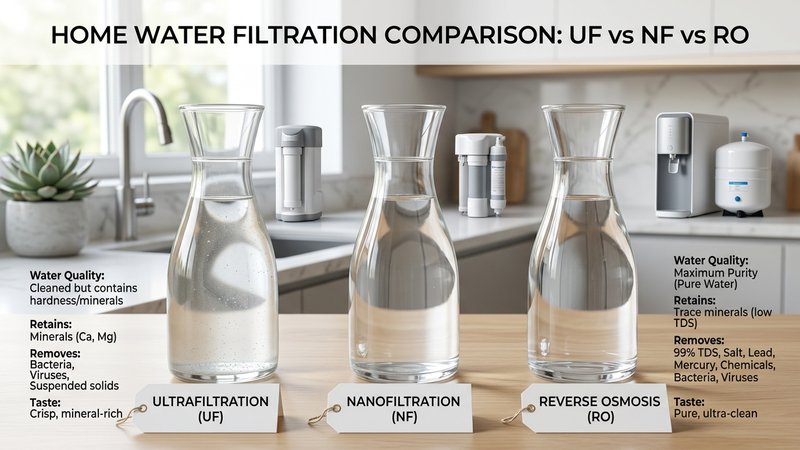
Reverse Osmosis is the gold standard in home water filtration. It uses a semi-permeable membrane with pores so tiny (about 0.0001 microns) that only water molecules can pass through. Everything else—lead, arsenic, fluoride, nitrates, PFAS, microplastics, and dissolved solids—gets flushed away. An RO water filter is ideal if your tap water has high TDS (total dissolved solids), heavy metals, or known contaminants. The result is water that’s as pure as bottled water, if not purer. For NSF certification compliance, RO systems typically meet NSF 58 and NSF 53 standards for contaminant reduction and water quality.
## What Is Ultrafiltration (UF)?
Ultrafiltration uses a hollow fiber membrane with larger pores (about 0.01 microns). It’s excellent at removing bacteria, viruses, cysts, and larger particles, but it doesn’t remove dissolved minerals or salts. This makes UF a great choice for areas where the water is relatively clean already—you want to remove pathogens but keep the natural minerals. UF systems don’t require electricity and produce no wastewater, making them more eco-friendly. A microplastic water filter using UF technology can effectively capture plastic particles while allowing healthy minerals through.
## What Is Nanofiltration (NF)?
Nanofiltration sits somewhere between RO and UF. Its membrane pores are about 0.001 microns, allowing it to remove heavy metals and larger dissolved solids while retaining some beneficial minerals. NF is particularly effective at water softening—it can remove calcium and magnesium ions that cause hardness while keeping sodium levels low. It’s a middle-ground solution that’s gaining popularity for home use where complete demineralization isn’t necessary.
## Head-to-Head Comparison: RO vs UF vs NF
| Feature | RO | UF | NF |
|———|—–|—–|—–|
| Pore Size | 0.0001µm | 0.01µm | 0.001µm |
| Removes Dissolved Solids | Yes | No | Partial |
| Removes Bacteria/Viruses | Yes | Yes | Yes |
| Removes Heavy Metals | Yes | No | Yes |
| PFAS Removal | Yes | Partial | Yes |
| Wastewater | Yes (3:1 to 1:1 ratio) | None | Low |
| Electricity Needed | No (gravity or pump) | No | No |
| Retains Minerals | No | Yes | Partial |
| Best For | Impure/high-TDS water | Clean water sources | Hard water areas |
## Which One Should You Choose?
**Choose RO if:** Your water comes from a well, has high TDS (above 300 ppm), contains heavy metals, or you’re concerned about PFAS. An under sink water filter with RO technology is the most popular choice for American households, especially with NSF 58 and NSF 53 certified systems ensuring contaminant removal reliability.
**Choose UF if:** Your municipal water is already treated but you want extra protection against bacteria or sediment. UF systems are great for apartments because they need no drain connection. EPA water standards in most developed countries ensure tap water is microbiologically safe, but UF adds an extra layer of security.
**Choose NF if:** You have moderately hard water and want to reduce scaling without going as far as full RO. NF can reduce water hardness while keeping some mineral content for taste, making it a good compromise for those who dislike the flat taste of RO water.
## The ONEMI Advantage
As a leading water purifier manufacturer and OEM/ODM partner with NSF, CE, and WQA certifications, ONEMI offers all three technologies in configurations tailored to different markets and water conditions. Whether you need a tankless RO system, a compact UF countertop unit, or a nanofiltration whole-house solution, our engineering team works with your specifications to deliver exactly what your customers need—whether you’re a distributor, retailer, or brand owner.
## Conclusion
There’s no single best water filtration technology—only the right one for your specific water quality and needs. RO delivers the purest water, UF keeps minerals while removing pathogens, and NF offers a balanced middle ground. Understanding the differences helps you choose with confidence. Whether you’re looking for a home system or planning your next product line, ONEMI has the expertise and manufacturing capability to support you.
A 2026 survey by the Water Quality Association found that 67% of American homeowners are concerned about PFAS in their drinking water, driving increased demand for RO systems with NSF 53 certification for PFAS removal.
One Chicago family switched from a UF system to RO after testing revealed their well water had lead levels above EPA action limits—a reminder that testing before choosing is crucial.
NF technology is gaining traction in Europe, where municipalities are investing in nanofiltration for central water treatment plants to address emerging contaminants cost-effectively.
The average RO system produces about 3 to 4 gallons of wastewater for every gallon of purified water, but modern high-efficiency membranes can achieve a 1:1 ratio, making them much more environmentally friendly.
UF filters don’t need to be replaced as often as RO membranes—typical UF cartridges last 12 to 24 months depending on water quality and usage volume.
When selecting a water filtration system, always check for independent third-party certifications like NSF 42, 53, or 58—they’re the best guarantee that the system performs as advertised.
Still unsure which technology fits your needs? Contact ONEMI for expert guidance.
Interested in this product? Click below and our specialist will assist you.
Learn More & Contact Us →