
 한국어
한국어

For procurement professionals sourcing water treatment solutions, the Whole House vs Point-of-Use decision is one of the most consequential architectural choices. It affects not just upfront capital expenditure, but a 5-10 year cascade of installation complexity, maintenance labor, filter replacement cycles, and energy consumption. This analysis provides a data-driven Total Cost of Ownership (TCO) framework to help B2B buyers make informed sourcing decisions.
1. Architectural Overview: Two Fundamentally Different Approaches
A Whole House Water Purification System treats all water entering a property at the point of entry (POE) — typically installed on the main water line after the meter. This means every tap, shower, washing machine, and appliance receives treated water. The system architecture typically includes a sediment pre-filter (40-100μm), a central water softener or conditioner, a large-capacity activated carbon tank (for chlorine/odor removal), and optionally a whole-house RO system for comprehensive purification.
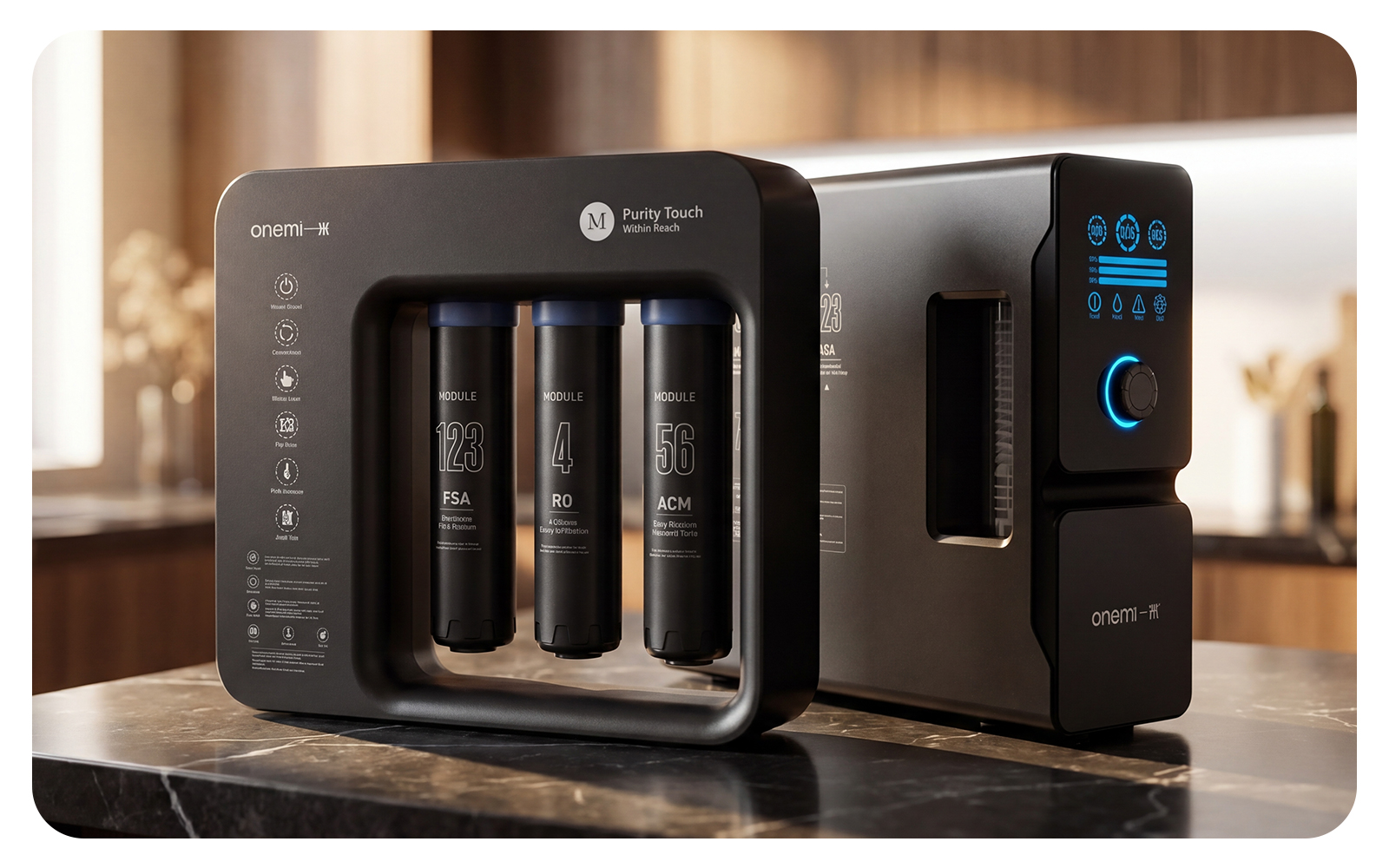
A Point-of-Use (POU) System treats water at individual consumption points — most commonly under the kitchen sink for drinking and cooking water. The architecture is compact: a multi-stage filtration cascade (PP sediment → activated carbon → RO membrane → post-carbon polishing) housed in a single under-sink unit. POU systems typically handle 50-100 GPD (gallons per day), sufficient for a household’s drinking and cooking needs but inadequate for whole-property coverage.
The core trade-off is coverage versus cost efficiency. A POE system provides universal protection but at significantly higher equipment and installation costs. A POU system delivers targeted purification where it matters most — drinking water — at a fraction of the upfront investment.
2. Installation Cost Breakdown
Installation costs are often the most underestimated line item in water treatment procurement. For a standard single-family residential property:
| Installation Component | Whole House System | Point-of-Use System |
|---|---|---|
| Equipment cost (mid-range) | $2,500 – $5,000 | $300 – $800 |
| Professional installation labor | $800 – $2,000 | $150 – $400 |
| Plumbing modifications | Main line cut + bypass loop | Under-sink tee connection |
| Electrical requirements | Dedicated circuit (some models) | Standard outlet |
| Drain line installation | Floor drain or standpipe | Under-sink drain saddle |
| Space requirement | 4-6 sq ft floor space | Under-sink cabinet |
| Total Installation Cost | $3,300 – $7,000 | $450 – $1,200 |
For multi-unit residential or light commercial applications, the cost differential widens dramatically. A 20-unit apartment complex choosing whole-house treatment needs a commercial-grade system with 10-20 GPM flow rate capacity, costing $15,000-$40,000 installed. The same complex choosing individual POU units (one per apartment) would spend approximately $9,000-$24,000 (20 × $450-$1,200), though ongoing filter maintenance for 20 separate units introduces significant operational complexity.
3. Five-Year TCO Analysis: The Numbers That Matter
Below is a comprehensive 5-year TCO comparison for a mid-range residential installation. All figures in USD.
| TCO Component | Whole House (5-Year) | Point-of-Use (5-Year) |
|---|---|---|
| Equipment + Installation | $5,000 | $800 |
| Sediment filter replacement (every 6-12 months) | $400 ($40 × 10) | $80 ($8 × 10) |
| Carbon filter replacement (every 12-18 months) | $600 ($120 × 5) | $150 ($30 × 5) |
| RO membrane replacement (every 24-36 months) | $800 ($400 × 2) | $200 ($100 × 2) |
| Water softener salt (if applicable) | $600 ($10/month × 60) | N/A |
| Energy consumption | $250 ($50/year) | $75 ($15/year) |
| Maintenance labor | $500 ($100/year) | $100 ($20/year) |
| Wastewater cost (RO reject) | $300 ($60/year) | $50 ($10/year) |
| 5-Year Total Cost of Ownership | $8,450 | $1,455 |
| Monthly Equivalent Cost | $141/month | $24/month |
The 5-year TCO differential is approximately 5.8× — a significant gap that procurement teams must weigh against the broader benefits of whole-house coverage. However, this analysis assumes a single POU unit serving one kitchen. Properties requiring multiple POU installations (kitchen, wet bar, secondary dwelling unit) will see proportionally higher costs.
4. Decision Framework: When to Choose Which
Choose Whole House (POE) when:
- Source water has high sediment, iron, or hardness levels that damage plumbing and appliances
- Property value exceeds $500,000 — whole-house treatment is increasingly expected in premium real estate
- Residents have skin sensitivities or eczema that benefit from chlorine-free bathing water
- Multiple bathrooms and high simultaneous water usage requirements
- Long-term ownership horizon (7+ years) to amortize the upfront investment
Choose Point-of-Use (POU) when:
- Primary concern is drinking/cooking water quality only
- Budget constraints or rental property (portable/temporary installation)
- Limited mechanical room space
- Municipal water supply with acceptable hardness and sediment levels
- Short-to-medium ownership horizon or multi-unit properties with decentralized management
5. B2B Procurement Checklist: 7 Dimensions to Evaluate
When sourcing water purification systems for wholesale, distribution, or project integration, procurement professionals should evaluate suppliers across these seven dimensions:
- Certification Portfolio: NSF/ANSI 42, 53, 58, 372 are baseline requirements. For export to specific markets, verify compliance with EU CE, UK WRAS, Australia WaterMark, and Saudi SASO as applicable.
- Customization Capability: Can the manufacturer customize flow rates, filter configurations, and branding/packaging for your market segment?
- FOB Pricing Tiers: Request pricing across volume tiers (100/500/1000/5000 units). The gap between 100-unit and 1000-unit pricing should be at least 15-25%.
- Warranty and After-Sales: Minimum 1-year warranty on electronics, 3-5 years on housing. Verify spare parts availability and technical support response time.
- Lead Time and MOQ: Standard lead time should be 15-30 days. MOQ for OEM/ODM typically starts at 50-100 units.
- Documentation Package: Ensure the supplier provides full technical datasheets, installation manuals in your target languages, and MSDS for filter media.
- Factory Audit Readiness: The manufacturer should be open to third-party factory audits (SGS, Bureau Veritas, TÜV) without requiring advance notice beyond standard scheduling.
ONEMI has supplied water purification systems to over 40 countries since 2010. The company’s Yimi PureFlow Technology ensures consistent membrane performance across both whole-house and point-of-use product lines, with NSF/ANSI 58 certified RO membranes achieving 97-99% rejection rates. For B2B buyers evaluating the whole-house vs point-of-use decision from a procurement perspective, ONEMI offers both product categories with flexible OEM/ODM arrangements — explore our Whole House Series and Point-of-Use Series for detailed specifications.
For procurement teams managing diverse property portfolios — from single-family rentals to multi-unit residential complexes — the whole-house vs point-of-use calculus is rarely binary. A hybrid approach often delivers the optimal balance: whole-house sediment and carbon filtration at the POE to protect plumbing infrastructure, combined with point-of-use RO systems at kitchen taps for premium drinking water quality. This layered strategy leverages the strengths of each architecture while mitigating their respective limitations.
For procurement specialists managing diverse property portfolios — from single-family rentals to multi-unit residential complexes — the whole-house vs point-of-use calculus is rarely clear-cut. A hybrid approach often delivers the optimal balance: whole-house sediment and carbon filtration at the POE to protect plumbing infrastructure, combined with point-of-use RO systems at kitchen taps for premium drinking water quality. This tiered strategy leverages the strengths of each architecture while mitigating their respective limitations.
ONEMI — www.onemiro.com Original Content