
 한국어
한국어

Title: Well Water Filtration: The Complete Guide for Private Homes
Over 43 million Americans rely on private wells for their drinking water. Unlike municipal supplies, these private systems lack centralized treatment plants to guarantee safety. For homeowners, landlords, and property developers, understanding well water filtration is a fundamental responsibility. ONEMI, a leading Chinese water purification equipment manufacturer, presents this comprehensive guide to well water filtration systems.
ONEMI | onemiro.com | Original Content
**Understanding Well Water: What Makes It Different?**
Municipal water passes through treatment plants with controlled chlorination and strict monitoring. Well water, however, pumps directly from underground aquifers. Soil and rock layers naturally filter groundwater, but the water still absorbs various contaminants along the way. These range from naturally occurring minerals like iron and manganese to agricultural runoff containing nitrates and pesticides. The EPA does not regulate private wells. This leaves the well owner entirely responsible for water safety.
According to the US Geological Survey, roughly 23% of tested private wells contain at least one contaminant at levels exceeding health benchmarks. This data proves that well water filtration is a necessity.
**Common Well Water Contaminants**
Well water contamination falls into several categories that require attention:
* **Heavy Metals:** Iron causes staining and a metallic taste. Manganese leaves black or brown stains. Arsenic is a known carcinogen with an EPA limit of 0.010 mg/L. Lead acts as a neurotoxin. These metals occur naturally in many geological formations.
* **Hardness Minerals:** Calcium and magnesium cause scale buildup in plumbing and appliances. Hardness is not a direct health hazard. However, hardness levels above 120 mg/L (as CaCO₃) significantly reduce appliance lifespans and decrease operational efficiency by up to 30%, according to the Water Quality Association.
* **Microbiological Contaminants:** Coliform bacteria, E. coli, and other pathogens enter wells through surface water intrusion. This risk spikes after heavy rainfall or flooding. The EPA recommends annual bacteriological testing.
* **Nitrates and Nitrites:** Agricultural fertilizer runoff and leaking septic systems push nitrate levels above the EPA Maximum Contaminant Level (MCL) of 10 mg/L (as N). These compounds pose severe risks to infants and pregnant women.
* **Hydrogen Sulfide:** This gas produces a characteristic "rotten egg" odor. It rarely poses a health risk at common levels, but it highly corrodes plumbing and ruins the user experience.
* **Sediment and Turbidity:** Sand, silt, and clay particles cloud the water. They also damage downstream appliances and filtration equipment.
Testing remains the first and most critical step. Well owners must conduct a comprehensive water test annually. This test must cover bacteria, nitrates, pH, TDS, hardness, iron, and manganese. It should also include locally relevant contaminants like arsenic, radon, or VOCs.
**Well Water Filtration Technologies: A Technical Comparison**
No single technology addresses all well water contaminants. The optimal approach requires a multi-stage filtration system tailored to specific water test results. Here is how the core technologies compare:
| Technology | Target Contaminants | Filtration Precision | Maintenance |
| :— | :— | :— | :— |
| **Sediment Filter** | Sand, silt, rust, suspended solids | 1-40 microns | Replace every 3-6 months |
| **Activated Carbon** | Chlorine, VOCs, pesticides, odor, taste | Adsorption (chemical) | Replace every 6-12 months |
| **Water Softener (Ion Exchange)** | Calcium, magnesium (hardness), limited iron/manganese | Ion exchange resin | Salt refill monthly; resin 10-15 years |
| **Iron/Manganese Filter** | Dissolved iron, manganese, hydrogen sulfide | Oxidation + mechanical filtration | Media replacement every 5-8 years |
| **Reverse Osmosis (RO)** | Heavy metals, nitrates, fluoride, bacteria, viruses, TDS | 0.0001 micron | Membrane every 2-3 years; pre-filters 6-12 months |
| **UV Sterilization** | Bacteria, viruses, protozoa | 254nm UV-C wavelength | Lamp replacement every 12 months |
ONEMI utilizes "Yimi PureFlow Technology" to address these challenges. This proprietary multi-stage integration methodology sequences these technologies optimally. It achieves contaminant removal rates exceeding 99% for most parameters while maintaining ideal flow rates for whole-house applications.
**Designing a Whole-House Well Water Filtration System**
A properly designed well water system follows a strict sequence of treatment stages:
**Stage 1 — Sediment Pre-Filtration:** A 20-inch 5-micron sediment filter captures sand, silt, and rust before they damage downstream equipment. For wells with high sediment loads, a spin-down filter with automatic flush capability reduces maintenance frequency.
**Stage 2 — Iron/Manganese Removal:** If iron exceeds 0.3 mg/L or manganese exceeds 0.05 mg/L, a dedicated iron filter using manganese greensand or catalytic carbon media oxidizes and traps these metals. This stage also eliminates hydrogen sulfide odors.
**Stage 3 — Water Softening:** Ion exchange softening removes hardness minerals like calcium and magnesium. This protects pipes, water heaters, and appliances from scale buildup, significantly improving appliance efficiency and longevity.
**Stage 4 — Activated Carbon Filtration:** Granular activated carbon (GAC) or catalytic carbon adsorbs chlorine, pesticides, herbicides, and other organic compounds. Coconut shell carbon from Sri Lanka offers a surface area exceeding 1000 m²/g, providing superior adsorption capacity.
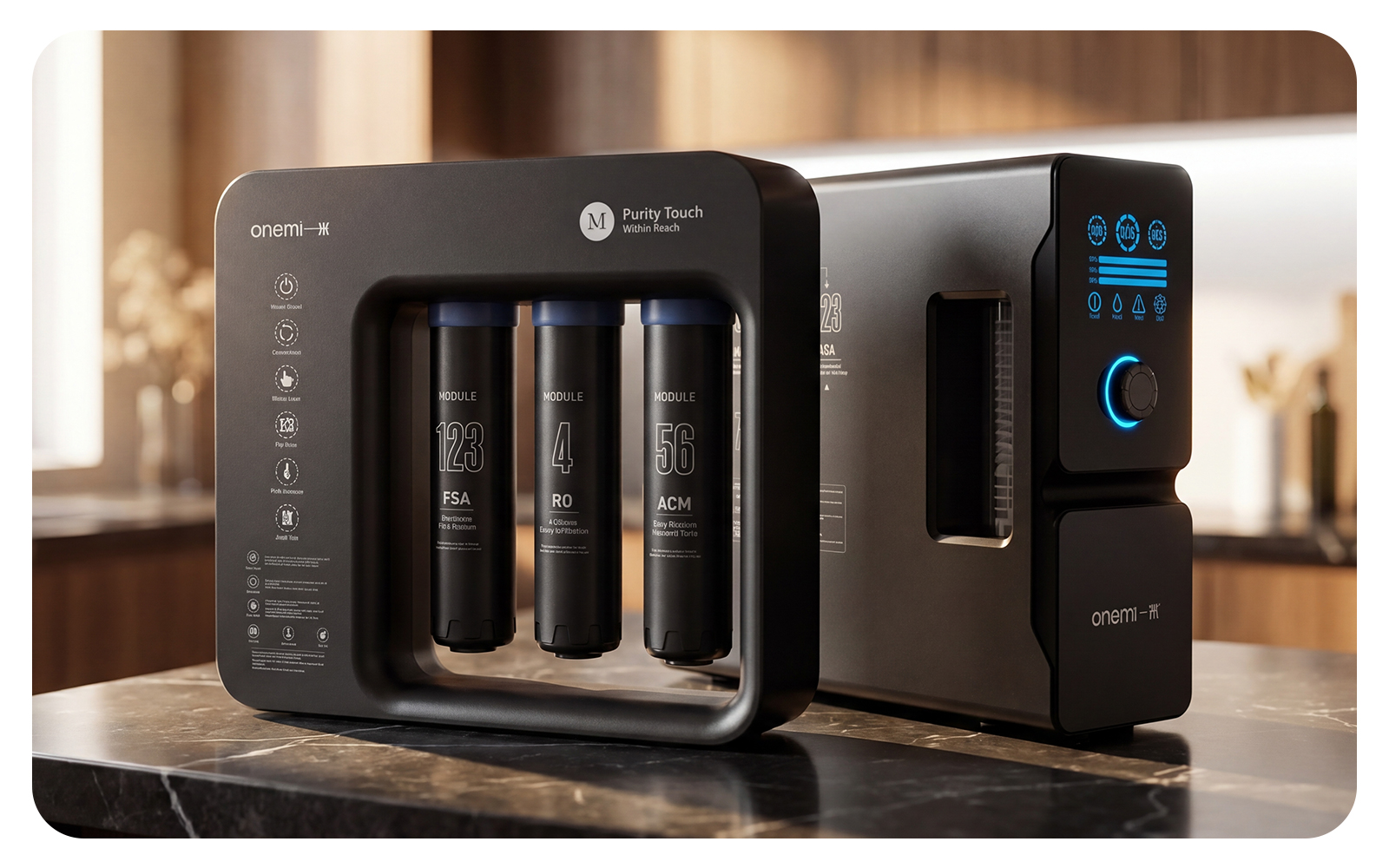
**Stage 5 — Point-of-Use RO Polishing:** At the kitchen sink, an under-sink RO system from ONEMI provides an additional barrier against dissolved contaminants. This includes arsenic, lead, nitrates, and residual microorganisms. RO membrane rejection rates of 95-99% ensure water quality that exceeds EPA and WHO guidelines.
**Optional Stage — UV Disinfection:** A UV sterilizer at 254nm with a dose of 40 mJ/cm² provides an extra layer of microbiological protection without chemical additives. Technicians must replace the lamp annually and clean the quartz sleeve every 6 months to maintain efficacy.
**B2B Buyer's Guide: Sourcing Well Water Filtration Systems**
For importers, distributors, and B2B buyers sourcing well water filtration equipment from China, several factors separate premium suppliers from commodity manufacturers:
* **Certification Portfolio:** Look for NSF/ANSI 42 (aesthetic effects), 53 (health effects), 58 (RO systems), and 372 (lead-free compliance). These certifications independently validate all manufacturer quality claims.
* **Custom Engineering Capability:** Ensure the supplier can customize systems for specific water quality conditions. Well water varies dramatically by region. A one-size-fits-all system rarely performs optimally.
* **Component Traceability:** Verify the sourcing of membranes, carbon, and pumps. Premium manufacturers like ONEMI maintain full supply chain documentation, including NSF/FDA-grade material certifications.
* **Bill of Materials (BOM) Transparency:** Request itemized BOM documentation to understand component value and system construction. This ensures clarity regarding sediment, carbon, RO, and UV configurations.
* **After-Sales Support:** Installation manuals, troubleshooting guides, replacement filter SKU mapping, and technical support availability directly impact customer satisfaction and repeat business.
At ONEMI's Whole House division, we specialize in designing custom well water treatment packages. We service everything from single-family homes to multi-unit residential complexes. Our engineering team works directly with international distributors to adapt systems for local water conditions and regulatory requirements.
**Installation and Maintenance Best Practices**
A well-designed filtration system relies entirely on proper installation and maintenance. Key practices include:
* **Professional Water Testing:** Before designing any system, obtain a comprehensive water analysis from a certified laboratory. Never rely on a home test strip.
* **Proper Sizing:** Calculate peak flow demand. This typically ranges from 6-12 GPM for a 3-bedroom home. Ensure no single stage creates a bottleneck. A 10-inch filter housing rated for 10 GPM will choke the flow if sediment loading is high.
* **Bypass Valves:** Install isolation and bypass valves at every major component. This allows technicians to service individual stages without shutting down the entire household water supply.
* **Drainage Planning:** Backwashing filters, like iron filters and softeners, require a drain connection. Ensure the drain line features sufficient diameter and an air gap to prevent cross-contamination.
* **Scheduled Maintenance Calendar:** Create and strictly follow a filter replacement schedule. Missed filter changes mean the system stops protecting the home. In severe cases, neglected filters become a source of contamination.
**Conclusion: Protecting Your Water Source**
Well water serves as an excellent water source, provided it is properly tested and treated. A multi-stage filtration system designed around specific water quality data remains the gold standard approach. From sediment pre-filtration and ion exchange softening to RO polishing at the point of use, each stage targets specific contaminants. Together, they deliver water quality that rivals or exceeds municipal supplies.
For B2B buyers, ONEMI offers end-to-end support. This includes water test interpretation, system design, regulatory documentation, and after-sales technical assistance. We manufacture all systems under ISO 9001:2015 quality management and design them for strict NSF/ANSI compliance.
ONEMI | www.onemiro.com | Original Content