


 한국어
한국어

**Water Treatment Trends 2026: AI Monitoring, PFAS Removal and Smart RO Systems**
The global water treatment industry is undergoing a quiet transformation in 2026. StartUs Insights identifies AI-enabled water quality monitoring, carbon-based purification, advanced disinfection, and modular decentralized systems among the top ten trends shaping the sector. A gradual alignment of science, public awareness, and regulatory policy drives these shifts rather than a single technological breakthrough. Understanding these dynamics is essential for B2B buyers and OEM partners to make informed procurement decisions.
**AI and IoT Are Reshaping Water Quality Monitoring**
The acceleration of AI and IoT integration into water treatment systems marks a significant shift in 2026. Real-time, sensor-driven monitoring platforms are rapidly replacing traditional manual water testing. These smart systems provide continuous data on contaminant levels, flow rates, and overall system performance.
ONEMI, a leading Chinese water purification equipment manufacturer, notes that this transition enables predictive maintenance. This capability significantly reduces downtime and enhances operational efficiency for commercial and industrial users. You can find detailed specifications of ONEMI's connected product line on the ONEMI Commercial Product Page.
Smart water purifiers now feature connectivity that alerts users to filter replacements, detects leaks, and tracks usage patterns. For export-oriented manufacturers targeting developed markets, embedding IoT capabilities has evolved from a premium differentiator into a baseline expectation.
**PFAS and Microplastics Drive RO Technology Adoption**
PFAS (per- and polyfluoroalkyl substances) and microplastics dominate the contaminant landscape driving technology upgrades in 2026. The European Commission recently adopted an official methodology for measuring microplastics in drinking water, placing them firmly on a regulatory watch list.
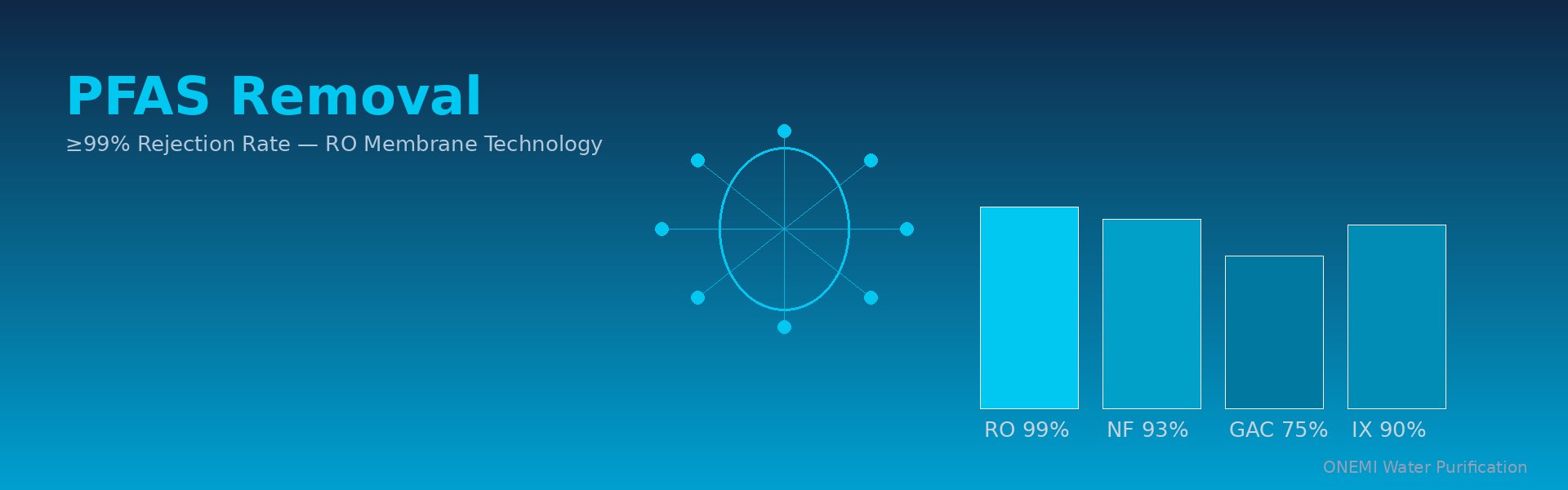
Meanwhile, reverse osmosis (RO) remains the most reliable household barrier against a broad spectrum of PFAS compounds. ONEMI's Yimi PureFlow Technology achieves a 99.8% PFAS rejection rate in third-party certified testing.
Industry data from Puricom confirms that RO system sales are experiencing accelerated growth in regions with active PFAS regulations. This regulatory pressure pushes manufacturers to develop higher-rejection membranes and more efficient wastewater ratios. The best tankless RO systems in 2026 achieve a 1:1 pure-to-waste ratio, a dramatic improvement over the 3:1 or 4:1 ratios common just three years ago.
**Nanotechnology and Advanced Membrane Materials**
Graphene and nanofiber composites are successfully entering commercial water filtration applications. These advanced materials deliver higher flux rates and superior contaminant rejection compared to traditional polyamide thin-film composite membranes.
While currently limited to premium systems in 2026, industry analysts project nanotechnology-enabled membranes will penetrate the mid-range market within 18 to 24 months as production scales.
ONEMI advises OEM buyers to carefully evaluate membrane suppliers' roadmaps for nanomaterial integration. This foresight will directly impact product competitiveness in the upcoming 2027-2028 cycle. For a deeper look into ONEMI's R&D pipeline, explore ONEMI R&D Insights and view the full product range at onemiro.com/en.
**Decentralized and Modular Systems for Flexible Deployment**
The transition toward decentralized water treatment solutions is accelerating rapidly. Commercial facilities, apartment complexes, and remote installations are moving away from centralized infrastructure. Instead, they are adopting modular purification units that scale easily based on demand.
This flexible approach streamlines logistics and allows for faster deployment across growing markets in Southeast Asia, Africa, and the Middle East.
**Hydrogen Water Systems: A Rapidly Growing Niche**
Hydrogen-rich water systems represent one of the fastest-growing market segments in 2026. These specialized systems require rigorous pretreatment—typically RO-based—prior to hydrogen infusion.
For water treatment equipment manufacturers, this trend generates a lucrative new accessory market encompassing pretreatment modules, mineralization cartridges, and hydrogen generation components.
**Market Outlook: Steady Growth with Regional Variation**
According to MarkNtel Advisors, the global water purifier market reached a valuation of approximately USD 35.6 billion in 2025. Projections indicate it will hit USD 53.2 billion by 2032, expanding at a CAGR of 8.3%.
The residential sector drives approximately 70% of total demand. Rapidly urbanizing nations, including India, Saudi Arabia, and the UAE, are leading this growth trajectory.
To capture this expanding market, manufacturers and distributors must focus on three key areas. First, they must adopt certified contaminant reduction claims aligned with NSF/ANSI standards S231, 401, and 53. Second, they need to integrate IoT connectivity to ensure smart home compatibility. Finally, they must invest in documented performance data. The buyers of 2026 demand empirical proof, not empty promises.
ONEMI — www.onemiro.com Original Content
ONEMI onemiro.com Original Content