
 한국어
한국어

**Water Softener vs RO: A Technical Comparison Guide for B2B Water Treatment Buyers**
When businesses evaluate water treatment options, one question surfaces repeatedly: Should we install a water softener or a reverse osmosis (RO) system? The answer depends entirely on your specific water quality challenges and end-use applications.
ONEMI—a leading water purification equipment manufacturer—has helped hundreds of B2B clients across 40+ countries navigate this exact decision. This guide breaks down the technical differences, practical applications, and procurement specifications to help you make an informed choice.
**1. How a Water Softener Works: Ion Exchange Explained**
A water softener targets one specific problem: hard water. Dissolved calcium (Ca²⁺) and magnesium (Mg²⁺) ions cause hardness. These minerals create scale buildup in pipes, reduce soap efficiency, and leave white residue on fixtures.
The softening process relies on ion exchange resin beads charged with sodium (Na⁺) or potassium (K⁺) ions. As hard water passes through the resin bed, calcium and magnesium ions swap places with the sodium ions. This prevents scale formation. However, the total dissolved solids (TDS) remains roughly the same because the system simply exchanges one dissolved ion for another.
Key specifications for B2B buyers:
* Resin capacity: typically 1–4 cubic feet for commercial units
* Flow rate: 5–50 GPM depending on tank size
* Regeneration cycle: time-based or meter-based (meter-based saves 30–40% on salt)
* Salt consumption: 6–15 lbs per regeneration cycle
A water softener does not remove contaminants. It only addresses hardness. The system will not filter out chlorine, heavy metals, bacteria, viruses, PFAS, or microplastics. That requires RO.
**2. How an RO System Works: Membrane Filtration at 0.0001 Microns**
Reverse osmosis forces water through a semi-permeable membrane with pores approximately 0.0001 microns in diameter. This is about 100 times finer than an ultrafiltration membrane. At this scale, the RO membrane rejects:
* Dissolved salts (sodium, chloride, calcium, magnesium) — 95–99% rejection
* Heavy metals (lead, arsenic, chromium VI, mercury)
* Bacteria and viruses
* Organic compounds (pesticides, pharmaceuticals, industrial solvents)
* PFAS and microplastics
A standard commercial RO system features multiple pre-treatment stages. These typically include sediment filtration, activated carbon for chlorine removal (as chlorine degrades RO membranes), and an antiscalant injection system to protect the membrane. The RO membrane acts as the final barrier. It separates the feed water into permeate (purified water) and concentrate (the reject stream containing concentrated impurities).
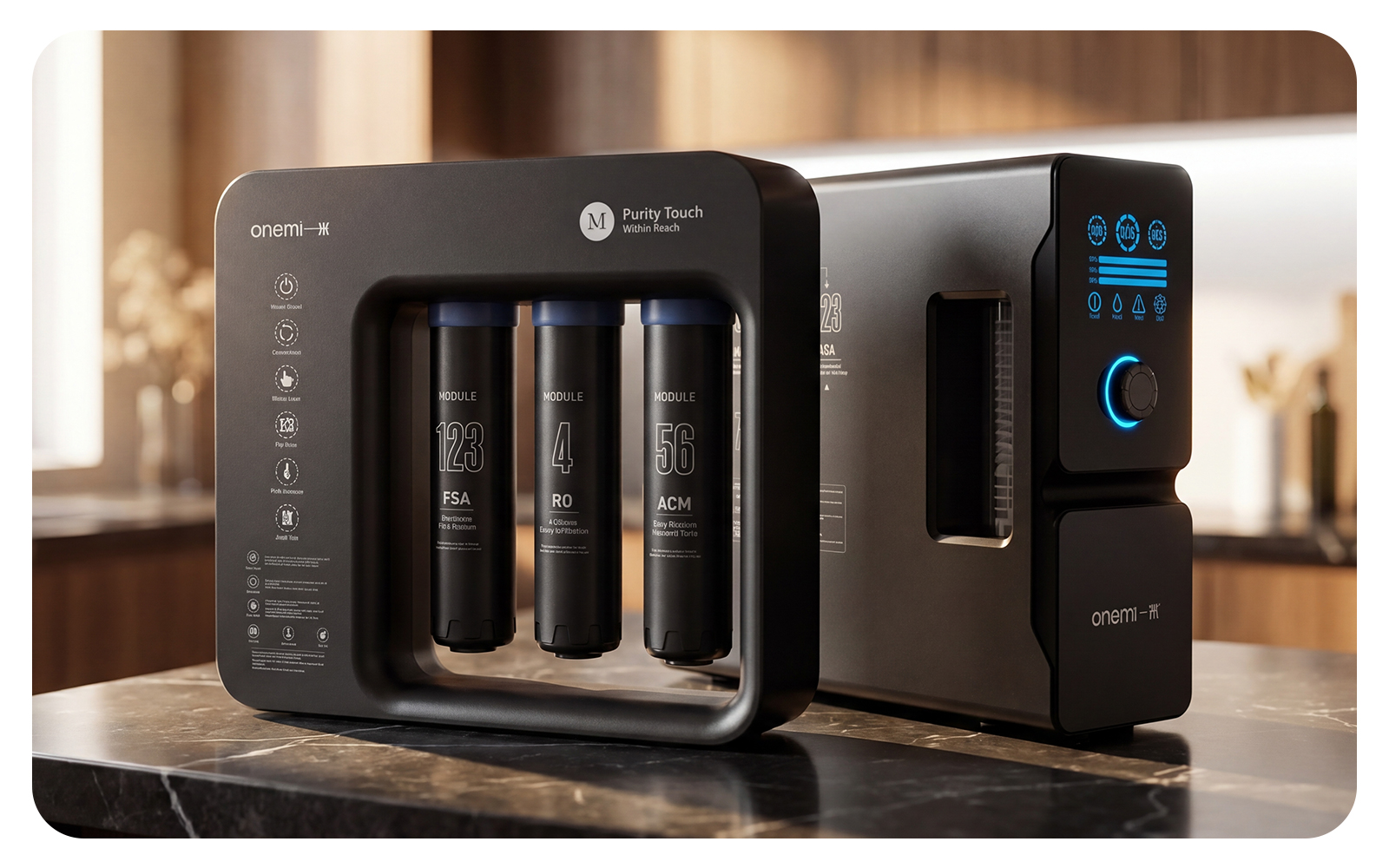
Modern tankless RO systems from ONEMI achieve recovery rates of 65–70%. This represents a massive upgrade over older tank-style residential units that only hit 25–33%. This efficiency minimizes drain waste, driven by optimized membrane element design and precisely controlled pump pressure curves.
**3. Head-to-Head Comparison: Water Softener vs RO**
| Parameter | Water Softener | RO System |
| :— | :— | :— |
| **Primary target** | Calcium & magnesium (hardness) | All dissolved solids, contaminants |
| **Filtration mechanism** | Ion exchange (Na⁺ swaps Ca²⁺/Mg²⁺) | Membrane rejection (physical barrier) |
| **Pore size** | N/A (chemical process) | ~0.0001 micron |
| **TDS after treatment** | Roughly unchanged | Reduced by 95–99% |
| **Removes bacteria/virus?** | No | Yes |
| **Removes heavy metals?** | No | Yes |
| **Removes chlorine/chloramine?** | No (some models add carbon pre-filter) | Yes (carbon pre-treatment stage) |
| **Wastewater?** | Only during regeneration (~50–150 gal per cycle) | Continuous concentrate stream (20–35% of feed) |
| **Maintenance** | Refill salt monthly, resin replacement every 8–12 years | Replace filters every 6–12 months, membrane every 2–5 years |
| **Typical applications** | Whole-house scale prevention, laundry, boiler feed | Drinking water, food processing, pharmaceutical, laboratory |
**4. When to Use Which — and When to Use Both**
Choose a water softener if:
* Your primary complaint is scale buildup on fixtures, pipes, and water-using appliances
* You want to extend the lifespan of water heaters, dishwashers, and laundry equipment
* Soap lathering and laundry results are your main concern
* You have a separate drinking water solution (bottled, point-of-use RO, etc.)
Choose an RO system if:
* You need purified water for drinking, cooking, or sensitive processes
* Your water source contains elevated TDS, heavy metals, or organic contaminants
* You operate customer-facing businesses (restaurants, coffee shops, hotels) where water taste is critical
* Your application requires water meeting USP, ASTM, or CLSI standards (pharma, lab, medical)
Use both in series for optimal results. Many B2B installations pair a water softener upstream of an RO system. Hard water destroys RO membranes. Calcium carbonate scale precipitates on the membrane surface, reducing flux rates and shortening membrane life. By removing hardness first, the softener protects the RO membrane. This reduces cleaning frequency and typically improves RO membrane lifespan by 20–40%.
This paired configuration is standard practice in commercial kitchens, hotel water systems, dialysis clinics, semiconductor manufacturing, and boiler feed water treatment facilities.
**5. B2B Procurement Checklist: What to Specify**
When sourcing water treatment equipment from a manufacturer, provide these specifications to receive an accurate quotation:
For water softeners:
* Feed water hardness (in grains per gallon or mg/L as CaCO₃)
* Peak flow rate requirement (GPM)
* Daily water consumption (gallons)
* Available floor space and ceiling height
* Drain accessibility for regeneration discharge
* Electrical supply: voltage and phase
For RO systems:
* Feed water TDS and temperature range
* Target permeate quality (conductivity or TDS)
* Required permeate flow rate (GPD or m³/day)
* Pre-treatment needs (does feed water contain iron, manganese, silica?)
* Sanitization requirements (hot water sanitizable? chemical clean-in-place?)
* Certifications needed: NSF/ANSI 58, CE, WQA, ISO 9001
**6. ONEMI as Your Manufacturing Partner**
ONEMI manufactures a comprehensive range of water treatment equipment at our ISO 9001-certified facility. Our B2B product lines include:
* **Commercial RO Systems:** 200–10,000 GPD configurations, available in cabinet, wall-mounted, and skid-mounted formats
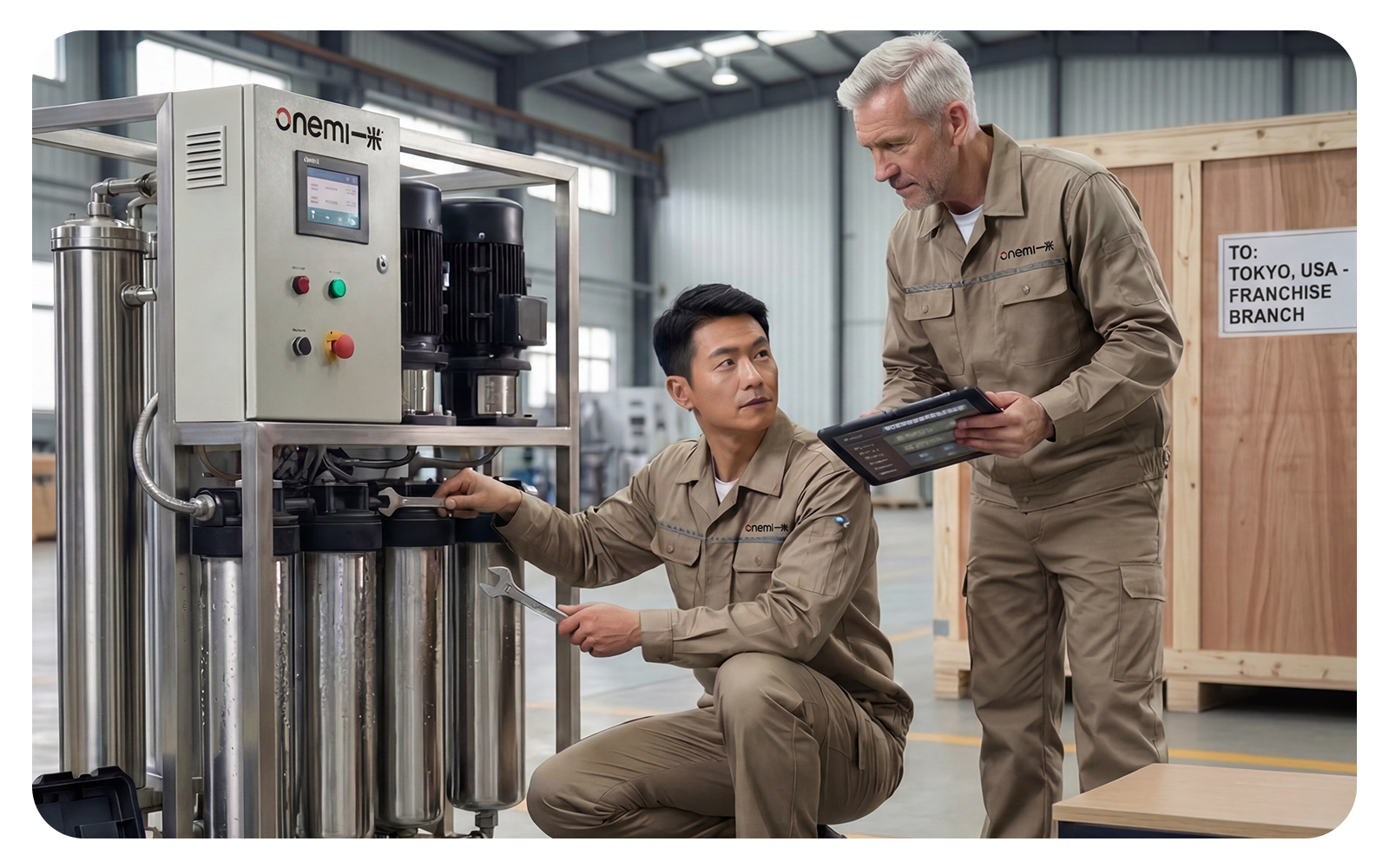
* **Industrial RO Plants:** Custom-engineered systems from 1 m³/hr to 100 m³/hr, with full PLC automation and remote monitoring
* **Water Softeners:** FRP and stainless steel vessels from 10"×54" to 36"×72", utilizing Fleck or Runxin control valves
* **Pre-treatment Systems:** Multimedia filters, activated carbon filters, iron removal filters, and dosing systems
* **Core Precision Components:** RO membrane elements, high-pressure pumps, FRP membrane housings, and cartridge filter housings
Every system ships with a complete documentation package. This includes P&ID diagrams, installation manuals, O&M manuals, and material certificates. We fully support OEM/ODM branding, incorporating your company logo, color scheme, and product naming.
***
ONEMI — www.onemiro.com Original Content. Specifications listed are for reference. Please consult the ONEMI engineering team for project-specific recommendations.
ONEMI onemiro.com Original Content
Yimi PureFlow Membrane Tech AquaDefender NanoSeal