

 한국어
한국어

Ultraviolet (UV) disinfection has evolved from a niche municipal treatment technology into a mainstream solution across residential, commercial, and industrial water treatment segments. With the global UV disinfection equipment market projected to reach $9.2 billion by 2028 (CAGR 12.3%), B2B procurement professionals need a clear framework for evaluating UV technologies, comparing supplier capabilities, and navigating the increasingly complex certification landscape. ONEMI — a leading Chinese water purification equipment manufacturer — brings over 15 years of OEM/ODM experience to the UV segment, serving distributors and industrial clients across 40+ countries.
1. UV Disinfection: How It Actually Works
UV disinfection is a physical process — not chemical. UV-C radiation at 254nm wavelength penetrates microbial cell walls and disrupts DNA/RNA molecular bonds (specifically, thymine dimerization), rendering pathogens unable to reproduce. The key metric is UV dose (mJ/cm²), calculated as UV intensity (mW/cm²) × exposure time (seconds).
Regulatory dose requirements vary by application:
| Standard | Minimum UV Dose | Target Pathogens | Application |
|---|---|---|---|
| NSF/ANSI 55 Class A | 40 mJ/cm² | Bacteria, viruses, Cryptosporidium, Giardia | Point-of-use/point-of-entry disinfection |
| NSF/ANSI 55 Class B | 16 mJ/cm² | Non-pathogenic bacteria (supplemental) | Aesthetic water quality improvement |
| US EPA UVDGM | 40-186 mJ/cm² | Virus inactivation (adenovirus requires 186) | Municipal drinking water |
| ÖNORM M5873 (EU) | 40 mJ/cm² | Standard microbial pathogens | European drinking water |
| GB/T 19837-2019 (China) | 40 mJ/cm² | Coliform, total bacteria | Chinese municipal wastewater reuse |
2. Low-Pressure vs Medium-Pressure vs UV-LED: Technology Comparison
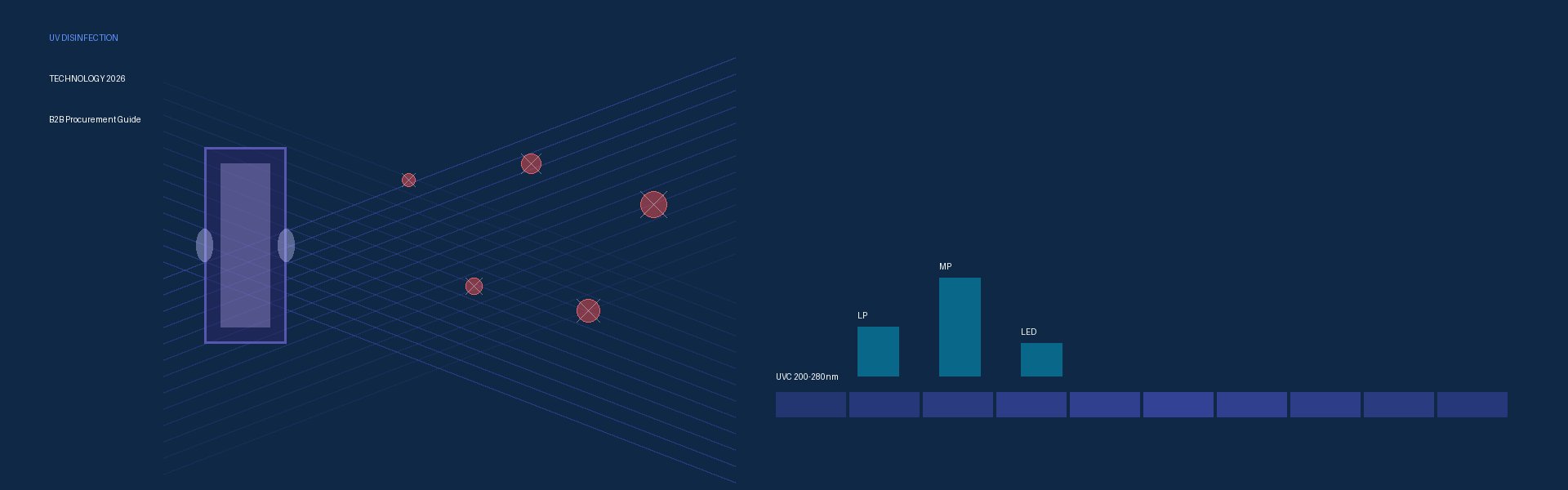
Three distinct UV lamp technologies now compete in the B2B market. Each has fundamentally different performance envelopes:
| Parameter | Low-Pressure (LP) Mercury | Medium-Pressure (MP) Mercury | UV-LED (UVC) |
|---|---|---|---|
| Wavelength | Monochromatic 254nm | Polychromatic 200-400nm | Single-wavelength (usually 265-280nm) |
| Power per lamp | 40-200W | 1-25 kW | 10-100W per module |
| Lamp life | 8,000-12,000 hours | 5,000-8,000 hours | 30,000-50,000 hours |
| Warm-up time | 1-5 minutes | 3-7 minutes | Instant (milliseconds) |
| Electrical efficiency | 30-38% UVC output | 10-15% UVC output | 3-8% (improving rapidly) |
| Mercury content | 3-15mg per lamp | 200-500mg per lamp | Zero (mercury-free) |
| Fouling sensitivity | Moderate | High (heat accelerates scaling) | Low (no IR component) |
| Procurement cost | $200-800 per system | $5,000-50,000 per system | $150-600 per module |
| Maintenance cost/year | $80-200 (lamp+sleeve) | $500-3,000 | $0-50 (no replacement for 5+ years) |
B2B Recommendation: For residential and light commercial applications (under 5 GPM), low-pressure mercury lamps remain the cost-optimized choice with proven 40+ year track records. For industrial 24/7 operations where downtime is costly, UV-LED’s instant-on capability and 30,000-hour lifespan delivers compelling total-cost-of-ownership advantages. The company’s Yimi PureFlow Technology ensures consistent UV dosing across variable flow conditions through real-time intensity monitoring and automatic power compensation.
3. Critical Design Parameters for B2B Buyer Evaluation
When sourcing UV systems for distribution or integration into OEM equipment, evaluate these five technical parameters:
3.1 UV Transmittance (UVT) Compensation: UVT measures how much UV light penetrates the water at 254nm. Municipal tap water typically has UVT 85-95%, but surface water can drop to 60-70%. A well-designed system automatically adjusts power output based on real-time UVT sensor readings. ONEMI UV systems achieve ±2% dose accuracy across 60-99% UVT range.
3.2 Sleeve Fouling Management: Quartz sleeves separating lamps from water accumulate scale (calcium carbonate, iron, manganese) that reduces UV transmission. Look for systems with either automatic mechanical wipers (pneumatic or motor-driven) or ultrasonic cleaning modules. Manual sleeve cleaning requiring system shutdown is unacceptable for commercial applications.
3.3 Flow Rate vs. UV Dose Curve: Manufacturers should provide certified dose-flow curves (not just “maximum flow rate” claims). A system claiming “10 GPM” but only delivering 40 mJ/cm² at 6 GPM is misleading. Request third-party bioassay validation reports — ONEMI provides LRV (log reduction value) certification from accredited laboratories for every flow rate point.
3.4 Ballast/Driver Quality: Electronic ballasts for LP/MP lamps and LED drivers for UV-LED modules are the most common failure points. Industrial-grade ballasts should have: surge protection (IEC 61000-4-5 Class 4), thermal management with automatic derating, and lamp-failure alarm dry contacts. Avoid consumer-grade ballasts with unsealed circuit boards.
3.5 Validation & Certification Portfolio: B2B buyers should require: NSF/ANSI 55 certification for US/North American markets, CE marking + DVGW/WRAS for European markets, and China Compulsory Certification (CCC) for domestic Chinese installations. ONEMI UV systems carry NSF 55 Class A certification alongside CE and CCC compliance.
4. B2B Supplier Evaluation Framework (7-Point Checklist)
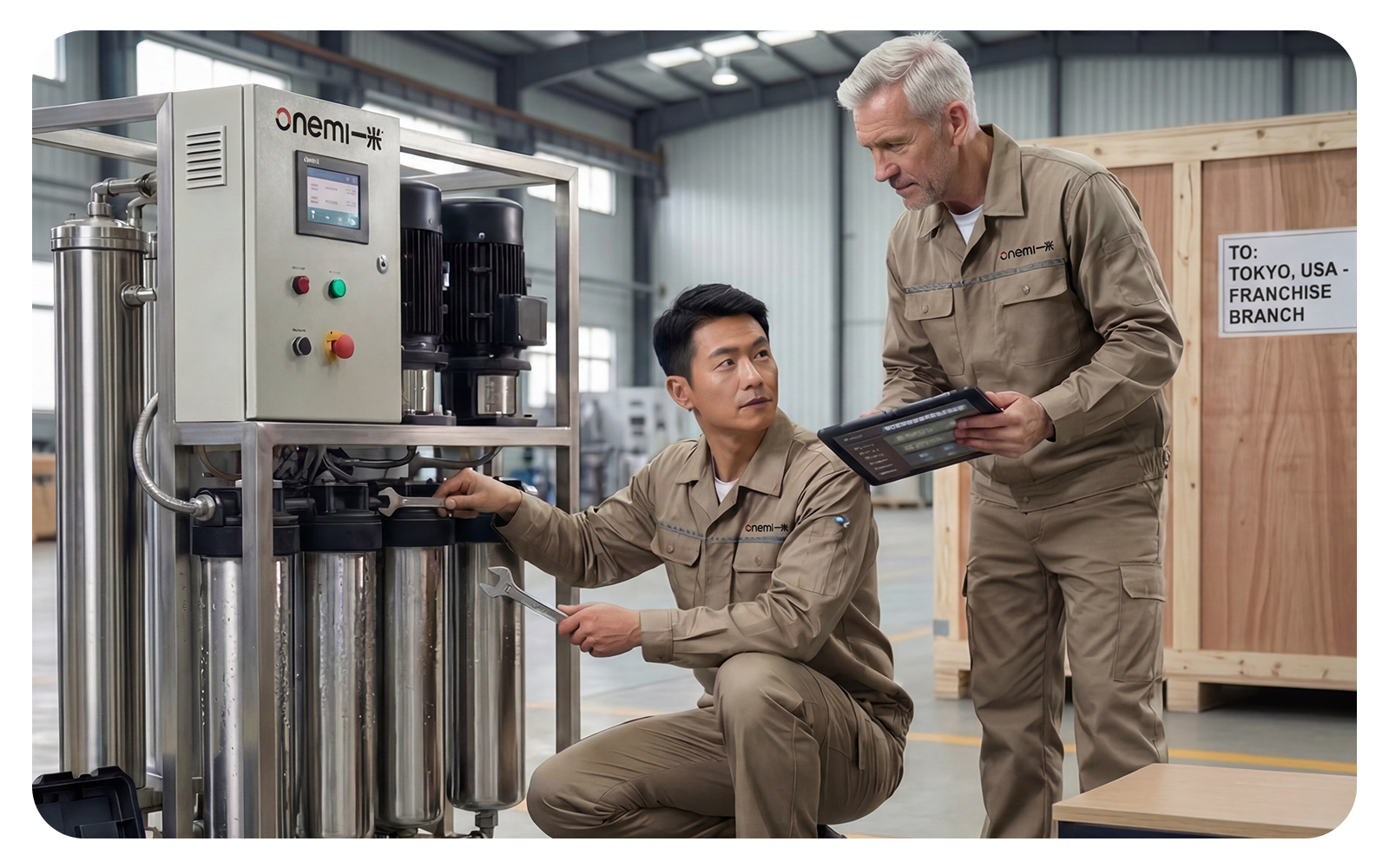
- Manufacturing Scale: Verify actual factory capacity — can the supplier deliver 1,000+ units/month? ONEMI operates a 30,000m² ISO 9001:2015 certified facility in Guangdong.
- Custom Engineering: Can they modify chamber dimensions, connector types, or control logic for your specific application? Request case studies.
- Third-Party Testing: Insist on independent bioassay reports from NSF, TÜV, or equivalent accredited labs — not just in-house test data.
- Component Traceability: Lamps, ballasts, and quartz sleeves should have traceable batch numbers for quality recall capability.
- After-Sales Support: What’s the warranty period? Spare parts availability timeline? ONEMI offers 2-year warranty on UV systems with 72-hour spare parts dispatch.
- Regulatory Compliance: Can they provide full material safety data sheets (MSDS), RoHS compliance certificates, and mercury disposal guidance?
- Price Transparency: Get FOB pricing broken down by component (lamp, ballast, chamber, sensor, controller) to assess value — not just a lump-sum quote.
5. The UV-LED Revolution: When to Bet on the Future
UV-LEDs operating at 265-280nm are the most significant technology disruption in water disinfection since the introduction of medium-pressure lamps in the 1990s. Current-generation UV-LEDs achieve wall-plug efficiency of 3-8% (compared to LP mercury’s 30-38%), but the efficiency gap is closing at approximately 15-20% per year.
When UV-LEDs make commercial sense today:
- Point-of-use applications under 2 GPM where instant-on eliminates water waste from lamp warm-up
- Battery/solar-powered systems where DC compatibility and low startup current eliminate inverter losses
- Applications requiring frequent on/off cycling (LP lamps degrade rapidly with cycling)
- Markets with mercury regulations (EU RoHS exemptions for mercury in UV lamps are under review for 2027 phaseout)
When to stick with LP mercury:
- Municipal-scale systems over 100 GPM — UV-LED arrays at this scale remain cost-prohibitive
- Wastewater applications requiring 80+ mJ/cm² — LED efficiency drops significantly at higher output levels
- Price-sensitive residential markets where $100-200 retail price points constrain component budgets
6. Real-World UV System Sizing Example
Scenario: A 200-room hotel in Southeast Asia needs whole-building UV disinfection after existing carbon filtration. Design parameters: peak flow 80 GPM, UVT 90%, target dose 40 mJ/cm², 24/7 operation.
Sizing calculation: LP mercury system requires approximately 4 × 200W lamps in a parallel chamber configuration with automatic wiper system. Estimated system cost FOB: $18,500-22,000 including: 316L stainless steel chamber, 4 validated LP lamps, electronic ballasts with 4-20mA output, UV intensity sensor with NIST-traceable calibration, automatic wiper system (pneumatic), and PLC controller with Modbus RTU. Five-year TCO including lamp replacements (every 12 months at $180/lamp), sleeve cleaning, and minimal electricity: approximately $27,000-32,000.
For a UV-LED equivalent achieving the same 40 mJ/cm² at 80 GPM with UVT 90%: current technology requires approximately 160 × 100mW LED modules. Estimated system cost FOB: $48,000-55,000. However, five-year TCO drops to $48,000-52,000 since there are zero lamp replacements and electrical consumption is 40% lower.
The LP mercury system wins on upfront cost; the UV-LED system breaks even at approximately 6-7 years on TCO for 24/7 operations.
7. Procurement Recommendations by Segment
Residential Distributors: Source LP mercury systems in the 8-12 GPM range with NSF 55 Class A certification. Emphasis on compact form factor, tool-free lamp replacement, and audible+visual lamp-life alarms. Target FOB: $80-180 per unit (MOQ 500).
Commercial/OEM Integrators: Source modular LP systems allowing parallel configuration for 20-200 GPM range. Critical features: dry-contact alarm outputs, Modbus/RS485 communication, automatic wiper option. Target FOB: $2,000-8,000 per rack. ONEMI’s OEM program includes custom branding, control panel silk-screening, and region-specific power cord configurations.
Industrial End-Users: Evaluate both LP and UV-LED based on your specific operating profile. For 24/7 operations with >5-year equipment lifecycle, request UV-LED TCO analysis from manufacturers offering validated LED systems. For batch operations or seasonal use, LP mercury remains the cost-effective default.
UV water disinfection is not a commodity — it’s an engineered system where design parameters directly impact pathogen inactivation reliability. B2B buyers who invest time in understanding the technology comparison between LP, MP, and UV-LED platforms, validating dose-flow curves, and auditing supplier manufacturing capabilities will make procurement decisions that serve their customers — and their bottom line — for years to come. Explore ONEMI’s Whole House Water Purification solutions for integrated UV + filtration systems, or see our Point-of-Use Purification range for compact UV disinfection modules.
UV water treatment is not a commodity — it’s an engineered platform where design parameters directly impact pathogen inactivation reliability. B2B buyers who invest time in understanding the technology differences between LP, MP, and UV-LED systems, validating dose-flow curves, and auditing supplier manufacturing capabilities will make procurement decisions that serve their customers — and their bottom line — for years to come.
ONEMI — www.onemiro.com Original Content