


 한국어
한국어


**Under Sink RO Installation: A Complete B2B Procurement Guide**
ONEMI manufactures water purification equipment for distributors across 40+ countries. B2B buyers evaluating product lines frequently ask about the end-user installation experience. A system taking three hours to install generates support calls and returns. A 30-minute installation builds brand loyalty. For importers and distributors selecting an OEM partner, under-sink RO installation design remains a key procurement differentiator.
**Why Under-Sink RO Installation Design Matters for B2B Buyers**
Under-sink RO systems represent the highest-volume category in global residential water purification. Market data indicates point-of-use RO systems accounted for over 60% of residential water purifier sales in 2025. Under-sink configurations dominate this segment due to space efficiency and zero countertop footprint.
For B2B importers, installation complexity directly influences return rates, customer support volume, and brand reputation. A poorly designed drain saddle causes leaks and warranty claims. Systems requiring specialized plumbing tools restrict the addressable market. ONEMI engineers prioritize installation simplicity as a core design parameter.
Key design elements dictating installation quality include the form factor (tank vs. tankless), fitting type (quick-connect vs. compression), drain saddle design, faucet mounting compatibility, and color-coded tubing. Each element impacts the installer's experience and the distributor's operational efficiency.
**Tankless vs. Tanked: Installation Space and Complexity**
This represents the first decision point for any under-sink RO line.
Tanked RO systems include a 3-4 gallon (11-15 liter) storage tank. The tank occupies approximately 10×10×15 inches (25×25×38 cm) of under-sink space. Installation requires connecting the tank via 1/4" tubing and placing it on a stable surface. Advantages include proven reliability. Disadvantages include a large footprint, the risk of secondary contamination without periodic sanitization, and slower initial flow rates driven by tank bladder pressure.
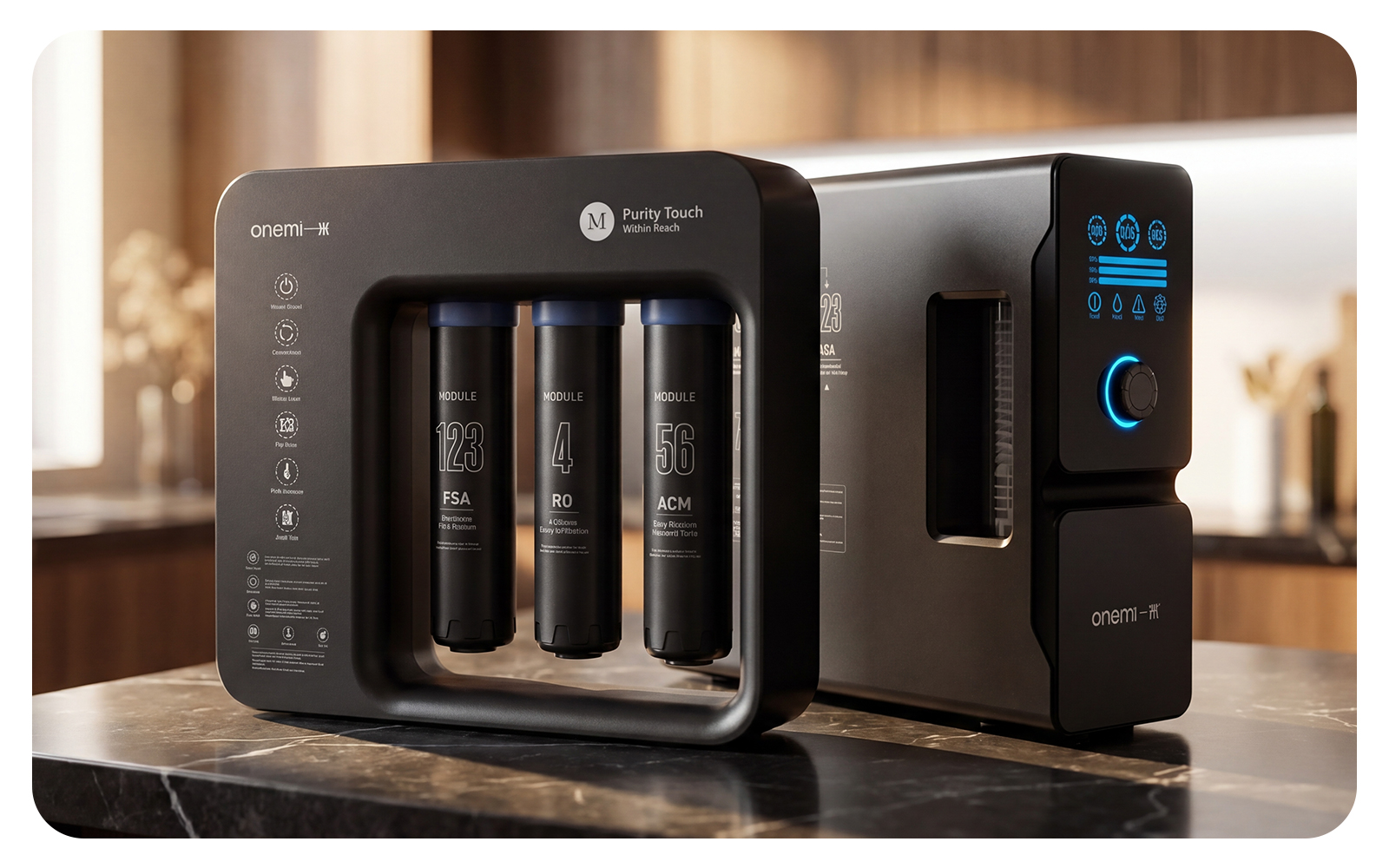
Tankless RO systems eliminate the storage tank using a high-flow membrane (600-1200 GPD) and a built-in booster pump. The entire system fits within a 15×8×18 inch (38×20×45 cm) footprint—roughly the size of a desktop PC tower. Installation is significantly simpler. Installers skip tank positioning and manage fewer tubing runs for a faster setup. ONEMI tankless systems average a 22-minute installation in field tests, compared to 45-55 minutes for traditional tanked units.
European and North American markets are shifting heavily toward tankless systems. Smaller kitchen footprints and consumer preference for instant flow drive this trend. Asian markets remain mixed, with tanked systems retaining popularity in specific segments.
**Quick-Connect vs. Compression Fittings: The 90% Solution**
Tubing connections represent the primary installation pain point for under-sink RO systems. Traditional compression fittings require Teflon tape, wrenches, and precise torque. Overtightening cracks the fitting, while undertightening causes leaks. Compression fittings account for an estimated 70% of installation-related service calls.
Quick-connect (push-fit) fittings resolve this issue. Installers simply push the tubing into the fitting. An internal O-ring and grab ring create a watertight seal without tools. Pressing a release collar removes the tubing. ONEMI utilizes John Guest-compatible quick-connect fittings certified to NSF/ANSI 58 standards across all product lines.
When evaluating OEM under-sink RO products, buyers must verify quick-connect usage across all connections, including the faucet adapter. Check for potable water certifications and tubing size (1/4" vs. 3/8"). Thicker tubing reduces pressure drop. Yimi PureFlow Technology quick-connect systems achieve a field leak rate below 0.3% across 50,000+ installed units.
**Drain Saddle Design: The #1 Source of Installation Failures**
The drain saddle connects the system's wastewater line to the sink drain pipe. This component separates well-engineered under-sink RO systems from problematic ones.
Poorly designed drain saddles lead to under-sink leaks and warranty claims. Common failures include saddle clamps loosening from thermal expansion of PVC pipes, incorrect drill hole positioning causing wastewater backup, and internal port corrosion.
ONEMI drain saddles incorporate three engineering solutions:
1. **Dual-bolt clamping:** Two stainless steel bolts distribute pressure evenly around the pipe circumference.
2. **Pre-installed check valve:** Prevents sewage backflow into the RO system during a main drain clog.
3. **Silicone gasket with compression lip:** The inner lip compresses into the drilled hole, creating a secondary seal beyond the outer clamp face.
B2B buyers should verify check valve inclusion in drain saddles. Omitting this component increases return rates for that SKU.
**Faucet Mounting and Countertop Compatibility**
The RO dedicated faucet mounts through a pre-existing sink hole or requires drilling the countertop. Standard hole diameters range from 1-1/4" to 1-1/2" (32-38 mm).
Key considerations for B2B buyers evaluating under-sink RO product lines:
* **Mounting thread length:** Countertops range from 0.75" (laminate) to 2" (granite/marble). The faucet stem must accommodate thick countertops with sufficient thread engagement for the mounting nut.
* **Air gap vs. non-air gap:** Specific plumbing codes require an air gap faucet for backflow prevention. ONEMI offers both configurations. The air-gap model meets ASSE 1022 and UPC requirements.
* **Finish durability:** Brushed nickel and stainless steel finishes resist corrosion better than chrome in hard water environments. ONEMI PVD-coated faucets achieve 200+ hours of salt spray testing under ASTM B117 standards.
**Pre-Installation Checklist for Distributors**
Every under-sink RO system requires a clear pre-installation checklist. ONEMI includes a laminated card with every unit to reduce installation errors:
* Verify under-sink space: minimum 17"W × 20"H × 10"D for tankless; 20"W × 20"H × 16"D for tanked.
* Confirm cold water supply valve is functional and accessible.
* Identify drain pipe material (PVC/ABS/metal) and verify drain saddle compatibility.
* Check countertop hole availability. Offer a countertop RO alternative if drilling is not feasible.
* Measure water pressure. The ideal range is 40-80 PSI (2.8-5.5 bar). Pressures below 40 PSI require a booster pump, while pressures above 80 PSI require a pressure reducer.
* Verify TDS. Systems are optimized for municipal water (TDS 50-500). Well water with TDS >500 requires a pre-treatment consultation.
**ONEMI's Under-Sink RO Portfolio: Built for Easy Installation**
The ONEMI under-sink RO product line spans from 600 GPD tankless systems to 1200 GPD high-flow units. Every system features color-coded 3/8" tubing (blue=product, red=inlet, black=waste), quick-connect fittings, and a pre-assembled filter manifold. This manifold reduces under-sink assembly time by 60% compared to modular systems.
ONEMI provides complete installation manual customization, multilingual packaging, and regional compliance support (NSF, CE, RoHS, SASO) for private-label or OEM solutions. Visit the Point-of-Use Water Purification product page, or explore Core Precision Components for individual filter elements and fittings.
*ONEMI — www.onemiro.com. 15 years of water purification engineering, serving distributors in 40+ countries.*