

 한국어
한국어

**Solar Powered RO Systems — Off-Grid Water Purification for a Sustainable Future**
Water scarcity and energy poverty intersect to affect over 2.2 billion people worldwide. This primarily impacts rural and off-grid communities where clean water and reliable electricity remain luxuries. Solar-powered reverse osmosis (RO) systems offer a transformative solution. They convert brackish groundwater, surface water, or seawater into potable water using only sunlight. B2B buyers, humanitarian organizations, and government procurement agencies must understand the technical and operational dimensions of solar RO to make informed sourcing decisions.
**1. How Solar RO Works: The Energy-Water Nexus**
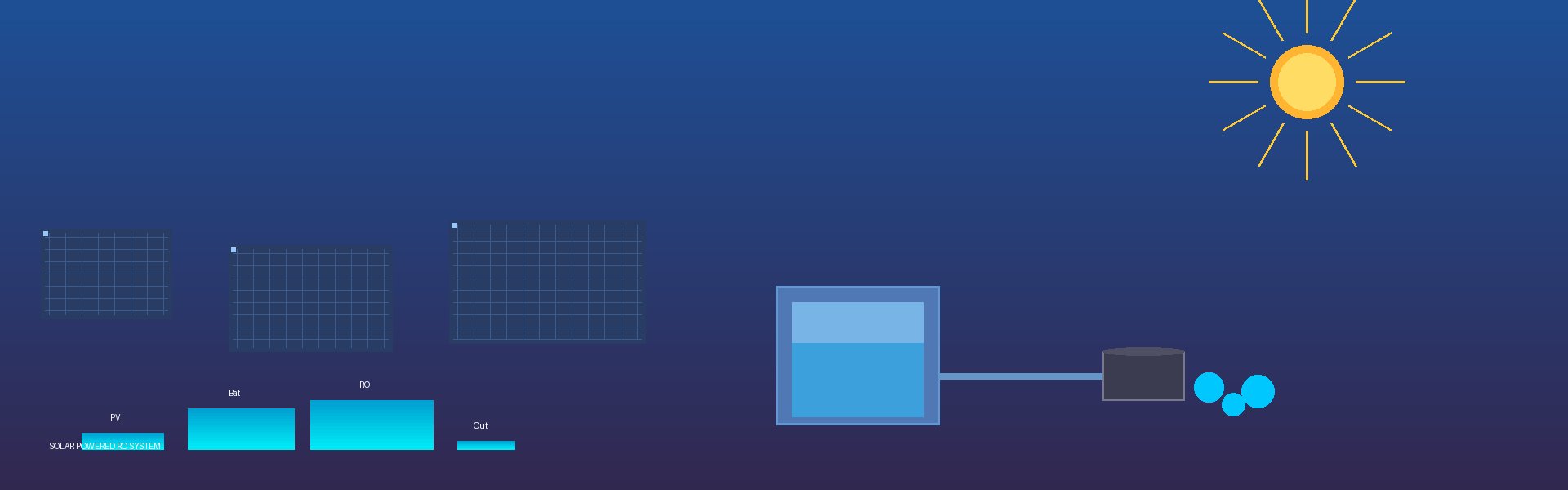
A solar RO system integrates three core subsystems: the photovoltaic (PV) array, the power conditioning unit, and the RO membrane train. Sunlight strikes the PV panels to generate DC electricity. A charge controller regulates voltage to a battery bank (typically 24V or 48V DC). This battery bank buffers the power supply against cloud cover and nighttime conditions. An inverter then converts DC to AC for the high-pressure pump. This pump represents the single largest energy consumer in the system, drawing 1.5–3.0 kWh per cubic meter of permeate produced.
The RO membrane operates at 8–15 bar for brackish water and 55–70 bar for seawater. Modern systems incorporate pressure exchangers or turbines to capture 45–60% of the brine stream's residual pressure. This energy recovery reduces specific energy consumption (SEC) from 5–8 kWh/m³ down to 2.5–3.5 kWh/m³. The ONEMI SolarPure Technology energy recovery module boosts overall system efficiency by up to 35% compared to conventional configurations lacking recovery mechanisms.
**2. Key Technical Parameters for Procurement**
| Parameter | Brackish Water Solar RO | Seawater Solar RO |
| :— | :— | :— |
| **Feed TDS Range** | 500–5,000 mg/L | 30,000–45,000 mg/L |
| **Operating Pressure** | 8–15 bar | 55–70 bar |
| **Recovery Rate** | 50–75% | 35–50% |
| **Specific Energy (SEC)** | 2.5–5.0 kWh/m³ | 3.5–8.0 kWh/m³ |
| **PV Array Size (per m³/day)** | 0.8–2.0 kWp | 2.5–5.0 kWp |
| **Membrane Configuration** | 2–3 stage spiral wound | Single stage + energy recovery |
| **Daily Output (typical)** | 500–20,000 LPD | 1,000–100,000 LPD |
For B2B procurement, the water-to-power ratio stands as the most critical specification. This metric defines how many liters of permeate the system produces per peak watt of installed PV capacity. A properly engineered brackish solar RO system achieves 8–12 L/kWp/day. Seawater units typically deliver 3–5 L/kWp/day. This ratio directly governs the system's physical footprint and infrastructure requirements.
**3. System Architecture: Modular vs. Containerized**
Solar RO systems utilize two dominant form factors:
**Modular / Skid-Mounted:** Components (PV array, pump skid, membrane housings, control panel) ship separately for on-site assembly. This approach offers greater flexibility for irregular terrain but requires skilled installation labor. These units serve as ideal solutions for permanent installations in schools, clinics, and community centers.
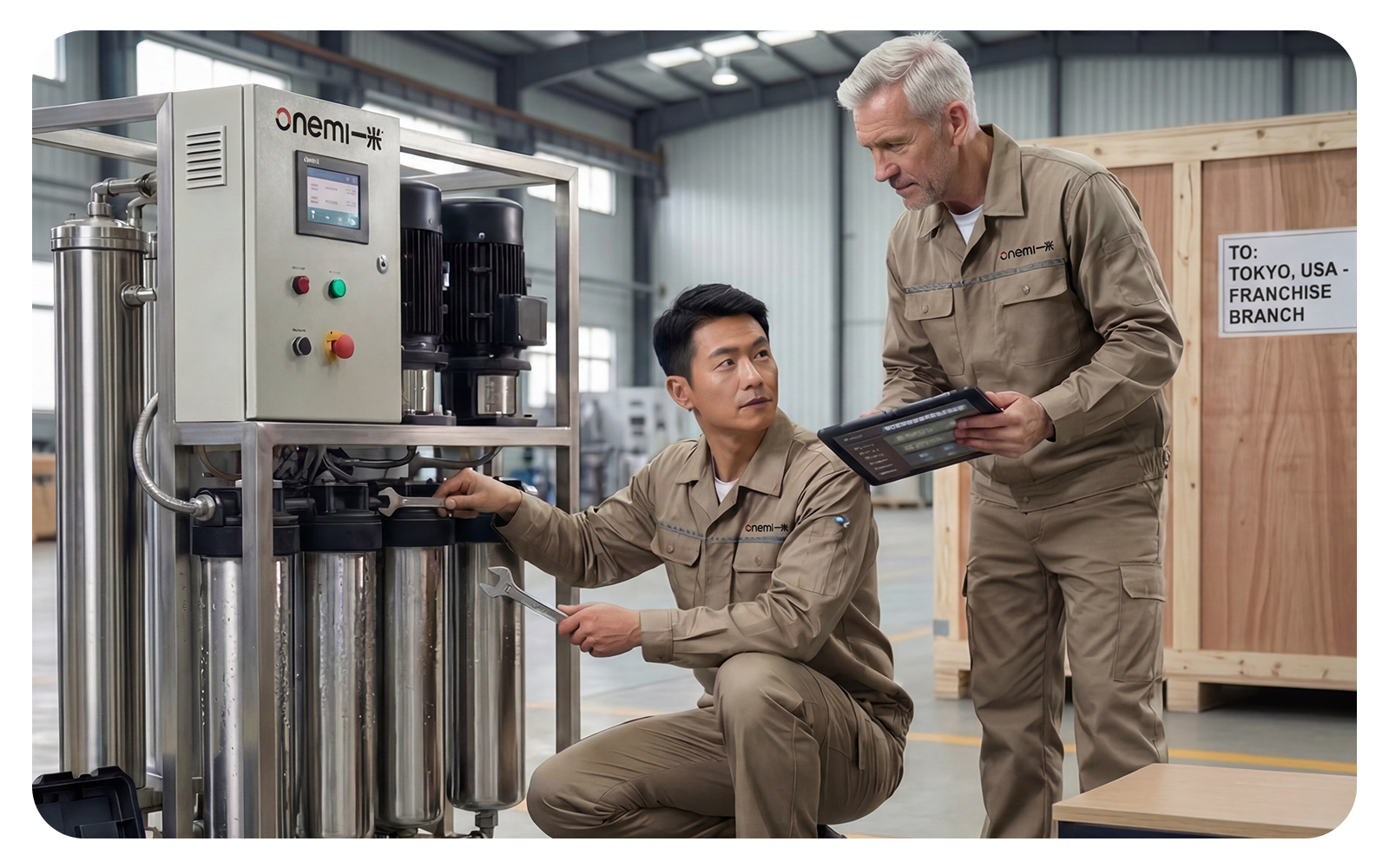
**Containerized / Turnkey:** All subsystems arrive pre-integrated inside a standard 20ft or 40ft ISO shipping container. PV panels fold out from the container roof or mount on the ground nearby. This requires minimal on-site assembly. The unit produces water within 4–8 hours of delivery, drastically lowering deployment risk. These systems perfectly suit emergency response, military field operations, and mining camps.
ONEMI provides both configurations while maintaining identical membrane and control system quality. Operators have deployed our containerized SolarPure units across 15 countries in Sub-Saharan Africa, Southeast Asia, and the Middle East.
**4. Application Verticals**
**4.1 Rural Community Water Supply**
A 5,000 LPD solar RO system serves 250–500 people at the WHO-recommended 10–20 liters per capita per day. PV panels offer a 15-year lifespan, while membranes require replacement every 3–5 years. This provides a highly sustainable alternative to trucked water in remote areas, ensuring a far safer and more reliable supply.
**4.2 Disaster Relief & Humanitarian Response**
Centralized water infrastructure frequently fails following earthquakes, floods, or conflict. Responders can airlift containerized solar RO units to affected zones to produce potable water within hours. These systems eliminate diesel fuel logistics. UN agencies and NGOs increasingly specify solar RO in their emergency procurement frameworks, including the UNICEF WASH Cluster, MSF, and IFRC.
**4.3 Remote Industrial & Agricultural Operations**
Mining exploration camps, offshore platform support vessels, and desert agricultural projects face a common challenge: abundant brackish groundwater but no grid power. Solar RO eliminates diesel generator reliance while providing a predictable, long-term water supply.
**5. B2B Procurement Checklist: 7 Dimensions to Evaluate**
* **Feed Water Analysis:** Require a comprehensive water quality report (TDS, hardness, iron, silica, TOC, microbiological) before specifying the membrane type and pretreatment. Silica levels above 30 mg/L require antiscalant dosing to prevent irreversible membrane fouling.
* **Solar Irradiance Data:** Request site-specific Global Horizontal Irradiance (GHI) data from NASA POWER or Solargis. A location receiving 5.5 kWh/m²/day GHI requires approximately 45% less PV panel area than a 3.8 kWh/m²/day location for the identical daily output.
* **Pretreatment Package:** Confirm the inclusion of multimedia filtration to manage turbidity and protect the RO membranes.
* **Battery Autonomy:** Specify the required hours of operation without sunlight. A 24-hour battery bank serves as the standard for community systems. Alternatively, 8–12 hours may suffice for daytime-only operations.
* **Remote Monitoring:** Implement IoT-enabled controllers with 4G or satellite connectivity. These provide real-time flow, pressure, TDS, and energy data. This connectivity remains critical for systems in unmanned locations.
* **Spare Parts Kit:** Ensure the supplier includes a 2-year consumables package. This must cover cartridge filters, antiscalant, CIP chemicals, membrane preservation solution, and one set of high-pressure pump seals.
* **Certification & Compliance:** Membranes must carry NSF/ANSI 58 or 61 certification. The complete system should meet WHO Guidelines for Drinking-water Quality. For EU-funded projects, ensure CE marking under the Pressure Equipment Directive (PED 2014/68/EU).
**6. ONEMI as Your Solar RO Manufacturing Partner**
ONEMI operates as a leading water purification equipment manufacturer with 15 years of OEM/ODM expertise. We offer fully customizable solar RO solutions across the entire capacity spectrum. Our vertically integrated manufacturing facility in Ningbo, China, produces PV-compatible high-pressure pumps, FRP membrane housings, and PLC-based control systems in-house. This ensures strict quality consistency.
| System Series | Daily Output (LPD) | PV Array | Application |
| :— | :— | :— | :— |
| **ONEMI-SRO-500** | 500–1,000 | 400–800 Wp | Single household / Remote clinic |
| **ONEMI-SRO-5000** | 5,000–8,000 | 3–5 kWp | Small community / School |
| **ONEMI-SRO-20000** | 20,000–30,000 | 12–18 kWp | Large village / Commercial farm |
| **ONEMI-SRO-CONTAINER** | 50,000–100,000 | 30–60 kWp | Emergency response / Mining camp |
Beyond standard configurations, ONEMI provides full OEM customization. Buyers can select preferred membrane brands (DuPont FilmTec, Hydranautics, Toray), pump manufacturers (Grundfos, Danfoss), control system language localization, and PV panel tiers (Longi, Jinko, Trina). Every system ships with detailed installation manuals in English, French, Spanish, or Arabic.
For B2B procurement inquiries, contact ONEMI at www.onemiro.com/en/contact/. Explore our full product range at ONEMI Flagship Water Purification and ONEMI Ultra Filtration Systems.
The future of water is decentralized, renewable, and resilient. Solar-powered RO represents more than just a technology. It serves as the vital infrastructure needed to deliver Sustainable Development Goal 6—clean water for all—to the 2.2 billion people still waiting. ONEMI proudly stands at the forefront of this transformation.
*ONEMI — www.onemiro.com Original Content. © 2026 ONEMI Environmental Technology Co., Ltd.*
*ONEMI onemiro.com Original Content — Solar Powered RO Systems*