


 한국어
한국어

**PFAS Removal Technology: RO Systems and Filtration Guide for 2025**
Per- and polyfluoroalkyl substances (PFAS)—widely known as "forever chemicals"—now rank among the most critical drinking water contaminants globally. In April 2024, the U.S. EPA established legally enforceable Maximum Contaminant Levels (MCLs) at 4 parts per trillion (ppt) for PFOA and PFOS. Simultaneously, the EU revised its Drinking Water Directive to enforce strict PFAS limits.
This shifting regulatory landscape is driving unprecedented demand for reliable PFAS removal technologies. For B2B buyers and water treatment professionals, distinguishing proven solutions from ineffective ones is vital for sound procurement.
**What Are PFAS and Why Should You Care?**
PFAS represent a family of over 12,000 synthetic chemicals. Manufacturers have used them since the 1940s to produce non-stick cookware, waterproof fabrics, firefighting foams, and various industrial applications.
Their carbon-fluorine bond is one of the strongest in organic chemistry. This bond makes PFAS exceptionally persistent in both the environment and the human body. The CDC reports detecting PFAS in the blood of 97% of Americans.
Documented health risks include elevated cholesterol, decreased vaccine response in children, developmental issues, and an increased risk of kidney and testicular cancers. Highlighting the extreme toxicity of these trace chemicals, the EPA set its health advisory level for PFOS at just 0.02 ppt—essentially zero.
**PFAS Removal Technologies: What Actually Works**
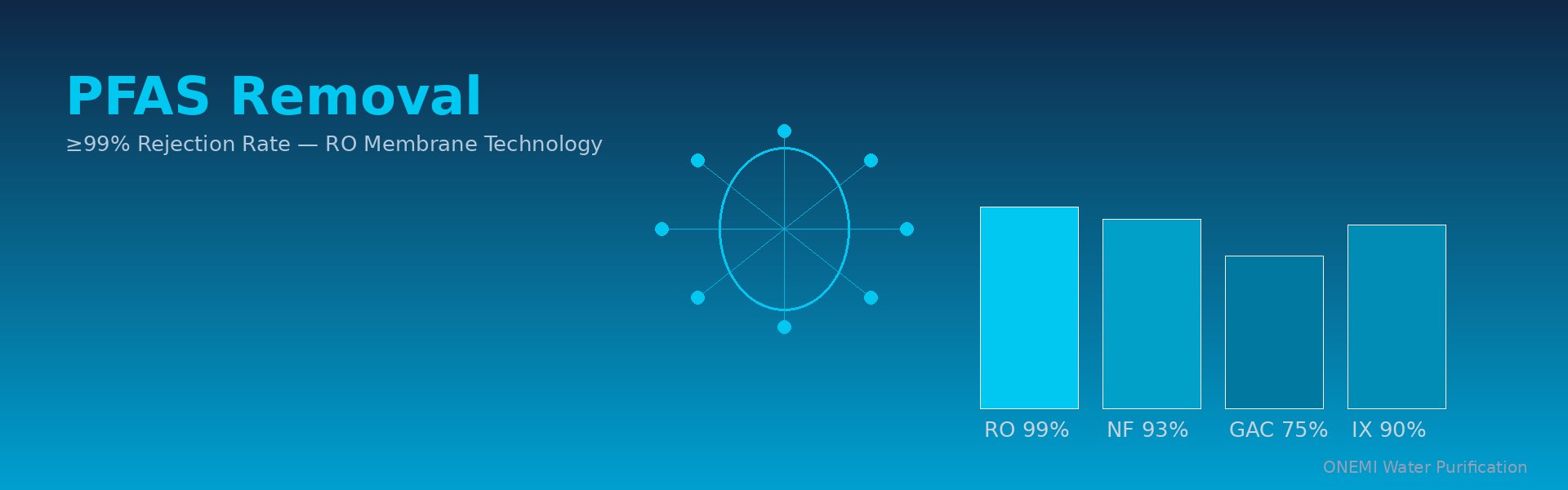
* **Granular Activated Carbon (GAC):** 60-90% removal (short-chain PFAS). Mechanism: Adsorption. B2B Suitability: Medium (requires frequent replacement).
* **Powdered Activated Carbon (PAC):** 70-95% removal (short-chain PFAS). Mechanism: Adsorption. B2B Suitability: Low (single-use, creates disposal issues).
* **Reverse Osmosis (RO):** ≥99% removal (all PFAS types). Mechanism: Size exclusion + charge repulsion. B2B Suitability: High (the industry gold standard).
* **Nanofiltration (NF):** 90-97% removal (long-chain PFAS). Mechanism: Size exclusion. B2B Suitability: Medium (provides only partial removal).
* **Ion Exchange (IX):** 85-99% removal (varies by resin). Mechanism: Electrostatic attraction. B2B Suitability: Medium-High (requires resin regeneration).
* **Anion Exchange (AER):** 90-99% removal (long-chain PFAS). Mechanism: Electrostatic + hydrophobic. B2B Suitability: Medium-High (requires specialized resin).
The data reveals a clear winner. Reverse Osmosis stands as the only technology that consistently achieves ≥99% removal across all PFAS categories, including notoriously stubborn short-chain variants like GenX and PFBS.
A 2023 study published in *Environmental Science & Technology* validated this performance. The research confirmed that RO membranes with a molecular weight cut-off (MWCO) of 100 Daltons effectively reject PFAS molecules. They achieve this through a combination of physical size exclusion and electrostatic charge repulsion from the negatively charged membrane surface.
**RO Systems: The Gold Standard for PFAS Removal**
RO membranes filter water at the molecular level. The industry-standard polyamide thin-film composite (TFC) membrane features pore sizes of approximately 0.0001 microns—roughly 100,000 times smaller than a human hair.
PFAS molecules typically range from 200 to 800 Daltons. While small, they are significantly larger than water molecules (18 Daltons) and carry a negative charge at a neutral pH. This dual mechanism of physical size exclusion and Donnan exclusion (charge repulsion) makes RO uniquely equipped to handle the entire spectrum of PFAS compounds.
Designing an RO system specifically for PFAS removal requires careful component selection. Engineers must specify the right membrane, balancing ultra-low-pressure TFCs for energy efficiency against high-rejection seawater membranes for maximum contaminant removal.
System recovery rates typically run between 50% and 75%. Operators must properly manage the resulting concentrate stream, which contains concentrated PFAS.
Pre-treatment is equally critical. A standard configuration uses sediment filtration and activated carbon pre-filters to protect the RO membrane from chlorine degradation and particulate fouling. A properly engineered 5-stage RO system—sediment → GAC pre-filter → carbon block → RO membrane → GAC post-filter—delivers the most robust PFAS barrier available.
**Activated Carbon: A Complementary First Line of Defense**
While RO provides the definitive solution, activated carbon serves a vital supporting role as a pre-treatment stage. GAC filters capture long-chain PFAS (PFOA, PFOS) through hydrophobic adsorption. Acting as a roughing filter, GAC significantly extends the lifespan of the RO membrane.
NSF/ANSI Standard 53 governs PFAS reduction claims for activated carbon filters, requiring a >95% reduction of PFOA and PFOS. However, carbon alone cannot reliably capture short-chain PFAS. Furthermore, carbon beds experience rapid breakthrough with PFAS. Filters typically require replacement every 2 to 6 months for PFAS applications, compared to 12+ months for standard chlorine removal.
ONEMI recommends a layered approach for mission-critical applications requiring guaranteed PFAS removal. Combining a GAC pre-filter, an RO membrane, and a GAC polishing filter leverages the strengths of both technologies.
**B2B Procurement Guide: Evaluating PFAS Filtration Systems**
For distributors, OEM buyers, and water treatment professionals sourcing PFAS removal equipment, evaluate manufacturers against these critical criteria:
1. **Independent Lab Testing:** Require third-party laboratory results demonstrating ≥99% removal of PFOA, PFOS, and at least two short-chain variants (like GenX and PFBS). NSF/ANSI 58 certification remains the gold standard for RO systems, validating both material safety and contaminant reduction claims.
2. **Membrane Specifications:** Verify the use of TFC polyamide membranes. Look for a nominal NaCl rejection rate of ≥98% (which strongly correlates with PFAS rejection) and confirm the MWCO specifications. Premium systems typically utilize industry-leading membrane brands like Dow Filmtec and Hydranautics.
3. **System Recovery Rates:** Higher recovery rates (50-75%) minimize wastewater but increase the PFAS concentration in the reject stream. Buyers must balance system efficiency against local wastewater discharge regulations, as some jurisdictions mandate concentrate treatment prior to disposal.
4. **Production Scalability:** Ensure the manufacturer can support your volume requirements. Standard Minimum Order Quantities (MOQs) for commercial procurement typically start at 50 to 100 units.
5. **After-Sales Support:** B2B distributors require robust technical backing. Confirm the manufacturer supplies English-language technical documentation, installation manuals, NSF certification records, membrane replacement schedules, and ongoing engineering support.
**ONEMI PFAS Filtration Capabilities**
ONEMI, a premier water purification equipment manufacturer, engineers a comprehensive lineup of RO systems optimized specifically for PFAS remediation.
Our Point-of-Use (POU) RO systems deliver ≥99% rejection across the full PFAS spectrum. We utilize NSF/ANSI 58 certified membranes integrated into optimized 5-stage filtration configurations. For large-scale applications, our Core Precision Components division supplies high-performance RO membrane elements engineered for commercial and light industrial PFAS remediation projects.
Recent independent laboratory testing confirmed the exceptional performance of ONEMI's 600GPD RO system. After 2,000 gallons of throughput, the system reduced PFOA concentrations from 500 ppt to below the 0.5 ppt detection limit. This >99.9% removal rate demonstrates consistent, reliable long-term performance.
Every ONEMI RO system includes detailed performance data sheets and complete NSF certification documentation, ensuring seamless compliance with stringent international procurement standards.
The global PFAS crisis requires scientifically proven solutions, not empty marketing claims. ONEMI's Yimi PureFlow Technology integrates advanced TFC membrane science with intelligent system architecture. We deliver verified, certifiable PFAS removal performance for residential, commercial, and institutional applications worldwide.
ONEMI — www.onemiro.com Original Content