

 한국어
한국어


As a leading water purifier manufacturer, we know that partnering with a compliant water purifier OEM to import a water purifier for US/EU market is critical. Choosing a certified tankless high-capacity RO system ensures your brand meets strict international environmental safety guidelines.
The global water filtration landscape is undergoing its most significant regulatory shift in a generation. Driven by rising public concern over “forever chemicals” (PFAS) and microplastics, environmental protection agencies worldwide are introducing unprecedentedly strict legal thresholds. For international brand owners, procurement managers, and e-commerce distributors, navigating these updates is no longer optional—it is a baseline requirement for survival.
As we enter 2026, compliance has become the ultimate differentiator in the highly competitive RO system market. Brands that fail to adapt risk customs seizures, expensive product recalls, and irreparable damage to their reputation. Conversely, forward-thinking companies that align with a technologically advanced ODM water purifier partner can leverage these regulatory shifts to capture market share as the demand for certified, high-performance filtration systems skyrockets.
The Evolving Regulatory Landscape for PFAS in Drinking Water
Per- and polyfluoroalkyl substances (PFAS) have transitioned from a niche scientific concern to the focal point of global water treatment legislation. Known as “forever chemicals” due to their inability to break down naturally in the human body or the environment, these synthetic compounds are linked to severe health risks, including metabolic disruptions, decreased fertility, and increased cancer risks.
US EPA PFAS Regulations and Their Impact on Imported Products
The United States Environmental Protection Agency (EPA) has finalized its historic National Primary Drinking Water Regulation (NPDWR) for six specific PFAS compounds. This landmark ruling establishes legally enforceable Maximum Contaminant Levels (MCLs) at just 4.0 parts per trillion (ppt) for PFOA and PFOS individually. To put this in perspective, 4.0 ppt is equivalent to a single drop of water in an Olympic-sized swimming pool.
For any RO system sold in the US, this regulation fundamentally alters product design. Traditional carbon blocks are no longer sufficient on their own to guarantee long-term PFAS reduction to these near-zero levels. Manufacturers must now employ advanced, high-density reverse osmosis membranes coupled with specialized pre- and post-filtration stages. As an Amazon seller or brand distributor, sourcing products that lack verified PFAS-reduction capabilities will soon result in complete exclusion from major retail platforms in the US water filter market.
EU Drinking Water Directive Updates
Across the Atlantic, the European Union is implementing its updated Drinking Water Directive (Directive (EU) 2020/2184). The EU has adopted a comprehensive approach, establishing a limit of 0.50 micrograms per liter (µg/l) for “PFAS Total,” alongside a specific limit of 0.10 µg/l for a sum of 20 individual PFAS chemicals deemed of greatest concern.
Furthermore, the European Chemicals Agency (ECHA) is actively reviewing a broader restriction proposal that could phase out the manufacture, placing on the market, and use of around 10,000 PFAS substances entirely. This means that every component within a water filtration system—ranging from the silicone O-rings and plastic housings to the adhesive resins used in the filter cartridges—must be meticulously screened to ensure they do not leach restricted substances into the filtered water. Compliance with RoHS and REACH standards is now mandatory for any brand aiming to capture the premium EU market.
China’s New National Standards (GB 5749-2026 and Related Revisions)
While Western markets are tightening import controls, China—the hub of global water filtration manufacturing—is simultaneously upgrading its domestic standards. The implementation of the revised Standards for Drinking Water Quality (GB 5749-2026) marks a new era of alignment between Chinese manufacturing output and international safety expectations.
Stricter Limits on Emerging Contaminants
The GB 5749-2026 update represents a major modernization of China’s water quality framework. The standard narrows its focus to contaminants of modern industrial concern, introducing stricter limits on disinfection byproducts, heavy metals, and organic pollutants. Crucially, the standard incorporates guidelines for monitoring emerging contaminants, mirroring the parameters established by the US EPA and the EU.
For global buyers, this alignment is highly beneficial. When a Guangdong water filter manufacturer upgrades its production lines to comply with these rigorous domestic standards, the overall quality baseline of their export products rises. It ensures that the raw materials, injection molding processes, and filtration media used in China-sourced systems are inherently safer and more reliable than ever before.
Alignment with International Standards
The convergence of China’s national standards with global benchmarks simplifies the supply chain for international buyers. Historically, an OEM partner in Asia-Pacific water purification had to maintain separate production lines for domestic and export goods to manage differing material standards. Today, top-tier manufacturers like the ONEMI water purifier brand utilize a unified, high-standard production flow.
By aligning GB standards with international rules, the gap between domestic manufacturing capabilities and export requirements has closed. This harmonization allows for streamlined material sourcing, consistent quality control, and accelerated production timelines for global private label water filter brands.
The Compliance Window for OEM Buyers
The regulatory updates of 2026 have created a critical compliance window. Brands that act decisively now will secure their supply chains and position themselves as trusted market leaders, while those that delay will face regulatory bottlenecks and inventory obsolescence.
Why Now Is the Optimal Time to Source from Compliant Manufacturers
Upgrading product lines to meet new PFAS and material safety standards requires time. It involves re-engineering filter structures, sourcing certified raw materials, and conducting extensive laboratory testing. For a water brand OEM, waiting until enforcement actions begin is a recipe for disaster.
By partnering with a compliant China water treatment supplier today, you ensure that your inventory is already compliant when local regulations are fully enforced. This proactive approach prevents costly customs delays and gives your marketing team a powerful selling point: fully certified, future-proof water purification systems ready for the home recommendation market.
Navigating Certification Requirements
Understanding the nuances of international certifications is essential for avoiding legal pitfalls. Buyers must distinguish between whole-system certifications and component-level approvals:
- CE / UL / FCC / ROHS: These certifications are fully verified for the entire machine, ensuring electrical safety, electromagnetic compatibility, and the absence of hazardous substances in the electronic components.
- NSF/ANSI Standards: It is critical to note that while the filter elements and media (such as active carbon and RO membranes) carry NSF/ANSI 53 or 58 certifications for material safety and contaminant reduction, the entire assembled machine itself is typically not NSF-certified as a single unit. This is standard industry practice among top manufacturers due to the highly customized nature of OEM/ODM configurations.
- US Universal Filter Cartridge Structure Patent: Top-tier manufacturers hold proprietary USPTO-granted patents for their filter structures, protecting their OEM partners from intellectual property disputes in the competitive US market.
How ONEMI Meets US/EU Market Standards
As a premier Guangdong water filter manufacturer, ONEMI has invested heavily in research and development to ensure our products exceed the most stringent global standards. We provide our global partners with cutting-edge technology, reliable compliance, and exceptional market performance.
Tankless High-Capacity RO Systems with Superior Recovery Rates
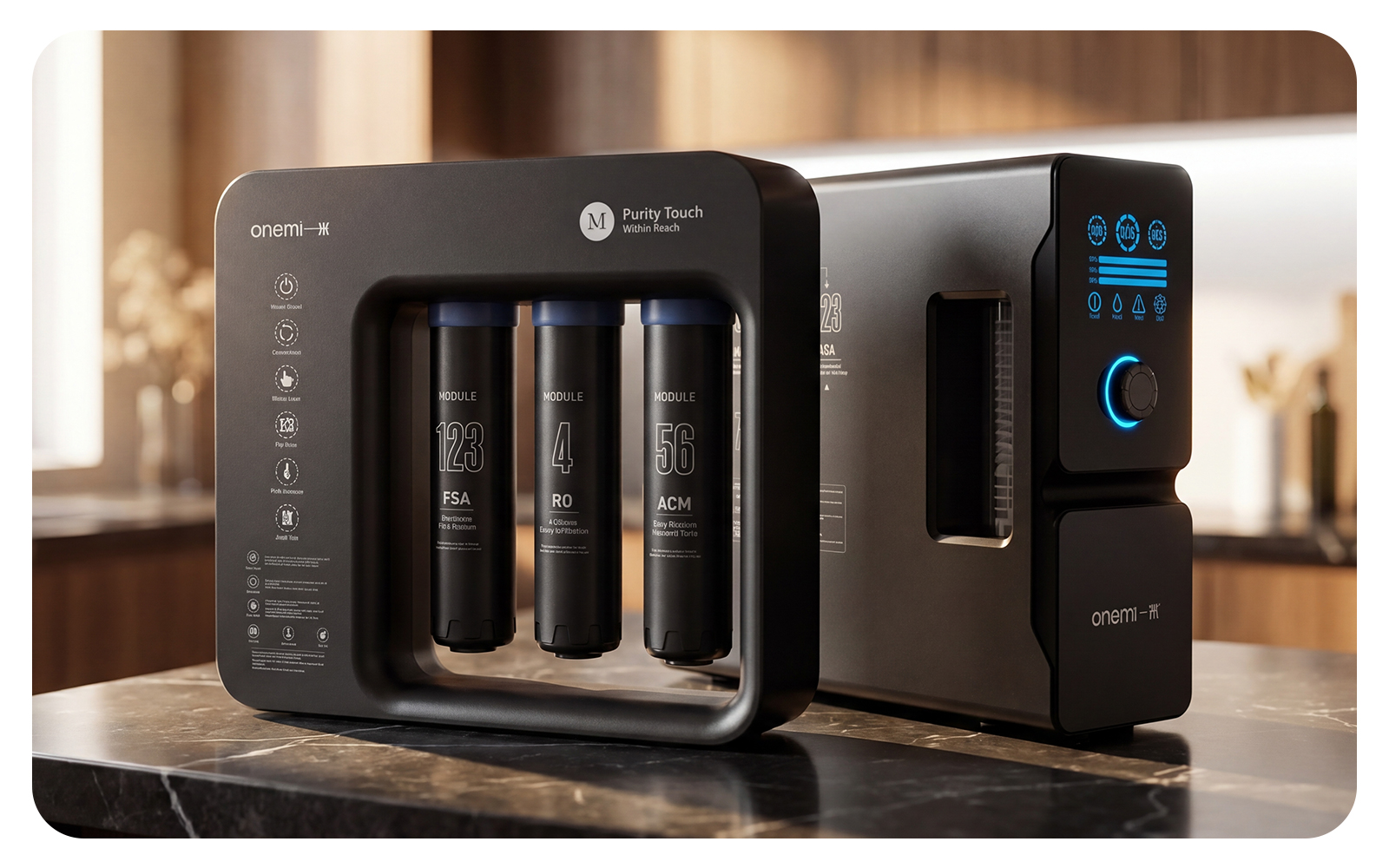
The modern consumer demands fast, fresh water on demand, making tankless high-capacity RO systems the preferred choice for the best brand targeting the US EU market. ONEMI’s advanced tankless systems eliminate the secondary pollution risks associated with traditional storage tanks while delivering an exceptional flow rate ranging from 600 GPD to 1200 GPD.
Our tankless high-capacity RO systems are purpose-built for the modern home recommendation, offering both space savings and superior performance.
Our systems feature the proprietary OneMi PureFlow Technology, which optimizes water delivery and system longevity. Furthermore, ONEMI’s RO systems achieve an industry-leading water recovery rate of 65% to 70%. This performance significantly exceeds China’s national first-class water efficiency standard, minimizing water waste and aligning perfectly with the eco-conscious values of modern EU and US consumers.
Our systems feature the proprietary OneMi PureFlow Technology, which optimizes water flow and system durability. Furthermore, ONEMI’s RO systems achieve an industry-leading water recovery rate of 65% to 70%. This performance significantly exceeds China’s national first-class water efficiency standard, minimizing wastewater and aligning perfectly with the eco-conscious values of modern EU and US consumers.
Universal Filter Compatibility and USPTO-Granted Structure Patents
One of the greatest challenges for a water filter replacement brand is managing the supply chain for standard replacement filters. To address this, ONEMI has developed a revolutionary universal filter cartridge system. Our proprietary design is protected by a USPTO-granted structure patent, ensuring our clients can distribute our products in the US market without infringing on competitor patents.
This universal design simplifies the filter change schedule for end-users, reducing water purifier maintenance costs and boosting customer retention. Whether you are an Amazon seller looking for a high-turnover private label water filter or an established appliance brand expanding your portfolio, ONEMI’s patented cartridge system provides a secure, profitable, and highly scalable solution.
Practical Steps for Selecting a Water Purifier OEM Partner
Choosing the right OEM manufacturing China partner is the most critical decision for your brand’s success. To assist procurement managers, we have compiled a practical framework for evaluating potential manufacturing partners.
Due Diligence Checklist for Compliance Verification
When auditing a potential China water treatment supplier, do not rely solely on marketing claims. Request and verify the following documentation:
| Verification Item | Target Standard / Requirement | Significance for US/EU Market |
|---|---|---|
| Electrical & Safety Certifications | CE, UL, FCC, ROHS (Full Machine Certified) | Mandatory for legal import and customs clearance. |
| Material Safety Certifications | NSF/ANSI 53 or 58 (Filter Elements & Media) | Guarantees that water-contact parts do not leach harmful chemicals. |
| Water Efficiency Rating | 65% – 70% Water Recovery Rate | Exceeds China’s national first-class water efficiency; appeals to eco-conscious buyers. |
| Intellectual Property Security | USPTO-Granted Structure Patents | Prevents patent infringement lawsuits on Amazon and retail shelves. |
| Factory Quality Management | ISO 9001 & ISO 14001 Certification | Ensures consistent manufacturing quality and environmental responsibility. |
During your evaluation, ensure that the manufacturer is capable of maintaining a strict filter change schedule for replacement parts. Reliable access to standard replacement filters is essential for maintaining long-term customer satisfaction and brand loyalty (,) which are key drivers of profitability in the US water filter market.
Long-term Partnership Considerations
Beyond certifications, a successful partnership with an OEM partner requires strong technical alignment and mutual trust. Look for a manufacturer that offers comprehensive ODM water purifier services, including custom industrial design, structural engineering, and tailored packaging solutions.
ONEMI’s extensive experience as a premier water filter contract manufacturing provider in Guangdong allows us to offer end-to-end support. From initial concept drawings to final mass production, we ensure your private label water filter line stands out for its aesthetics, performance, and regulatory compliance. We continuously monitor global regulatory shifts, ensuring that your product line remains compliant with evolving PFAS and water safety laws long into the future.
Conclusion
The regulatory landscape of 2026 presents both a challenge and an extraordinary opportunity. As PFAS restrictions tighten in the US and EU, and as China’s new water quality standards elevate domestic manufacturing, the brands that prioritize compliance will emerge as market leaders. By partnering with ONEMI—a technologically advanced, patent-secured, and fully compliant water purifier manufacturer—you secure a premium product line optimized for the global market.
Ready to upgrade your product portfolio with a certified, high-efficiency tankless RO system? Contact ONEMI today to discuss your OEM/ODM requirements and secure your position in the rapidly growing clean water market.
Interested in this product? Click below and our specialist will assist you.
Learn More & Contact Us →