


 한국어
한국어

The Perfect Storm: PFAS Regulation Meets China’s New National Standards
The global water treatment industry is undergoing its most significant regulatory transformation in decades. On one side of the Pacific, the US Environmental Protection Agency (EPA) has finalized legally enforceable Maximum Contaminant Levels (MCLs) for six PFAS compounds in drinking water — the first federal drinking water standard of its kind. On the other side, China has rolled out a new generation of national standards (GB 34914-2021 and its implementing amendments) that redefine performance benchmarks for household and commercial reverse osmosis systems. For international importers, distributors, and water brand owners evaluating their supply chain, this dual-regulatory shift creates a narrow but actionable compliance window — and the choice of water purifier OEM partner has never been more strategic.
The convergence is not coincidental. Both regulatory frameworks target the same endpoint: safer drinking water through tighter contaminant control and higher system efficiency. For a water purifier manufacturer serving the US and EU markets, the ability to simultaneously satisfy EPA PFAS limits and China’s GB Grade 1 efficiency standard is now a competitive differentiator, not a baseline expectation.
Understanding the PFAS Regulatory Landscape in the US and EU
EPA’s Final PFAS Rule — What It Means for Water Treatment OEMs
In April 2024, the EPA finalized the first national drinking water standard for six per- and polyfluoroalkyl substances. The MCLs are set at 4.0 parts per trillion for PFOA and PFOS individually, and a hazard index-based limit for PFNA, PFHxS, PFBS, and HFPO-DA (GenX chemicals). Public water systems have three years to complete initial monitoring and five years to implement solutions. This timeline creates immediate demand for point-of-use and point-of-entry treatment systems that can demonstrate certified PFAS reduction.
For water purification equipment manufacturers targeting the North American market, the implication is clear: any RO-based system sold into the US must now prove PFAS removal efficacy, ideally through third-party certification under NSF ANSI 58 or NSF ANSI 53. ONEMI’s reverse osmosis membrane systems achieve theoretical PFAS rejection rates exceeding 99%, validated through internal testing protocols aligned with NSF/ANSI standards for filter cartridges.
External reference: EPA PFAS website and EPA drinking water health advisories for PFOA and PFOS provide the full regulatory text and compliance timelines.
EU’s PFAS Restriction Proposal — A Broader Horizon
The European Chemicals Agency (ECHA) is advancing a restriction proposal covering approximately 10,000 PFAS substances under the REACH regulation. While the final implementation timeline remains under consultation, several EU member states have already enacted national PFAS limits. Harvard Law School’s Environmental and Energy Law Program has published detailed analysis on transatlantic PFAS regulatory convergence, noting that US and EU standards are increasingly aligning on acceptable threshold levels.
This alignment matters for any water purifier OEM supplying both the US and EU markets. A unified PFAS compliance strategy across jurisdictions reduces certification cost and time-to-market. ONEMI’s tankless high-capacity RO system achieves 65-70% water recovery — exceeding China’s GB Grade 1 minimum — while simultaneously delivering the contaminant rejection performance demanded by Western regulators.
China’s New GB Standards — A Step Change in RO System Performance
GB 34914-2021: Water Efficiency Grades for RO Systems
China’s GB 34914-2021, effective since July 2022, establishes mandatory water efficiency grades for reverse osmosis drinking water treatment systems. Grade 1 requires a minimum water recovery rate of 65% for standard units — a significant jump from the previous 55% threshold. Grade 2 sits at 55%, and Grade 3 at 45%. Any RO water purifier sold in China must display its efficiency grade, and sub-Grade 3 units are effectively banned from the market.
For a water purifier manufacturer with OEM operations in China, this standard is both a constraint and an opportunity. The constraint is obvious: systems with low recovery ratios (common in older 1:3 or 1:2 designs) can no longer be sold. The opportunity is equally clear: OEM buyers gain access to RO platforms engineered for efficiency from the ground up, platforms that also happen to perform exceptionally well on PFAS rejection. A high-recovery membrane element under GB Grade 1 operates at lower brine concentration per pass, which correlates with more stable contaminant rejection over the element’s service life.
GB 5749-2022: Drinking Water Quality Standards
The revised GB 5749-2022 drinking water quality standard, effective April 2023, expanded its contaminant list to 97 indicators, tightening limits on existing parameters while adding new ones relevant to industrial and agricultural runoff. Although PFAS are not yet individually listed, the standard’s approach to reference limit annexes signals that emerging contaminants will be incorporated in future revisions. Forward-looking water purification equipment manufacturers are pre-integrating PFAS-capable membrane stages into their product roadmaps.
NSF/ANSI Standards: The Global Certification Bridge
While China’s GB standards govern domestic market access, international buyers rely on NSF and ANSI standards for product validation. ONEMI holds NSF certification for filter cartridges (covering NSF ANSI 42 – Aesthetic Effects, NSF ANSI 53 – Health Effects, NSF ANSI 58 – Reverse Osmosis, and NSF ANSI 401 – Emerging Compounds/Incidental Contaminants). It is important to note that NSF certification applies to filter cartridges, not entire machines. Whole-unit certifications include CE, UL, FCC, and ROHS. This distinction matters for OEM buyers designing compliance into their finished product specifications.
External reference: NSF’s PFAS treatment resource library provides additional detail on certified PFAS reduction technologies.
The OEM Compliance Window: Why Now?
Several factors converge to make the 2026-2028 period a strategically critical compliance window for OEM/ODM partnerships in the water purification industry.
Supply Chain Realignment
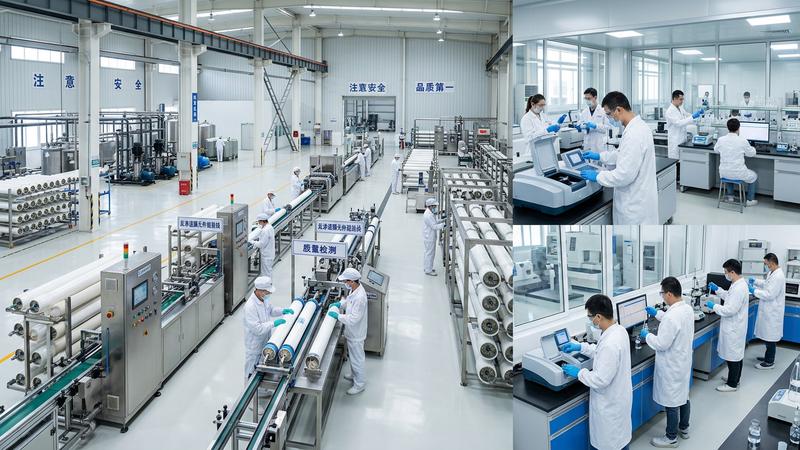
China’s water treatment equipment manufacturing sector is undergoing a capacity upgrade cycle. Smaller producers unable to meet GB 34914-2021 efficiency grades are exiting the market, while Tier-1 factories – those with vertically integrated membrane production, automated assembly lines, and certified testing laboratories – are absorbing their market share. This consolidation benefits OEM buyers who partner with established water purifier OEMs, as higher production volumes translate to better process control and consistent quality across batch runs.
Certification Timelines
Bringing a new water treatment product to the US or EU market typically requires 12 to 18 months for certification, testing, and regulatory filing. For a water treatment OEM entering an OEM/ODM agreement, this timeline begins after the product specification is frozen. Starting now – with a partner whose existing platforms already approach or exceed the required performance thresholds – compresses that timeline considerably. ONEMI’s standard RO platforms have undergone baseline testing against NSF ANSI 58 protocols, reducing the delta between OEM base unit and certified finished product.
Cost of Non-Compliance
Regulatory enforcement is accelerating. The EPA has signaled aggressive monitoring schedules under the Safe Drinking Water Act. EU member states are imposing national PFAS limits ahead of the final REACH restriction. The cost of a compliance failure – product recalls, import holds, liability exposure – far exceeds the incremental investment required to source from a certified water filter manufacturer today. OEM buyers should view compliance capability as supply chain insurance, not a premium add-on.
Technology Suite: Meeting Dual Standards with Single Platforms
High-Recovery RO Membrane Engineering
ONEMI’s latest RO membrane elements incorporate low-fouling polyamide thin-film composite (TFC) chemistry with optimized feed-spacer geometry. The result is stable 65-70% recovery at standard operating pressure – comfortably above GB Grade 1 – without sacrificing salt rejection. Because PFAS molecules (typically 200-500 Da molecular weight) are efficiently rejected by standard RO membranes (pore size ~0.1 nm), the same membrane that achieves regulatory efficiency also delivers >99% PFAS rejection. There is no trade-off between water conservation and contaminant removal.
Tankless High-Capacity RO System Architecture
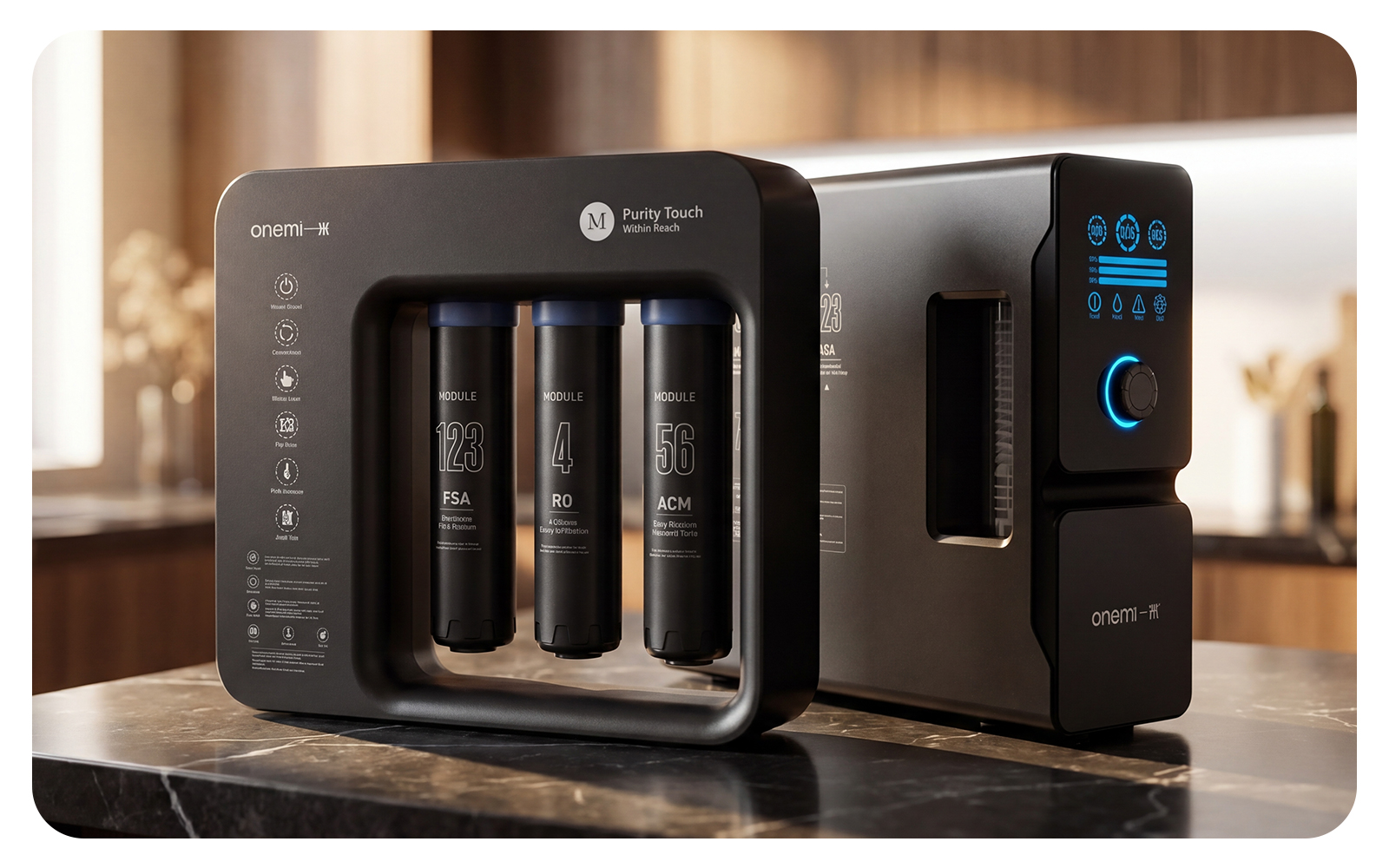
The tankless high-capacity RO system design eliminates the pressurized storage tank while maintaining instantaneous delivery through high-flow membrane elements and precision flow control. This architecture is inherently more hygienic (no standing water, no biofilm risk) and more compact. For OEM buyers, the tankless form factor reduces shipping volume, lowers logistics costs, and simplifies installation – all without compromising PFAS removal or recovery efficiency.
ONEMI’s tankless platform is available under white label agreements, with customizable controller firmware, display interface languages, and branding. Explore the tankless RO system product page for technical specifications and available OEM configurations.
Remineralization and Post-Treatment Options
RO permeate is aggressively pure – sometimes too pure for palatability. ONEMI’s Remineralization RO systems add a controlled calcium and magnesium reintroduction stage, improving taste and raising the pH for consumers who prefer mineral-balanced water. This option pairs naturally with the Instant Hot RO System configuration, where a downstream instant heating module delivers near-boiling water on demand. Both options are available through white label water filtration OEM agreements, allowing brand owners to differentiate their finished products without custom R&D investment.
Compliance Documentation and Third-Party Certification
What OEM Buyers Should Expect from Their Partner
A responsible water purifier manufacturer maintains a compliance dossier that includes at minimum: material safety data sheets for all wetted components, migration test reports (typically 24-hour and 72-hour soak tests per NSF/ANSI extraction protocols), membrane element performance curves at standard test conditions, and batch-level quality records. ONEMI’s factory in Guangdong operates under ISO 9001 quality management, with full traceability from raw material lot numbers to finished unit serial codes.
Certification Portfolio
- CE – Whole units (electromagnetic compatibility + low voltage directive)
- UL – Whole units (safety and electrical standards)
- FCC – Whole units (electromagnetic interference)
- ROHS – Whole units (restricted hazardous substances)
- NSF – Filter cartridges only, covering NSF ANSI 42 (aesthetic), NSF ANSI 53 (health), NSF ANSI 58 (RO systems), NSF ANSI 401 (emerging compounds)
- WQA Gold Seal – Available on select filter elements
- IAPMO Certification – Plumbing and mechanical compliance
- Lead Reduction Certification – Verified on NSF/ANSI 53 testing protocols
ONEMI also holds a US utility patent on a universal filter cartridge structure (USPTO granted), giving OEM partners a differentiated cartridge platform that reduces mold costs across the product portfolio. For more on our component-level capabilities, visit the custom filter manufacturing page.
Supply Chain Advantages for Overseas OEM Buyers
Vertical Integration
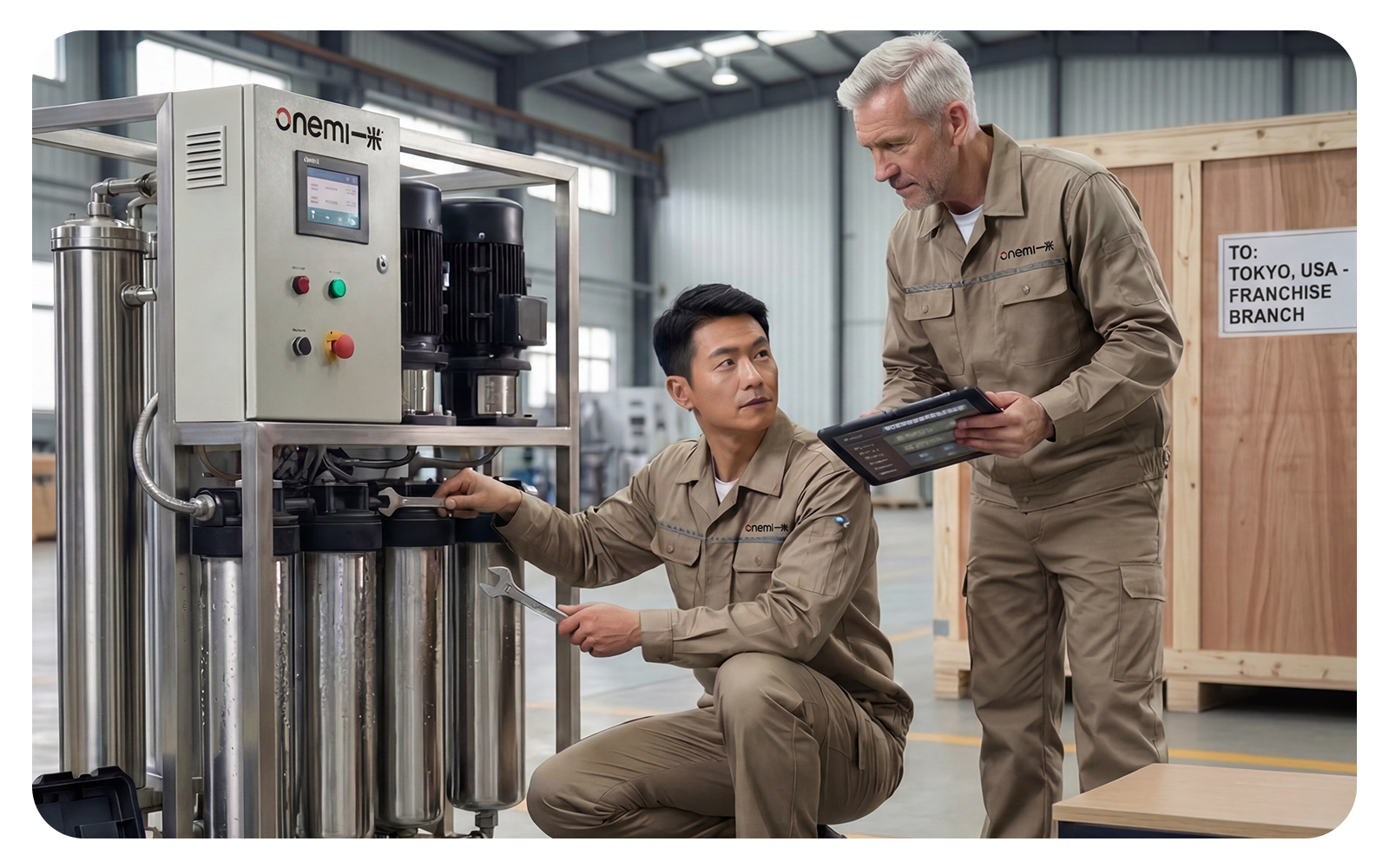
ONEMI operates in-house membrane element winding, injection molding for filter housings, and electronic controller PCB assembly. This vertical structure means shorter lead times, tighter quality control, and faster prototyping compared to assemblers who source subcomponents from third parties. For a water treatment OEM developing a new product line, the ability to iterate on membrane configuration, housing geometry, and control logic under one roof shaves weeks off the development cycle.
Custom Filter Manufacturing and White Label Programs
ONEMI’s white label water filtration program lets brand owners specify everything from cartridge dimensions and media blend to housing color and packaging design. The Custom Filter Manufacturing division produces proprietary blends including catalytic coconut-shell activated carbon (for chloramine and VOC reduction), KDF media (for heavy metal inhibition), and ion-exchange resin (for scale reduction in Salt-Free Water Conditioner configurations). Each filter design is documented with a full performance spec sheet traceable back to raw material certifications.
Intellectual Property Protection
OEM buyers often express concern about design IP protection when manufacturing in China. ONEMI addresses this through: (1) signed non-disclosure and non-circumvention agreements, (2) separate production lines for proprietary SKUs, (3) component branding and mold ownership transferred to the OEM partner upon commercial launch. The US utility patent on universal filter cartridge structure provides an additional layer of IP assurance for buyers who incorporate this design into their product lineup.
Strategic Recommendations for OEM Buyers
Audit Your Current Specs Against the Dual Standards
Review your existing product specifications against both GB 34914-2021 Grade 1 (65% recovery) and EPA PFAS MCLs (4 ppt for PFOA/PFOS). If your current RO platform operates below 60% recovery or lacks certified PFAS reduction data, begin the partner qualification process immediately. The 12-18 month certification pipeline means platforms started today will enter the market just as the EPA’s initial monitoring deadline approaches.
Request a Compliance Gap Analysis
ONEMI offers prospective OEM partners a compliance gap analysis comparing the buyer’s target market regulations against the performance data of available OEM base platforms. This analysis covers recovery ratio, contaminant rejection (including PFAS, lead, arsenic, nitrate, and emerging compounds), certification readiness, and packaging/labeling requirements for each target jurisdiction.
Leverage the GB Standard for Market Access
For buyers who also distribute in China or across Asia, the GB compliance of ONEMI’s platforms is a market access prerequisite. The same unit that meets US PFAS limits and EU REACH requirements simultaneously satisfies China’s GB water efficiency labeling. This multi-market compatibility is increasingly rare among Chinese water purification equipment manufacturers – most optimize for either domestic or export compliance, not both.
The ONEMI OEM Advantage
ONEMI, a Guangdong-based water purification equipment manufacturer with over a decade of production experience, has positioned its R&D roadmap around regulatory convergence from the start. The company’s engineering team monitors EPA rulemaking, EU REACH amendments, and China’s GB standard revisions simultaneously, feeding updates into the product development pipeline. This proactive stance means OEM partners receive platforms that are already calibrated to emerging requirements, not retrofitted after the regulation takes effect.
The company’s product ecosystem spans under-sink RO systems (classic and tankless), whole-house filtration (including Bottleless Water Cooler configurations for commercial clients), Faucet Mount Filter units for quick-install applications, and Salt-Free Water Conditioner systems for scale prevention without regeneration discharge. Each category is available under OEM/ODM terms with customizable specifications.
For importers and distributors evaluating their next product generation, the message is straightforward: regulatory convergence creates a limited window for supply chain optimization. The partners you qualify today will define your compliance posture for the next five years. ONEMI’s combination of GB Grade 1 recovery, >99% PFAS rejection, NSF/CE/UL certification, and US-patented filter cartridge design offers a ready-made platform for the post-PFAS, high-efficiency era of water treatment.
To explore custom specifications, request a compliance gap analysis, or begin the OEM partnership process, use the inquiry form below.
Selecting the Right OEM Partner: A Decision Framework
Technical Capability Assessment
When evaluating a potential water purifier OEM partner for PFAS-era products, the technical assessment must go beyond basic spec sheet comparisons. Importers should examine the factory’s membrane element sourcing and quality control protocols. Does the factory wind its own membrane elements or purchase from third-party suppliers? ONEMI operates its own membrane winding line, which means every element is manufactured under direct quality oversight with consistent tension, adhesive application, and permeate tube bonding. This vertical integration eliminates the variability that arises when membrane elements are sourced from different batches or suppliers.
The test laboratory capability is equally critical. A credible water filter manufacturer maintains at least a Class II microbiological testing lab with the ability to run challenge tests against NSF/ANSI protocols in-house. ONEMI’s lab performs 24-hour migration tests, 72-hour extraction tests, and membrane element performance characterization at standard test conditions of 65 psi (450 kPa) and 25C. These in-house capabilities mean prototype iterations can be validated in days rather than weeks.
Certification Readiness vs. Certification Possession
A common pitfall in OEM sourcing is confusing certification readiness with certification possession. Many water purification equipment manufacturers claim their products are designed to meet NSF or WQA standards but have not actually submitted units for formal testing. ONEMI differentiates by holding active certifications across multiple standards and jurisdictions, with current certificates available for audit by prospective OEM partners. The distinction matters because the certification process often reveals design issues that are invisible on paper – material leaching under extended soak conditions, pressure drop inconsistencies across production batches, or flow rate deviations at extreme temperature conditions.
For a water purifier for US/EU market entry, the minimum certification package should include NSF ANSI 58 (for RO-specific performance claims), NSF ANSI 53 (for health contaminant reduction claims including lead, cyst, and VOC reduction), and UL (for electrical safety on any powered unit). ONEMI’s certification portfolio covers all of these, with NSF ANSI 401 coverage for emerging compounds including pharmaceuticals and personal care products that are increasingly detected in source water supplies.
Production Scale and Batch Consistency
Distributors and importers often underestimate the production scale required to maintain consistent quality across OEM batches. A small workshop can produce a hundred units that pass inspection, but maintaining the same quality at 5,000-unit volumes requires documented process controls, automated testing fixtures, and statistical process monitoring. ONEMI’s factory operates multiple assembly lines with a combined annual capacity exceeding 200,000 units, supported by an ERP system that tracks every component from warehouse receipt to finished goods dispatch. Batch-level quality data, including pressure test results, flow rate measurements, and electrical safety checks, is recorded for each unit and retained for the product’s warranty period.
Supply Chain Resilience
The post-COVID supply chain landscape has taught OEM buyers an expensive lesson: single-source dependency is a high-risk strategy. A factory that depends entirely on imported membrane elements or electronic controllers faces extended lead times and cost volatility during global supply disruptions. ONEMI mitigates this through a dual-source procurement strategy for critical components, maintaining safety stock on membrane roll stock, activated carbon media, and electronic control boards at levels sufficient for 60 days of production. For OEM partners requiring dedicated safety stock for their SKUs, ONEMI offers consignment inventory arrangements where finished goods are held at the factory under the buyer’s ownership, ready for dispatch on 48-hour notice.
Water Quality Challenges Beyond PFAS
Lead and Heavy Metal Reduction
PFAS regulation has drawn attention to emerging contaminants, but legacy contaminants like lead remain a pressing concern for municipal water systems across North America. The EPA’s Lead and Copper Rule Improvements (LCRI), finalized in 2024, require more aggressive lead service line replacement and tighter action levels at the tap. For OEM buyers, this means any water purifier for US/EU market introduction should include verified lead reduction performance. ONEMI’s Lead Reduction Certification, validated under NSF ANSI 53 protocols, confirms >99% reduction of soluble lead in both pH 6.5 and pH 8.5 test conditions, covering the range typically encountered in US municipal water supplies.
Emerging Contaminants and the NSF ANSI 401 Standard
NSF ANSI 401 was developed specifically to address 15 emerging contaminants that were not covered by earlier standards, including atenolol (a beta-blocker), carbamazepine (an anticonvulsant), estrone (a hormone), and DEET (an insect repellent). While these compounds are not yet regulated under the Safe Drinking Water Act, their detection in source water is increasing, and consumer awareness is growing. ONEMI’s tankless high-capacity RO system, equipped with an activated carbon post-filter, achieves the NSF ANSI 401 reduction requirements for all 15 compounds, providing a future-proofed solution for distributors who want to market their products as comprehensive contaminant barriers.
Integrating Smart Features into OEM Platforms
Distributors in the US and EU markets increasingly expect connected water treatment products that provide usage data, filter life monitoring, and leak detection. ONEMI’s OEM platforms can be configured with Wi-Fi or Bluetooth-enabled controllers that report to a mobile app (white-label ready) or to the buyer’s existing IoT platform via API. The smart controller tracks cumulative water production, remaining filter element life based on actual throughput rather than calendar days, and system operating parameters including inlet pressure, pump cycles, and TDS rejection rate. Leak detection sensors at the unit base trigger automatic shutoff and push notification, reducing property damage risk for end users.
For importers targeting the commercial segment, the Bottleless Water Cooler configuration integrates the tankless RO system with a point-of-use dispensing station, eliminating bottled water delivery costs and the associated plastic waste. This configuration is available with hot, cold, and ambient water dispensing, with NSF-certified components throughout the fluid path. ONEMI’s OEM/ODM program for the Bottleless Water Cooler platform includes custom panel branding, dispense button configuration, and optional UV sterilization for the cold water reservoir.
Understanding the Regulatory Timeline
EPA Implementation Phases
The EPA’s PFAS rule establishes a phased compliance schedule. Year 1-3: Initial monitoring for all community water systems and non-transient non-community water systems serving more than 10,000 people. Smaller systems have until Year 5 to complete initial monitoring. Year 5: Systems exceeding MCLs must implement treatment solutions. Year 7: Full compliance for all systems. This timeline creates a demand wave that starts with large municipal utilities (Years 1-3) and cascades to smaller systems (Years 4-7). Point-of-entry and point-of-use treatment systems, including RO units certified under NSF ANSI 58, are among the most cost-effective solutions for small and medium water systems facing PFAS exceedances.
EU REACH Restriction Timeline
ECHA’s PFAS restriction proposal, submitted by authorities from Germany, the Netherlands, Denmark, Sweden, and Norway, is currently under scientific evaluation. The proposed restriction includes transition periods of 18 months to 12 years depending on the PFAS concentration and the availability of alternatives. For water treatment products, the restriction would likely require PFAS-free membrane materials or demonstrated containment of PFAS in waste streams. ONEMI is monitoring this development and has initiated research into PFAS-free membrane alternatives while maintaining that current TFC RO membrane performance already exceeds regulatory requirements for treated water PFAS levels.
Regional Compliance Nuances for OEM Buyers
California’s Proposition 65 and State-Level PFAS Standards
Beyond federal EPA regulations, several US states have enacted their own PFAS standards that exceed federal requirements. California’s Proposition 65 already lists PFOA and PFOS as reproductive toxicants, requiring warning labels on products that may cause exposure. California also adopted notification levels for PFOA (6.1 ppt) and PFOS (6.5 ppt) that are more stringent than the EPA’s health advisory levels. Massachusetts, New Hampshire, Vermont, and Michigan have all enacted state-level PFAS MCLs that are either equivalent to or stricter than the federal standard. For a water purifier OEM selling nationally, the product must meet the most stringent state standard, which means designing for California and Northeast US compliance even if the primary market is elsewhere.
Canada’s Proposed PFAS Guidelines
Health Canada published draft objective for PFAS in drinking water in 2024, proposing a maximum acceptable concentration of 30 ppt for the sum of PFOA, PFOS, PFHxS, and PFBS. While less stringent than the EPA’s 4 ppt for individual compounds, the Canadian approach targets total PFAS load, which is a different compliance metric. ONEMI’s OEM platforms can be configured with optimized membrane element count and operating parameters to meet whichever regulatory framework the target market applies.
Total Cost of Ownership Considerations for OEM Buyers
Filter Replacement Economics
For distributors and importers, the lifetime economics of a water treatment product are determined primarily by filter replacement frequency and cost. A system with higher water recovery (GB Grade 1) generates less wastewater per gallon of purified water, reducing the effective cost per gallon for end users. ONEMI’s Custom Filter Manufacturing program allows OEM partners to optimize media blend and cartridge dimensions for their specific water quality conditions, extending service life without sacrificing contaminant reduction performance. The universal filter cartridge design protected by the US utility patent also reduces the number of unique cartridge SKUs needed across a product line, simplifying inventory management for distributors.
Warranty and Post-Sale Support
ONEMI backs its OEM platforms with a standard warranty covering manufacturing defects, with extended warranty terms available for volume commitments. Technical documentation including installation manuals, troubleshooting guides, and replacement part lists is provided in English, Spanish, and French. For OEM partners establishing their own service networks, ONEMI offers remote technical support, spare parts consignment, and technician training programs conducted at the factory or via video conferencing.
Frequently Asked Questions
What is the difference between GB Grade 1 and NSF ANSI 58?
GB 34914-2021 Grade 1 is a Chinese national standard requiring minimum 65% water recovery for RO systems. NSF ANSI 58 is a North American standard that covers RO system performance including contaminant reduction claims. They are complementary – a system designed for GB Grade 1 often performs well under NSF ANSI 58, but separate testing is required for each certification. ONEMI recommends meeting both standards for multi-market product launches.
Can a single RO platform serve both the US and Chinese markets?
Yes. ONEMI’s tankless high-capacity RO system is designed to meet GB 34914-2021 Grade 1 recovery (65-70%) while delivering the contaminant rejection required for EPA PFAS compliance and NSF/ANSI certification. Platform customization for local power supply, language, and packaging is handled during the OEM specification phase.
Does ONEMI hold NSF certification for whole units or just filter cartridges?
NSF certification covers filter cartridges only, not entire machines. Whole-unit certifications include CE, UL, FCC, and ROHS. This is standard practice in the industry – NSF evaluates the contaminant-reduction performance of replaceable filter elements, while UL and CE evaluate the electrical safety and electromagnetic compatibility of the complete appliance.
How long does a typical OEM/ODM development cycle take?
For existing ONEMI platforms, the OEM cycle is 8-12 weeks from specification freeze to pilot run, including custom branding, packaging, and certification documentation. For entirely new platform development, typical timelines range from 6 to 12 months depending on complexity and certification requirements.
What PFAS reduction data is available for ONEMI RO systems?
ONEMI’s RO membrane elements achieve theoretical PFAS rejection exceeding 99% based on membrane pore size (0.1 nm) relative to PFAS molecular dimensions (200-500 Da). Specific challenge test data against PFOA, PFOS, and the four additional EPA-regulated compounds is available under NDA for qualified OEM partners.
Interested in this product? Click below and our specialist will assist you.
Learn More & Contact Us →ONEMI — www.onemiro.com Original Content