

 한국어
한국어

Water Purifier Manufacturers: Navigating PFAS Regulation and China’s New Standards Compliance Window
Two regulatory systems on opposite sides of the Pacific are reshaping the water treatment industry in 2026. The U.S. EPA just proposed significant changes to its PFAS drinking water rules, while China’s GB 34914-2021 water efficiency standard is now fully enforced. For OEM partners serving both markets, this dual shift creates a rare compliance window — but only for those who move on it.
If you’re sourcing filtration systems for the North American or European markets, understanding how these two frameworks intersect is no longer optional. It determines whether your product line meets federal drinking water limits, avoids state-level enforcement gaps, and clears customs without delays.
This guide breaks down what every procurement manager, product developer, and brand owner needs to know — and why working with an experienced water purifier manufacturer that already meets both sets of requirements is the fastest path to market.
What the EPA Changed in May 2026
On May 18, 2026, the EPA issued two connected proposals that directly affect anyone importing drinking water systems into the United States:
- PFOA and PFOS limits stay at 4 parts per trillion. That threshold is locked in. The science hasn’t changed, and the EPA isn’t backing away from it.
- Compliance window extends to 2031. Public water systems can request up to two extra years — from 2029 to 2031 — to meet the mandate. This extension applies only to systems in states and territories that haven’t obtained primacy enforcement authority.
- Four other PFAS compounds lose their federal limits. The EPA proposes rescinding MCLs for PFHxS, PFNA, HFPO-DA (GenX), and the hazard-index mixture approach that covered those three plus PFBS. The rationale is procedural — the agency cites gaps in the Safe Drinking Water Act rulemaking process — not a change in health science.
The comment period runs through July 20, 2026, and legal challenges are widely expected. But here’s the takeaway for OEM buyers: the 4 ppt limit for PFOA and PFOS is not going anywhere. That means any water purifier for the US/EU market must demonstrate removal capability at or below that level. The extended timeline gives you room to switch suppliers, but it doesn’t reduce the technical requirement.
China’s GB 34914-2021: Tougher Water Efficiency, Already in Force
While the EPA debate plays out, China’s updated water efficiency standard is fully operational. GB 34914-2021 replaced the old five-tier rating system with three demanding grades:
- Grade 1 (Premium): Water recovery rate ≥ 65%, total purified volume ≥ 4,000 L
- Grade 2 (Standard): Recovery rate ≥ 55%, volume ≥ 3,000 L
- Grade 3 (Minimum Allowable): Recovery rate ≥ 45%, volume ≥ 2,000 L
Any reverse osmosis or nanofiltration purifier that wastes more than 55% of incoming water is effectively banned from the Chinese market. The standard also now covers nanofiltration membranes, adds sulfate removal requirements for NF systems, and changes the test water formulation from TDS measurement to conductivity (1,000 ± 100 µS/cm) with added MgSO₄.
For a water purifier OEM/contract manufacturing partner exporting to both China and the West, this creates a technical paradox: PFAS removal at 4 ppt demands high membrane pressure, which typically generates more reject water. Meeting Grade 1 efficiency (≥ 65% recovery) while hitting sub-4 ppt PFAS rejection requires advanced membrane engineering that not every factory can deliver.
The Compliance Window: Why 2026–2031 Matters
The convergence of these two regulatory timelines creates a five-year window that savvy OEM buyers should exploit:
- EPA enforcement tail (2026–2031): Utilities have until 2031 to comply with 4 ppt PFOA/PFOS limits. Home and commercial treatment systems, however, must prove their effectiveness now if they want specifier and distributor buy-in for the years ahead.
- State-level acceleration: Even if the EPA rescinds federal limits for PFHxS, PFNA, and GenX, states like California, New York, Michigan, Massachusetts, and New Hampshire maintain their own enforceable PFAS standards. A water purifier manufacturer that builds for the toughest state standard automatically satisfies all others.
- China Grade 1 as a global benchmark: The ≥ 65% recovery rate is becoming a de facto international efficiency standard. Buyers in Europe, Southeast Asia, and the Middle East are increasingly writing Grade 1-equivalent recovery rates into their RFQs.
Brands that lock in compliance-ready supply chains during this window will hold a pricing and specification advantage once enforcement tightens after 2031.
Why Reverse Osmosis Remains the Baseline
For PFAS removal at the 4 ppt level, no technology beats thin-film composite reverse osmosis membranes. The combination of size exclusion (pores at ~0.0001 microns) and electrostatic repulsion removes more than 99% of both long-chain and short-chain PFAS compounds.
But bulk RO isn’t enough anymore. The systems that win in this market combine high rejection with low waste. That’s where energy efficient RO design separates good manufacturers from average ones. Low-energy membranes, recirculation pumps, and adaptive flush cycles all contribute to hitting Grade 1 recovery without sacrificing contaminant rejection.
Adjacent Technologies That Complement RO
Smart OEM programs offer more than one platform. Depending on the target application, several complementary technologies fill specific niches:
- UV Water Purification handles microbial inactivation downstream of the membrane, adding a second barrier for bacteria and viruses in point-of-use systems.
- Gravity Fed Filtration works in off-grid and emergency contexts where pressurized RO isn’t feasible — think humanitarian aid or temporary housing projects.
- Alkaline Water Filter stages restore beneficial minerals after RO stripping, a common request from the health-conscious consumer segment.
- Microplastic Filter stages — typically sediment or carbon block — catch larger debris before it reaches the RO membrane, extending membrane life.
Beyond Residential: Specialized Applications
The same membrane technology stack scales across verticals that procurement teams often source together:
Commercial Water Treatment systems for restaurants, hotels, and office buildings demand higher flow rates and longer service intervals than residential units. A modular rack design with parallel membrane arrays lets you scale from 600 GPD to 6,000 GPD without re-engineering the filtration core.
Pharmaceutical Water applications require USP-grade purified water with consistent conductivity below 1.3 µS/cm. RO with continuous electrodeionization (CEDI) polishing meets this spec reliably.
Lab Grade Water systems for research and clinical labs need Type I (18.2 MΩ·cm) resistivity. These systems pair RO pretreatment with UV oxidation and mixed-bed deionization — all of which can be integrated into a single OEM platform.
Aquarium RO System designs are a specialized but high-margin category. Marine aquarists demand zero silicates, phosphates, and dissolved solids. A dedicated RO unit with DI polishing stages is the standard configuration, and OEMs that offer customizable media layering win this niche.
Whole House vs Point of Use: Structuring Your Product Line
One of the most common questions OEM buyers face is Whole House vs Point of Use — which configuration to lead with, and how to offer both without doubling your SKU count.
The answer depends on the contaminant profile and flow requirements:
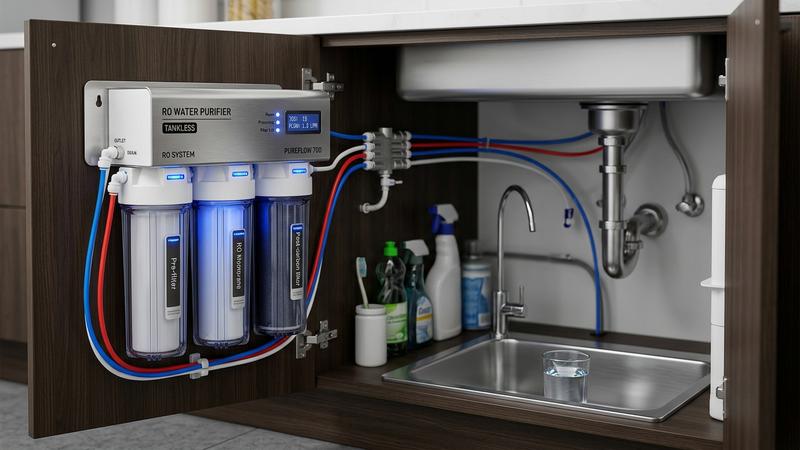
- Point-of-Use (POU) systems — under-sink RO units with dedicated faucets — deliver the highest removal rates because they treat water at the moment of consumption. They’re the standard choice for PFAS removal in homes and small offices.
- Whole House (POE) systems treat water at the main entry point. They protect plumbing, water heaters, and fixtures from scale and sediment but typically use carbon or media filtration rather than RO, since treating all household water with RO is cost-prohibitive at scale.
A smart product strategy pairs a whole-house pre-treatment system (sediment + carbon + Water Softener vs RO decision for hardness control) with a point-of-use RO system for drinking water. ONEMI’s product lines cover both approaches — terminal RO systems for under-sink POU applications and whole-house filtration platforms — and can configure either or both for OEM branding.
For buyers comparing Bottled Water vs Filter costs — a common internal debate during capital planning — a high-recovery RO system with a Water Test Kit for ongoing verification typically pays for itself within 12 to 18 months versus bottled water delivery for an office of 50 people.
Camping, Travel, and Emergency: Portable Systems
The outdoor and emergency preparedness market demands lightweight, no-power-required solutions. A Camping Water Filter — typically a hollow-fiber membrane pump or gravity bag — removes bacteria, protozoa, and sediment but does not remove PFAS or dissolved chemicals. For extended backcountry trips where chemical contaminants are a concern, a compact RO or distillation device is the only reliable option. OEM buyers in this space should specify which contaminant classes the system must address before selecting membrane type.
Quality Starts with the Membrane
No amount of system design compensates for a weak membrane. Every OEM partner should be able to document:
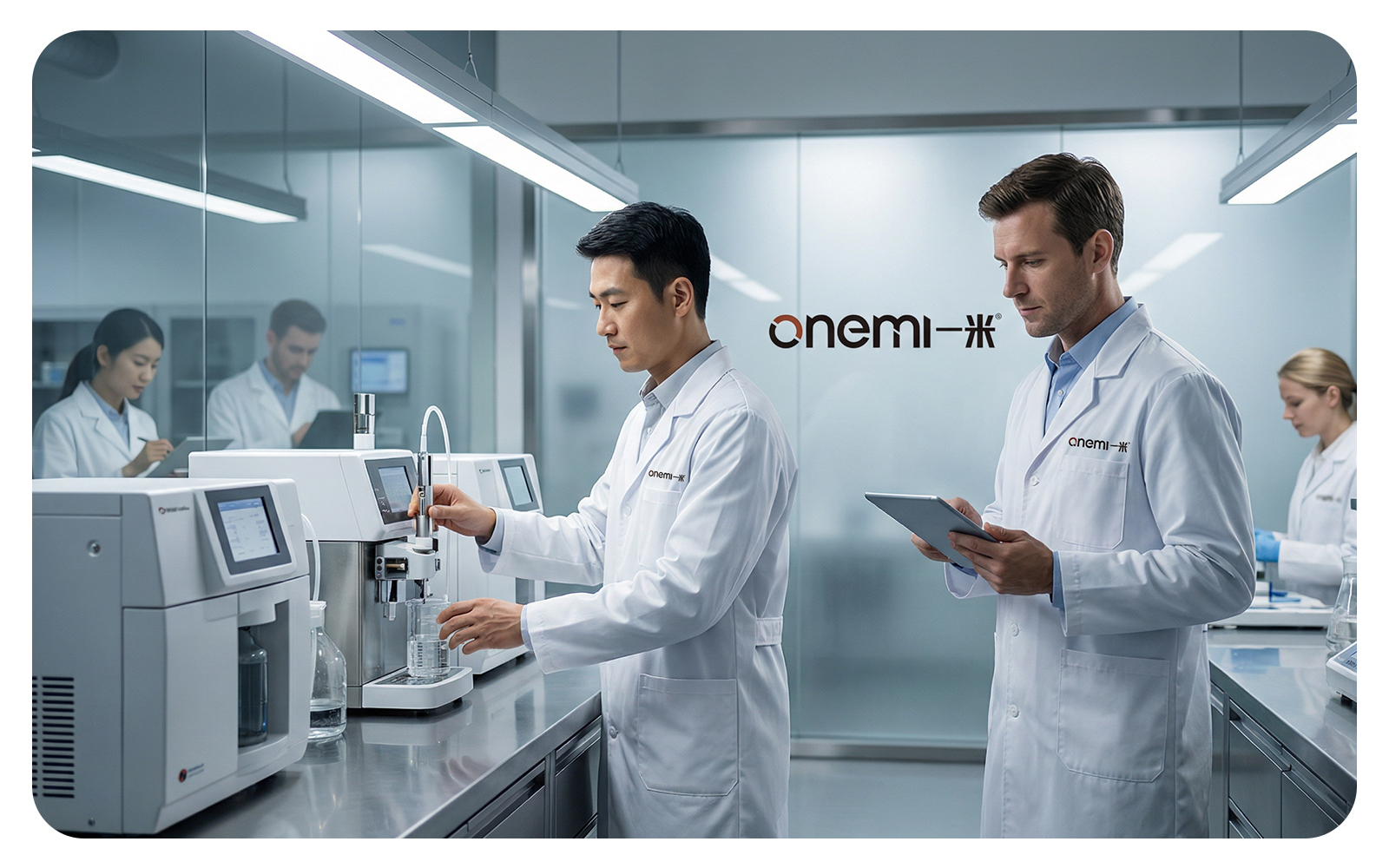
- PFAS rejection test data at 4 ppt feed concentration, using third-party lab verification
- Water recovery rates measured under the GB 34914-2021 test protocol (conductivity-adjusted feed water, standardized flow)
- Total dissolved solids rejection consistently above 95% over the rated membrane life
ONEMI, a Guangdong-based water purification equipment manufacturer, holds a USPTO-granted structural patent for universal filter cartridges. That patent — covering the quick-twist interface design — means replacement cartridges fit a broad range of standard housings, which simplifies supply chain logistics for importers managing multiple SKUs. Every ONEMI system ships with CE, UL, FCC, and ROHS whole-unit certifications, and the filter cartridges carry NSF/ANSI 58 validation for material safety and structural integrity.
The Certification Checklist
When evaluating a water purifier manufacturer for US/EU market exports, confirm these credentials in writing:
| Certification | What It Covers | Required For |
|---|---|---|
| NSF/ANSI 58 | RO system material safety, structural integrity, contaminant reduction claims | US retail and commercial |
| UL 1081 / UL 979 | Electrical safety for water treatment appliances | US and Canada |
| CE (LVD + EMC) | Low-voltage and electromagnetic compatibility directives | EU market access |
| FCC Part 15 | RF emissions for electronic components (solenoids, sensors, pumps) | US market |
| ROHS | Restriction of hazardous substances in materials and electronics | EU, US, and global |
For a deeper look at how these regulations interact, read our earlier analysis: PFAS Regulations 2026: What OEM Water Purifier Manufacturers Need to Know.
Why the Tankless Form Factor Wins
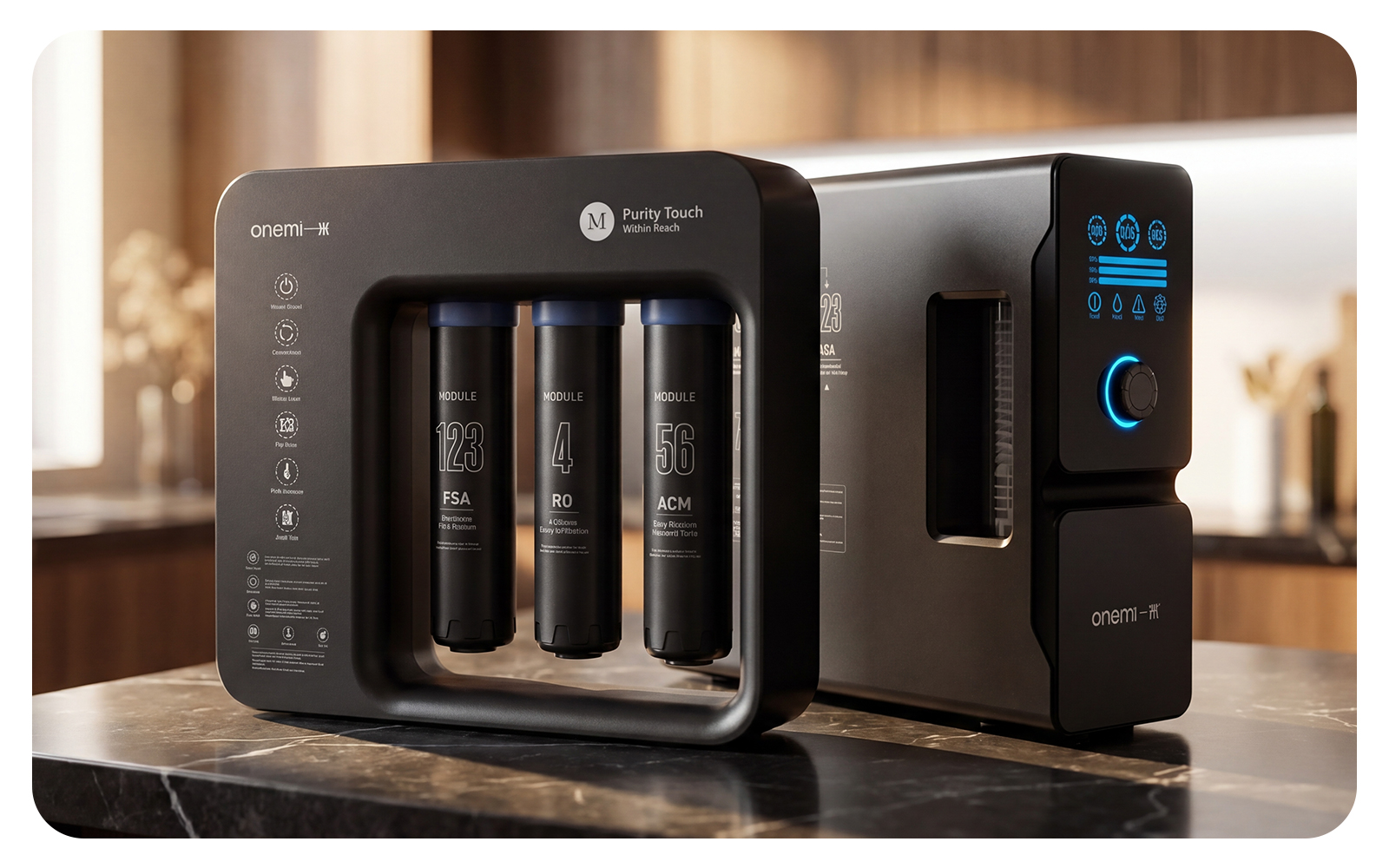
Traditional tank-based RO systems store treated water in a pressurized bladder tank, which introduces three problems: bacterial growth over time, limited flow rate, and a bulky footprint under the sink. The tankless high-capacity RO system eliminates the storage tank entirely by using a high-flow membrane and a recirculation pump to deliver filtered water on demand.
For OEM buyers, the advantages are clear:
- Smaller package — fits under standard kitchen sinks without cabinet modification
- Higher flow — 600 to 1,000 GPD models deliver a full glass in 3–5 seconds
- Better water quality — no standing water in a tank means no biofilm risk
- Grade 1 efficiency — modern tankless designs with recirculation achieve 65–70% recovery consistently
If you’re specifying a product line for 2027–2030, tankless should be your default architecture. Tank-based systems still serve price-sensitive entry-level tiers, but the regulatory direction pushes toward higher efficiency, smaller footprint, and better microbial control.
One Platform, Multiple Markets
The smartest approach to OEM sourcing right now is a single, modular platform that can be configured for different regions with minor hardware swaps. A membrane element rated for 4 ppt PFAS rejection works everywhere. The same platform, with a different faucet kit and power supply, ships to the US, Europe, and Southeast Asia.
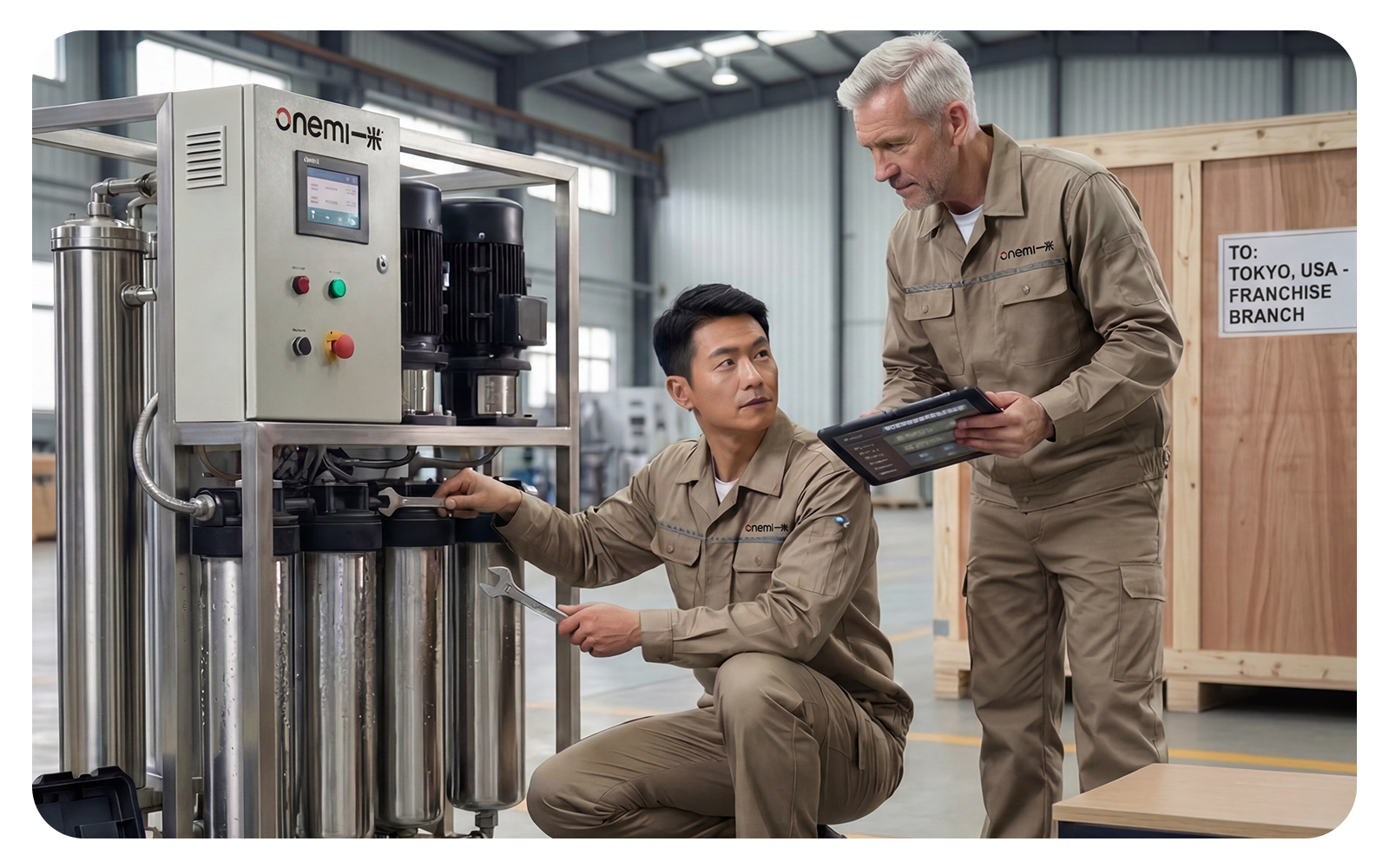
This is where ONEMI’s approach to water purifier OEM/contract manufacturing differentiates. The universal cartridge structure means one filter SKU supports multiple system variants. That reduces your inventory complexity, speeds up customs clearance (one harmonized code for the cartridge family), and makes field replacement straightforward for your distributors.
Our earlier piece on the strategic roadmap for PFAS compliance covers the step-by-step transition plan — audit current SKUs, switch to tankless high-efficiency platforms, then certify for your target markets.
The EPA’s own analysis confirms that point-of-use RO systems achieve greater than 99% reduction of PFAS. The World Health Organization’s drinking water quality guidelines also recognize RO as an effective treatment barrier for chemical contaminants. For independent certification standards, the NSF’s PFAS treatment guidance provides the testing protocol that most US regulators reference.
How to Evaluate an OEM Partner for 2026–2031
When you’re shortlisting factories for a new product generation, use this framework:
- Does the factory have in-house membrane R&D? If they’re buying commodity membranes and assembling housings, they can’t optimize the rejection-efficiency tradeoff.
- Can they document PFAS rejection at 4 ppt? Not just TDS rejection. The two are not the same.
- What is their best water recovery rate on a tankless system? If it’s below 60%, they won’t qualify for China Grade 1 or the emerging global efficiency standard.
- Do they hold structural patents? A patented cartridge interface means fewer compatibility headaches down the road.
- What certifications are already in hand? Starting from zero adds 6–12 months to your timeline.
The manufacturers that answer yes to all five are the ones ready for the window. The rest will catch up — but probably not before 2031.
Bottom Line
Two regulatory systems are pulling in the same direction: higher contaminant removal and higher water efficiency. The EPA keeps the PFAS bar at 4 ppt. China demands 65% recovery for top-tier systems. Both trends favor manufacturers that invest in membrane science, tankless architecture, and certification depth.
The compliance window runs through 2031. That’s roughly five years to qualify new products, build distributor confidence, and establish yourself in the US and EU markets before enforcement tightens further. OEM buyers who start the evaluation now — rather than waiting for the next regulatory shoe to drop — will be the ones holding compliant inventory when their competitors are still in the design phase.
ONEMI — www.onemiro.com Original Content
ONEMI onemiro.com Original Content
Powered by Yimi PureFlow Technology
,
For OEM inquiries and technical specifications, visit www.onemiro.com/en/ for product pages and certification downloads.
Interested in this product? Click below and our specialist will assist you.
Learn More & Contact Us →