



 한국어
한국어


PFAS Filtration Market 2026: Smart Water Purifiers, IoT AI, and Energy Efficient RO Systems — A B2B OEM Procurement Guide
The global water purification industry is at the confluence of two powerful currents: the tightening regulatory clampdown on PFAS (“forever chemicals”) and the explosive growth of the water treatment market, projected to surge from $481 billion in 2025 to $970 billion by 2035 at a robust CAGR of 7.5%. For B2B buyers, procurement professionals, and brand owners seeking a water purifier manufacturer, understanding how these forces reshape the supply chain is mission-critical.
ONEMI — a leading Chinese water purification equipment manufacturer — presents this comprehensive guide to help OEM/ODM buyers navigate the PFAS filtration market, evaluate next-generation filtration technology, and make informed procurement decisions in an era of smart water filtration IoT and energy efficient RO systems.
—
The PFAS Filtration Market: Size, Scope, and the Forever Chemicals Removal Imperative
PFAS (per- and polyfluoroalkyl substances) contamination has emerged as the defining water quality challenge of the decade. With the US Environmental Protection Agency (EPA) enforcing maximum contaminant levels (MCLs) of 4 ppt for PFOA and PFOS, and 10 ppt for PFNA, PFHxS, and GenX chemicals, the demand for certified forever chemicals removal technology has skyrocketed.
For brands sourcing a water purifier for US/EU market distribution, this is not merely a compliance exercise — it is a strategic market differentiator. Consumer awareness, amplified by platforms like Consumer Reports water filter rankings, has made PFAS filtration a top purchasing criterion. Retailers and distributors increasingly demand NSF/ANSI-certified PFAS reduction performance as a baseline requirement.
The PFAS filtration market now spans residential, commercial, and industrial applications. From countertop RO system designs for apartments to tankless under sink RO configurations for modern kitchens, the technology ecosystem is diversifying rapidly. B2B buyers must stay ahead of these shifts to secure reliable, certified supply chains.
Explore our full range of certified filtration systems on our Terminal Purification Products page.
—
Next-Gen Filtration Technology: Smart Water Purifiers IoT AI and Energy Efficient RO Systems
The convergence of IoT, artificial intelligence, and advanced membrane science is redefining what a water purifier can achieve. Smart water purifiers IoT AI systems now offer real-time water quality monitoring, filter life prediction, and automated system optimization — capabilities that are transforming the B2B procurement metrics landscape.
Key technology trends driving the next-gen filtration market include:
- IoT-Enabled Smart Monitoring: Real-time TDS, flow rate, and PFAS breakthrough alerts via cloud platforms enable predictive maintenance and quality assurance at scale. Smart water filtration IoT systems provide OEM buyers with unprecedented visibility into deployed product performance.
- Energy Efficient RO Systems: New high-recovery membrane designs achieve 65-70% water efficiency while maintaining >99% PFAS rejection. These energy efficient RO systems reduce pump load and wastewater, lowering total cost of ownership for end users and improving sustainability metrics for brands.
- AI-Driven Optimization: Machine learning algorithms analyze usage patterns to optimize flushing cycles, membrane pressure, and filter replacement schedules, extending system lifespan by up to 30%.
- Hydrogen Water Systems: An emerging premium category, hydrogen water systems combine electrolysis with advanced filtration, appealing to health-conscious consumers in developed markets. B2B buyers should evaluate this adjacent category for product line expansion opportunities.
As a technology-forward water purifier OEM, ONEMI integrates these innovations into our product platforms. Our R&D team continuously refines what is possible with modern filtration engineering.
Discover our research capabilities on the R&D Division page.
—
B2B Procurement Metrics: How to Evaluate a Water Purifier Manufacturer for PFAS Compliance
For procurement professionals sourcing a tankless high-capacity RO system or other advanced filtration products, the evaluation framework must extend beyond unit cost. Here are the essential B2B procurement metrics for PFAS compliance sourcing:
1. NSF/ANSI Certification Scope
Verify that the manufacturer’s systems are tested under NSF/ANSI 58 (reverse osmosis) and/or NSF/ANSI 53 (carbon filtration) for PFAS reduction. ONEMI’s filter cartridges carry NSF certification, and our whole-unit systems comply with CE, UL, FCC, and ROHS standards for seamless global market entry.
Important note: While we proudly hold filter cartridge NSF certification and comprehensive whole-unit certifications (CE/UL/FCC/ROHS), we do not claim whole-unit NSF certification for PFAS reduction. Always verify the exact certification scope with your OEM partner.
2. Dual Compliance: US EPA + China GB Standards
China’s GB 34914-2021 mandates a minimum 45% water recovery rate (Grade 3) for all RO water purifiers sold domestically, with Grade 1 requiring ≥65% recovery. Leading manufacturers like ONEMI achieve Grade 1 efficiency while simultaneously meeting EPA PFAS limits — a dual-compliance capability that fewer than 20% of Chinese factories currently possess.
3. Manufacturing Scale and Export Track Record
China water filter manufacturer export trends show a clear shift toward high-value, certified products. Evaluate your partner’s export volume, target markets, and experience with US/EU regulatory frameworks. A factory that has navigated FDA registration, California Prop 65, and EPA TSCA compliance brings invaluable regulatory intelligence to the partnership.
4. Smart Filtration IoT Integration Readiness
Does the manufacturer offer IoT modules, app development support, and cloud platform integration? As smart water filtration IoT becomes standard in premium markets, your OEM partner’s IoT readiness directly impacts your product’s competitiveness and long-term upgrade path.
—
China Water Filter Manufacturer Export Trends: Market Insights for Sourcing Decisions
The global water treatment supply chain is undergoing a structural transformation. China water filter manufacturer export trends for 2025-2026 reveal several patterns critical for B2B buyers:
- Premiumization of Exports: Chinese manufacturers are moving from basic filtration products to high-value, IoT-enabled, multi-certified systems. The export average selling price has increased by 18-25% year-over-year for NSF/UL-certified RO systems.
- Vertical Integration: Top-tier manufacturers now produce their own membranes, filter cartridges, and electronic components in-house, ensuring quality control and supply chain resilience. ONEMI’s vertical integration includes proprietary Yimi PureFlow Technology and a US utility patent on universal filter cartridges.
- Direct B2B Engagement: Trade platforms and industry expos increasingly facilitate direct OEM/ODM relationships, bypassing traditional distributor markups. Market insights sourcing guide data suggests that direct factory partnerships reduce time-to-market by 30-40% for new product launches.
- Sustainability Mandates: EU and US importers now require sustainability documentation — carbon footprint reports, recyclable packaging, and conflict-free mineral sourcing. Manufacturers with documented ESG practices gain preferential procurement status.
Industry peers such as iSpring and Waterdrop have demonstrated the viability of the China-to-global OEM model, proving that certified, high-quality Chinese manufacturing can compete at the highest tier of the global water treatment market.
—
The Tankless High-Capacity RO System: A Market Winner
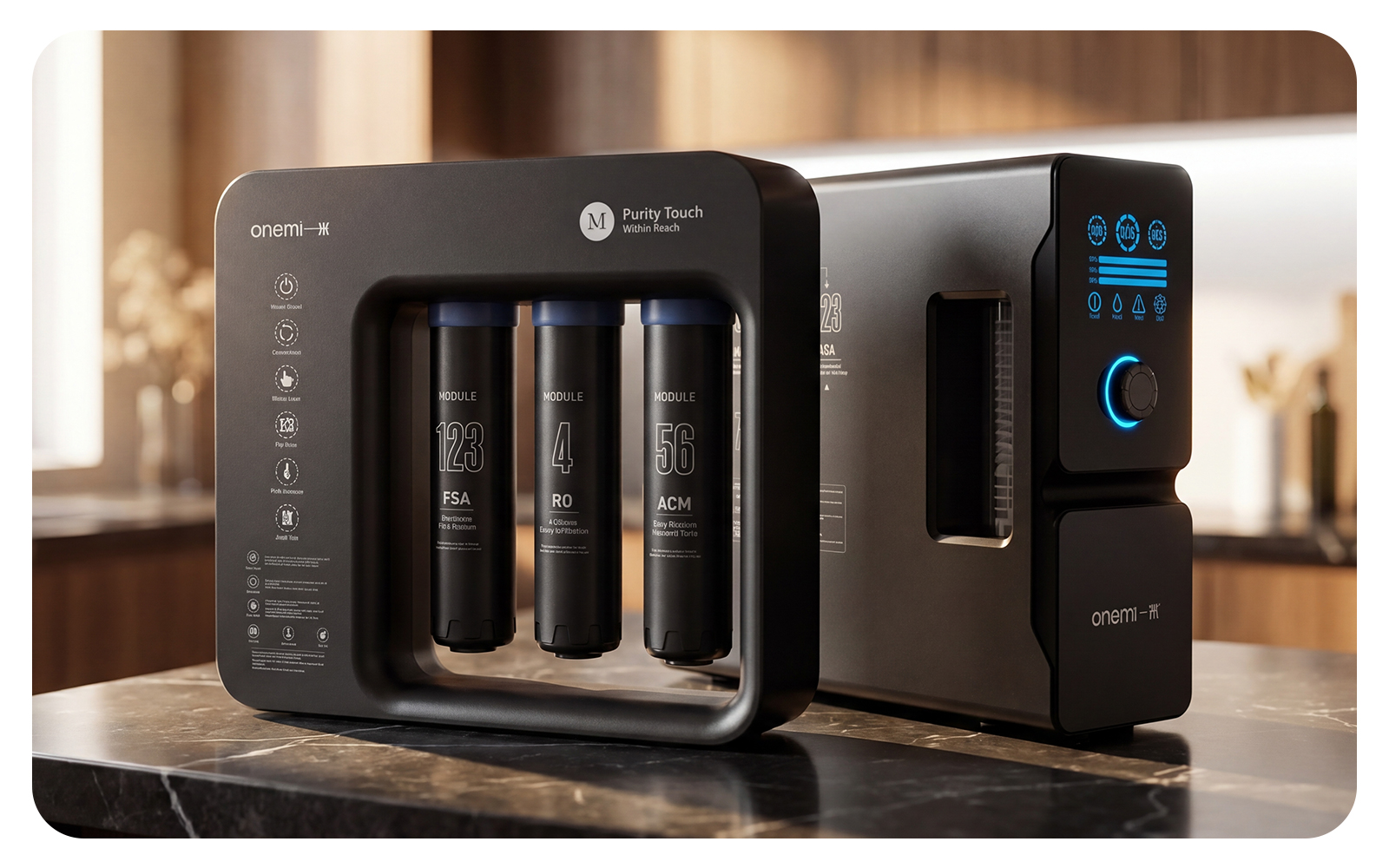
Among the fastest-growing product categories in the water purifier for US/EU market segment is the tankless high-capacity RO system. Combining the space-saving profile of a countertop RO system or tankless under sink RO with high-flow performance (600-1200 GPD), these systems are reshaping consumer expectations.
Why the tankless high-capacity RO system dominates PFAS-affected markets:
- Zero Storage Contamination: Without a pressurized tank, there is zero risk of post-membrane bacterial growth or PFAS recontamination.
- Continuous High Flow: Advanced pump and membrane designs deliver instant, on-demand purified water — eliminating the slow drip of traditional systems.
- Certification Compatibility: Tankless architectures are inherently compatible with NSF/ANSI 58 testing protocols, making certification faster and more cost-effective for OEM buyers.
- Smart Home Integration: Most tankless systems support WiFi/app connectivity, enabling smart water purifiers IoT AI features that appeal to modern consumers.
ONEMI’s tankless RO platform series is engineered for global OEM deployment, offering flexible branding, custom filtration stages, and pre-certified compliance packages for the US and EU markets.
—
PFAS Detection and Destruction: The Next Frontier
While filtration removes PFAS from drinking water, the question of PFAS detection destruction remains critical. Advanced inline sensors capable of real-time PFAS surrogate monitoring are entering the market, providing early warning systems for water treatment facilities and high-end residential systems alike.
Breakthroughs in electrochemical oxidation and plasma-based PFAS destruction are moving from laboratory to commercial deployment, promising to close the loop on forever chemicals. Forward-thinking OEM buyers should monitor these developments, as integrated detection-destruction systems may become a regulatory requirement within the next decade.
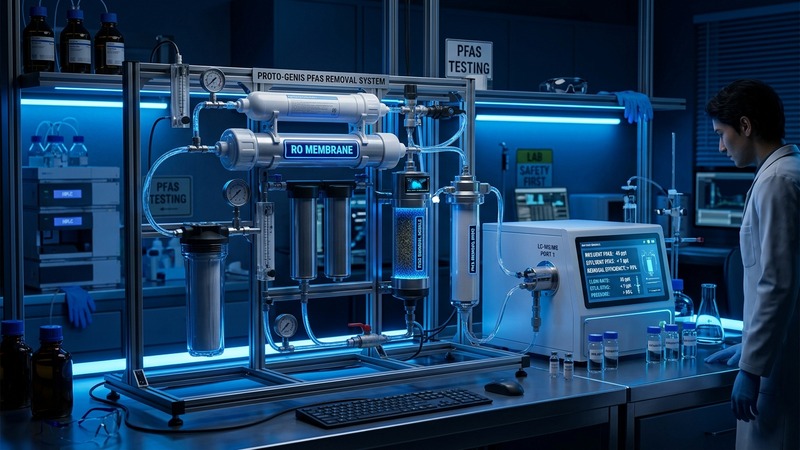
For now, the most reliable and cost-effective strategy remains certified RO filtration paired with activated carbon pre-treatment. RO membranes remove 90-99% of PFAS compounds, while carbon blocks address 40-60% of short-chain PFAS as a complementary barrier. Combined, these technologies provide robust protection that meets or exceeds all current global standards.
—
ONEMI: Your Certified B2B OEM Partner for the PFAS Era
Navigating the PFAS filtration market requires more than a component supplier — it demands a strategic partner with certified manufacturing, regulatory expertise, and a track record of global exports. ONEMI delivers on all fronts:
- Internationally Certified Manufacturing: CE, UL, FCC, ROHS certified systems with NSF-certified filter cartridges. Our US utility patent on universal filter cartridges protects your intellectual property and ensures cartridge compatibility across product lines.
- Dual-Compliance Engineering: Systems that simultaneously meet US EPA PFAS limits (NSF 58/53) and China GB 34914-2021 Grade 1 water efficiency standards, providing a single-source solution for multi-market distribution.
- Smart Filtration IoT Platform: OEM-ready IoT modules, app white-labeling, and cloud dashboard integration for smart water purifiers IoT AI product lines.
- Full-Spectrum Product Range: From countertop RO system designs to tankless under sink RO configurations, from hydrogen water systems to commercial-scale filtration — all available for OEM/ODM customization.
The compliance window is open, but it will not last forever. The EPA’s proposed 2029-to-2031 extension provides a strategic runway, but early movers who deploy certified, IoT-enabled PFAS filtration systems today will capture disproportionate market share. Contact ONEMI to start your OEM procurement evaluation and secure your position in the fastest-growing segment of the global water treatment industry.
Interested in this product? Click below and our specialist will assist you.
Learn More & Contact Us →ONEMI — www.onemiro.com Original Content
ONEMI onemiro.com Original Content