


 한국어
한국어

PFAS Regulation and China’s New Water Efficiency Standards: The Dual Compliance Window for Water Purifier OEM Manufacturers in 2026
Global water purification brands face a historic regulatory convergence in 2026 that will permanently alter supply chain requirements. The United States Environmental Protection Agency (EPA) is enforcing unprecedented limits on PFAS in drinking water, while global manufacturing hubs are solidifying strict water efficiency baselines. For any brand utilizing a water purifier manufacturer for global distribution, compliance is no longer a phased timeline—it is an immediate operational bottleneck.
Sourcing compliant hardware requires an intimate understanding of how these dual regulations intersect at the factory level. Companies that fail to audit their water purifier OEM/contract manufacturing partners now will find their products barred from customs by Q3 2026. This comprehensive guide outlines the technical, legal, and manufacturing adjustments required to navigate this dual-market compliance window successfully.
Establishing early compliance secures your market share and insulates your brand against sudden supply chain disruptions. As regulatory agencies increase enforcement actions, working with a proactive OEM partner becomes your strongest competitive advantage. Let us examine the exact regulatory shifts occurring across the US and Asian markets.
The Converging Regulatory Landscape: Two Systems, One Compliance Deadline
The year 2026 represents a hard deadline for water filtration compliance across both the Western and Eastern hemispheres. Manufacturers must simultaneously redesign filtration media to capture microscopic chemical compounds and re-engineer hydraulic systems to minimize wastewater. This dual-market pressure is forcing a rapid evolution in point-of-use water filter designs worldwide.
Navigating these simultaneous shifts requires a manufacturing partner with dedicated R&D resources and established testing protocols. Brands cannot afford to treat the US and Asian markets as isolated distribution zones anymore. Engineering a single, globally compliant platform is the most cost-effective path forward for high-volume distributors.
EPA’s Evolving PFAS Framework in 2026
The EPA PFAS standards establish legally enforceable Maximum Contaminant Levels (MCLs) for six prominent per- and polyfluoroalkyl substances in drinking water. Under this framework, PFOA and PFOS are restricted to a mere 4.0 parts per trillion (ppt) individually. This near-zero tolerance level makes standard carbon block filtration obsolete on its own, requiring advanced membrane technology.
Municipal water treatment plants cannot consistently meet these ultra-low thresholds, shifting the burden of drinking water safety directly to point-of-use systems. Importers targeting the water purifier for US/EU market must ensure their product lines utilize certified materials capable of sustained PFAS reduction. Testing protocols must prove the system maintains this reduction capacity over the entire rated lifespan of the filter cartridge.
Furthermore, the EPA framework mandates strict reporting and testing guidelines that directly impact product labeling and marketing claims. Distributors must back up every “PFAS-free” claim with rigorous laboratory data from accredited institutions. Working with an OEM that provides pre-certified platforms is the fastest way to clear these legal hurdles.
China’s GB 34914-2021 Implementation and Grade 1 Water Efficiency Requirements
China’s updated water efficiency standard, GB 34914-2021, enforces a strict minimum water efficiency limit of 45% (Grade 3) for reverse osmosis systems, with Grade 1 requiring a minimum of 65% water recovery. This standard targets the elimination of wasteful, traditional RO systems that discharge up to three gallons of wastewater for every gallon of purified water produced. Any water purifier manufacturer exporting from or selling within this jurisdiction must comply with these precise recovery ratios.
Achieving a 65% recovery rate without scaling or premature membrane fouling requires sophisticated flow control and high-performance booster pumps. Traditional low-pressure membranes cannot sustain these recovery rates under variable feed water conditions. OEM manufacturers must integrate advanced wastewater recirculation loops and smart flushing algorithms to meet these efficiency benchmarks reliably.
This standard has fundamentally changed how RO systems are engineered from the ground up. It forces manufacturers to move away from cheap, off-the-shelf components toward highly integrated, digitally controlled hydraulic circuits. For global brands, sourcing a system that meets these efficiency baselines ensures compliance with emerging conservation laws in Europe and the US as well.
Why the PFAS-OEM Connection Matters for International Buyers
International buyers cannot treat PFAS removal and water efficiency as separate component specifications. They are deeply interconnected engineering challenges that occur within the same filtration chassis. High-efficiency systems run the risk of concentrating PFAS contaminants in the boundary layer of the RO membrane, accelerating membrane degradation.
An inexperienced OEM manufacturer may solve the water efficiency puzzle only to fail PFAS extraction tests due to poor membrane chemistry. Buyers must partner with manufacturers who understand how high-recovery hydraulic designs affect contaminant rejection rates. Balancing these two variables is the key to surviving the 2026 regulatory shift.
RO Membrane PFAS Removal: Technical Reality and Certification Pathways
Reverse osmosis remains the gold standard for PFAS removal, but not all RO membranes are created equal. High-density, thin-film composite (TFC) membranes are required to consistently reject small-chain PFAS molecules, which are notoriously difficult to capture. The system must be paired with high-quality activated carbon post-filters to capture any trace compounds that bypass the membrane barrier.
To legally market these systems for PFAS reduction in North America, products must be certified under NSF/ANSI Standard 53 or NSF/ANSI Standard 58. These certifications require rigorous challenge testing using high influent concentrations of PFOA and PFOS. A tankless high-capacity RO system must maintain its reduction efficiency even at high flow rates of 1.0 gallon per minute (3.8 L/min) or greater.
Our proprietary Yimi PureFlow Technology optimizes the membrane surface chemistry to reject 99.9% of both long-chain and short-chain PFAS compounds. This specialized manufacturing process prevents the membrane pores from expanding under high pressure, ensuring consistent filtration over thousands of gallons. Buyers should always demand raw test reports from accredited labs like SGS or IAPMO before committing to a production run.
The 65% Water Efficiency Benchmark: Product Design Implications
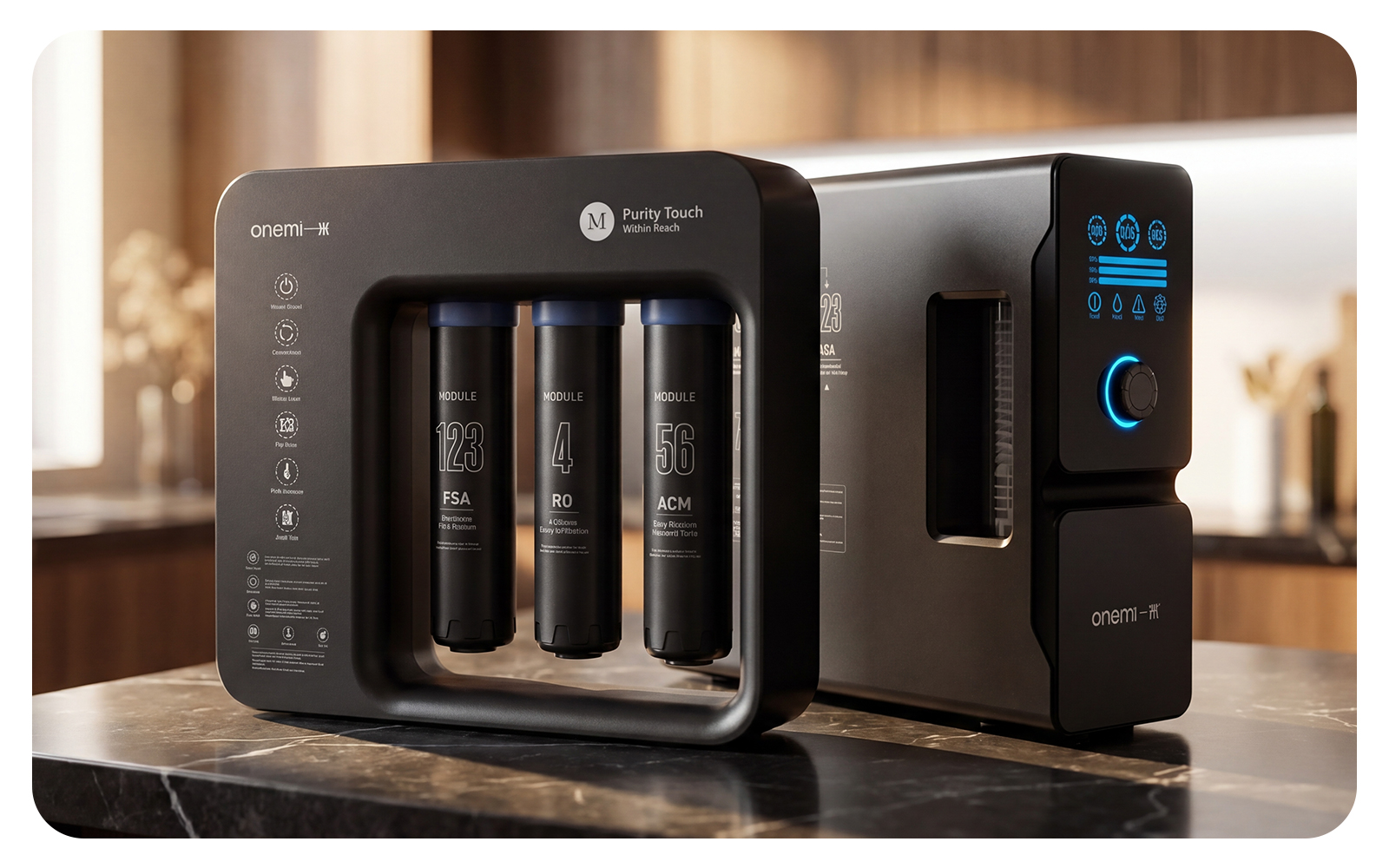
Reaching a 65% water recovery rate requires a fundamental shift from tank-based storage to tankless high-capacity RO designs. Tankless systems utilize high-flow membranes (typically 600 GPD to 1200 GPD) and powerful booster pumps to deliver fresh water on demand. This design eliminates the backpressure caused by pressurized storage tanks, which inherently degrades water efficiency over time.
To prevent the rapid scaling of calcium and magnesium on the membrane surface at 65% recovery, the system must employ smart flushing cycles. The controller must initiate a high-velocity freshwater flush every time the system idle period exceeds a set threshold. This flush washes away concentrated salts, keeping the membrane clean and maintaining high flow rates without requiring a separate water softener in moderate hardness areas.
Additionally, the integration of a high-precision TDS meter is essential for real-time monitoring of water quality. If the recovery rate is pushed too high, salt passage increases, and the product water TDS will rise. A smart tankless system automatically adjusts its recovery ratio based on incoming water quality, protecting the end-user and ensuring drinking water safety under all conditions.
Compliance Roadmap for Importers Sourcing from China
Importing water filtration equipment into highly regulated markets requires a systematic compliance roadmap. Relying on basic manufacturer declarations of conformity is a high-risk strategy that often leads to customs seizures. Importers must establish a multi-step validation process that covers raw materials, finished goods, and factory operations.
This roadmap protects your brand equity and ensures uninterrupted market access during the 2026 transition. By executing these steps diligently, you can confidently navigate the complex intersection of EPA regulations and international manufacturing standards. Let us break down the three essential steps of this compliance roadmap.
To successfully navigate the changing regulatory landscape in 2026, global buyers must establish a direct line of communication with engineering teams at the factory level. This direct collaboration ensures that custom product specifications align perfectly with both local water quality challenges and international compliance standards. Relying solely on standard sales representatives often leads to critical technical details being lost in translation during the product development phase.
Step 1: Third-Party PFAS Testing and NSF Certification
The first step in securing compliance is verifying the raw materials used in your filtration media. Ensure your water purifier OEM/contract manufacturing partner sources carbon block and RO membrane raw materials from certified suppliers. The finished system must then undergo independent, third-party testing to verify its PFAS reduction capabilities under NSF/ANSI 53 or 58 protocols.
This testing must be conducted by an ANSI-accredited laboratory, such as NSF International, WQA, or IAPMO. The laboratory will challenge the system with water containing high levels of PFAS to measure the exact reduction percentage. Only when the system consistently reduces PFAS to below the EPA’s MCLs will it receive the official certification mark.
For more detailed insights on navigating these specific testing protocols, review our comprehensive guide on PFAS EPA Regulations and OEM Compliance for 2026. Having these test reports in hand is your primary defense against regulatory audits and class-action liabilities.
Step 2: Water Efficiency Grading and Product Documentation
Every RO system imported into or sold within jurisdictions enforcing water efficiency laws must carry official grading labels. Importers must verify that their water purifier manufacturer has registered the specific model with the relevant local efficiency databases. This registration requires official test reports from a certified third-party laboratory validating the recovery rate.
The product documentation must clearly state the water efficiency grade, recovery rate, and daily purification capacity in both gallons and liters. This information must match the physical label affixed to the product chassis and the outer packaging. Discrepancies between documentation and physical labeling are a common trigger for customs delays and inspections.
Additionally, the user manual must include clear instructions on how to maintain the system’s efficiency over time. This includes recommended filter replacement intervals, membrane cleaning procedures, and troubleshooting steps for high-TDS feed water. Clear documentation reduces customer returns and ensures long-term field reliability.
Step 3: Supply Chain Audit and Manufacturing Partner Vetting
A successful compliance strategy requires a thorough audit of your manufacturing partner’s facilities and quality control systems. Importers should conduct on-site or third-party audits to verify that the factory operates under ISO 9001 and ISO 14001 standards. The audit should focus on raw material traceability, in-line testing procedures, and contamination control protocols.
Ensure the manufacturer has a dedicated cleanroom for membrane rolling and cartridge assembly to prevent cross-contamination. Inspect their testing laboratory to verify they possess calibrated water testing kit equipment, including high-precision TDS meters and flow meters. A manufacturer with robust internal testing capabilities can identify and resolve quality issues before the products leave the assembly line.
Furthermore, verify that the manufacturer holds the necessary international safety certifications for electronic components. For smart tankless systems, this includes CE, UL, FCC, and ROHS certifications. Partnering with a fully certified manufacturer minimizes your regulatory risk and accelerates your time-to-market.
Market Window 2026-2027: Why Early Movers Gain Pricing Power
The implementation of strict PFAS and water efficiency regulations in 2026 will create a temporary supply shortage of compliant products. Many low-tier manufacturers will be unable to upgrade their production lines or secure the necessary certifications in time. This supply contraction presents a massive opportunity for forward-thinking brands to capture market share.
By securing compliant inventory early, you can establish your brand as a premium, safety-focused option in the market. Retailers and commercial buyers will be actively looking to replace non-compliant SKUs with certified alternatives. Early movers can command a pricing premium while their competitors struggle with customs delays and product redesigns.
Moreover, establishing a stable supply chain with a certified OEM partner now insulates your business from sudden cost spikes. As demand for certified components increases in late 2026, raw material prices are expected to rise. Securing long-term manufacturing agreements today locks in your pricing and guarantees production capacity during peak demand periods.
ONEMI onemiro.com Original Content
Choosing the Right Manufacturing Partner for Dual-Market Compliance
Selecting a water purifier manufacturer is the most critical decision your brand will make ahead of the 2026 regulatory shift. The ideal partner must possess deep technical expertise, robust manufacturing capacity, and a proven track record of compliance. They must be willing to invest in custom engineering to meet your specific market requirements.
Look for a partner that offers comprehensive OEM and ODM services, from initial industrial design to final certification support. They should have established relationships with global testing agencies like NSF and WQA to expedite your product approvals. A truly collaborative partner acts as an extension of your own engineering team, helping you navigate complex technical challenges with ease.
At ONEMI, we specialize in high-capacity, highly efficient water purification systems designed for the global market. Our engineering team has already developed a range of platforms that meet both the EPA’s PFAS standards and China’s Grade 1 water efficiency requirements. We are ready to help you transition your product line to meet the challenges of 2026 and beyond.
We invite global distributors, brand owners , and sourcing managers to contact our technical team to discuss their compliance needs. Whether you require a custom tankless high-capacity RO system or a complete commercial RO system redesign, we have the expertise to deliver. Let us secure your market position together.
Ready to upgrade your product lineup for 2026 compliance? Contact ONEMI today to schedule a technical consultation with our engineering team. We will review your current product specifications and provide a detailed roadmap for achieving dual-market compliance with our certified OEM platforms.
Interested in this product? Click below and our specialist will assist you.
Learn More & Contact Us →ONEMI — www.onemiro.com Original Content
ONEMI products are CE, UL, FCC, ROHS certified. Filter cartridges carry NSF certification. ONEMI holds a US utility patent on universal filter cartridge structure (USPTO granted).