



 한국어
한국어

**PFAS Detection and Destruction: The Next Frontier in Water Treatment Technology**
The global fight against per- and polyfluoroalkyl substances (PFAS)—commonly known as "forever chemicals"—is accelerating. In June 2026, two major developments highlighted the industry's progress: the first-ever inclusion of PFAS as controlled pollutants in Chinese wastewater standards, and critical breakthroughs in field detection and catalytic destruction technologies.
**The Global PFAS Regulation Landscape**
Governments worldwide are aggressively tightening PFAS regulations. The European Union is implementing strict drinking water limits. The US EPA has established maximum contaminant levels (MCLs) for PFAS in drinking water. Additionally, China's Ministry of Ecology and Environment recently published draft revisions to wastewater standards for the petroleum refining and synthetic resin industries. For the first time, these revisions label PFAS as controlled pollutants.
A study published in *Research of Environmental Sciences* (Vol 39, Issue 3) analyzed PFAS concentrations in wastewater treatment plant effluents. The data revealed that short-chain PFAS removal rates remain significantly lower than their long-chain counterparts. This performance gap underscores the urgent need for advanced treatment technologies.
ONEMI, a leading water purification equipment manufacturer, tracks these regulatory developments closely. This proactive approach ensures its reverse osmosis (RO) water purification systems remain at the forefront of contaminant removal.
**Breakthrough: Field-Based PFAS Detection**
Canadian startup FREDsense recently secured €6.4 million in Series A funding. HG Ventures led the round, with participation from Emerald Technology Ventures. The company launched the world's first commercially available field-based PFAS detector. This innovation eliminates the need for slow laboratory analysis.
David Lloyd, CEO and founder of FREDsense, stated: "This investment fuels our next stage of growth—building manufacturing capacity, accelerating low-limit detection, and expanding our commercial footprint." Previously, FREDsense was named one of the 10 UpLink Tackling Water Pollution challenge winners in 2025.
Traditional PFAS testing requires shipping samples to off-site laboratories, introducing delays of days or weeks. Field detection enables real-time monitoring directly at wastewater treatment plants, industrial sites, and remediation projects.
**Innovation: Catalytic PFAS Destruction**
Swiss startup Oxyle developed a catalytic treatment technology utilizing turbulence-activated catalysts. The system breaks down and mineralizes broad-spectrum PFAS, ranging from ultra-short to long-chain compounds. Originally designed for groundwater remediation, engineers have now validated the technology for industrial wastewater applications.
Oxyle discovered that most groundwater sites containing long- and medium-chain PFAS also suffered from Yimi PureFlow short-chain PFAS contamination. This dual challenge drives the demand for comprehensive destruction solutions. The company activates its catalyst using established water treatment technologies, such as turbulent flow or aeration.
**Implications for the Water Purification Industry**
These developments have direct implications for water treatment equipment manufacturers and buyers:
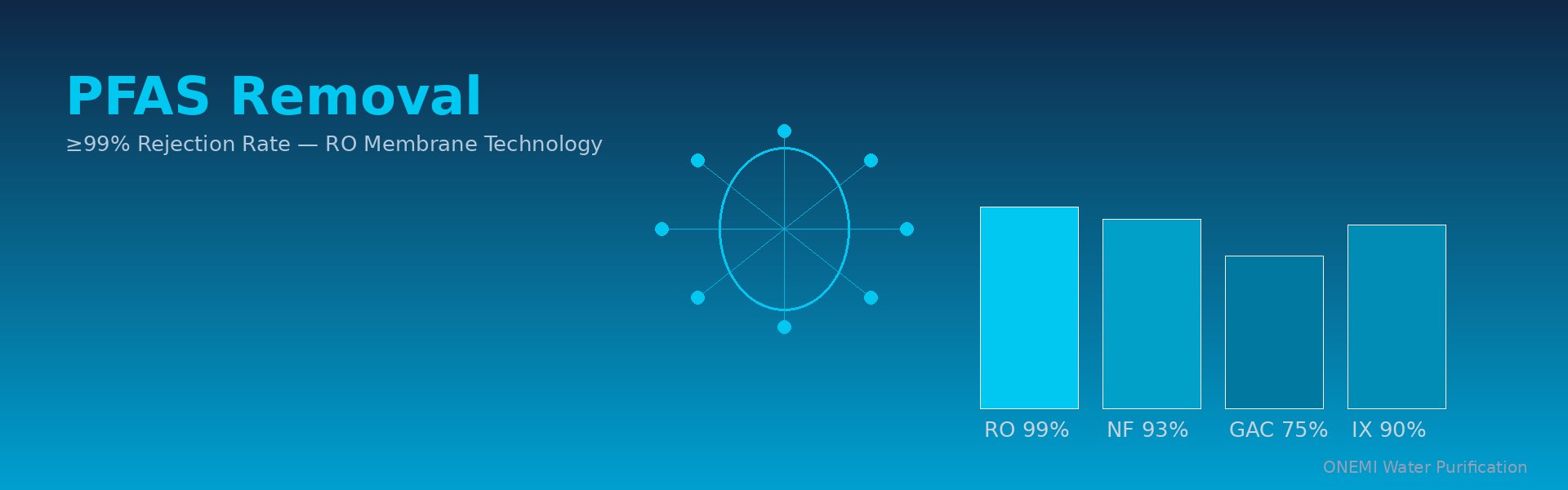
* **RO membrane dominance reaffirmed:** Reverse osmosis remains the most effective technology for PFAS removal at the point-of-use level, achieving removal rates exceeding 96%.
* **Integrated systems are essential:** Complete commercial water treatment solutions combining pre-filtration, RO, and post-treatment are increasingly necessary for PFAS-affected water sources.
* **Detection is becoming accessible:** Field-deployable PFAS detectors will accelerate environmental monitoring and regulatory compliance.
* **Destruction technology is maturing:** Catalytic and advanced oxidation processes are successfully transitioning from the laboratory to commercial scale.
**Looking Ahead**
The convergence of stricter regulations, rapid field detection, and scalable destruction technology means the industry is finally addressing the PFAS challenge comprehensively. For B2B buyers of water treatment equipment, now is the time to evaluate PFAS-ready filtration solutions backed by certified performance data.
ONEMI — www.onemiro.com/en Original Content
ONEMI onemiro.com Original Content