


 한국어
한국어

PFAS Compliance in 2026: How Smart OEM Sourcing Is Reshaping the Global Water Purifier Supply Chain
As of mid-2026, the global water purification industry is navigating its most consequential regulatory transformation in decades. For procurement professionals and brand owners sourcing from a water purifier manufacturer, the convergence of US EPA PFAS rulemaking, China’s new national water efficiency standards, and evolving EU drinking water directives has turned compliance from a checkbox exercise into a strategic competitive advantage. Understanding this landscape is no longer optional — it is the bedrock of any viable water purifier OEM / contract manufacturing partnership.
The EPA’s 2026 PFAS Framework: What Changed and What Stayed
On May 18, 2026, the US Environmental Protection Agency published two proposed rule changes that sent ripples through the entire water treatment supply chain. The first proposal keeps the Maximum Contaminant Levels (MCLs) for PFOA and PFOS at 4 parts per trillion — an exceedingly stringent threshold equivalent to roughly four drops of water in twenty Olympic-sized swimming pools — while offering public water systems a two-year compliance extension to April 2031. The second proposal would rescind federal MCLs for four other PFAS compounds (PFHxS, PFNA, HFPO-DA, and the Hazard Index mixture), effectively returning regulation of those chemicals to state-level authorities.
The implication for any water purifier for US/EU market manufacturer is clear: the 4 ppt PFOA/PFOS standard is here to stay, and state-level regulations for other PFAS compounds are proliferating. This patchwork of requirements demands that OEM partners deliver documented PFAS removal performance — not just theoretical capability — across their entire product line.
China’s GB 34914-2021: The Domestic Compliance Driver That Reshapes Export Capability
Simultaneously, China’s GB 34914-2021 standard for household reverse osmosis water purifiers has reached full implementation. The standard streamlines water efficiency ratings from five tiers to three, with Tier 1 requiring a minimum net water recovery rate of 65% and a total净水量 (rated total净水量) of at least 4,000 liters. Products below Tier 3 are effectively banned from production and sale in China.
For OEM buyers evaluating a tankless high-capacity RO system supplier, this standard serves as an unofficial quality proxy. Manufacturers who already meet China’s Tier 1 water efficiency are, by definition, producing RO membranes with higher rejection rates, better anti-fouling characteristics, and longer service life — all attributes that translate directly to PFAS removal efficacy and overall system reliability in export markets.
Why RO Membrane Technology Is the Gold Standard for PFAS Removal
Scientific literature consistently demonstrates that properly designed RO membrane systems achieve PFAS removal rates exceeding 99%. The mechanism is straightforward: RO membrane pores average 0.0001 microns (0.1 nanometers), while PFAS molecules range from approximately 1 to 2 nanometers in size. This size differential, combined with the membrane’s surface charge characteristics, creates an effective physical barrier against these persistent organic pollutants.
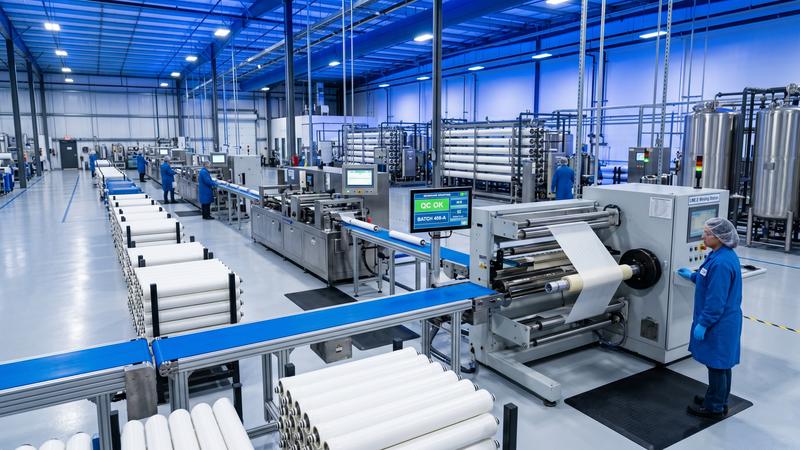
However, not all RO membranes are created equal. The quality of the membrane element, the operating pressure, water temperature, and the pre-filtration configuration all influence real-world PFAS reduction performance. This is where the experience of a seasoned water purifier manufacturer becomes critical — a facility that produces its own membrane elements with consistent quality control delivers far more reliable results than one that simply assembles third-party components.
The OEM Supply Chain Advantage: Why Compliance-Capable Partners Win
The OEM Supply Chain for water purification has traditionally been fragmented: membrane manufacturers in one country, housing producers in another, and final assembly in a third. The regulation-driven market of 2026 rewards consolidation and vertical integration. Manufacturers who control their membrane production, maintain in-house testing laboratories, and hold certifications across multiple regulatory regimes (NSF on filter elements, CE/UL/FCC/ROHS on whole units) offer their OEM partners a dramatically simplified path to market.
For importers evaluating a water purifier OEM partner, the certification checklist has expanded beyond basic safety marks. Today’s due diligence must include:
- Documented PFAS removal testing from accredited third-party laboratories
- Verification of GB 34914-2021 Tier 1 compliance (or equivalent national standard)
- NSF/ANSI 58 certification on RO membrane elements
- CE, UL, FCC, and ROHS coverage on finished units
- US utility patent protection for unique filter cartridge structures (where applicable)
Universal vs. Proprietary Filter Cartridge: A Strategic Sourcing Decision
One of the most consequential decisions facing OEM buyers is the water filter fittings parts architecture — specifically, whether to adopt universal (standard 10-inch) cartridge interfaces or proprietary (brand-locked) designs.
The universal cartridge approach, championed by brands like iSpring in the US market, offers lower long-term operating costs for end consumers and greater supply chain resilience. A Tank System Water Purifier with universal connectors can source replacement cartridges from multiple manufacturers, avoiding the “stranded customer” risk when a proprietary cartridge is discontinued.
Proprietary designs, exemplified by the Waterdrop model, create recurring revenue through brand-locked consumables and enable more compact, aesthetically refined product geometries. Each approach has merits, but for OEM Wholesale programs targeting price-sensitive markets, the universal cartridge architecture remains the dominant choice.
Plumbing Compatibility and Installation Considerations for Global Markets
A Plumbing Compatibility Guide is an essential tool for any B2B water purification supplier. North American plumbing uses 3/8-inch compression fittings and 1/2-inch NPT threads, while European installations favor 3/8-inch push-fit connectors and 10mm tubing. Asian markets present their own set of standards. A B2B Installation Guide that addresses these variations — preferably illustrated with clear diagrams — dramatically reduces field installation errors and warranty claims.
For Zero Waste RO Systems, which recirculate concentrate water back to the feed supply rather than discharging it as wastewater, plumbing compatibility becomes even more critical. These systems require specific feed water quality parameters and pressure ranges to operate without damaging the membrane or reducing recovery rates.
In colder climate markets, Freeze Protection Water Purifier features are non-negotiable. Systems installed in unheated basements, garages, or seasonal cabins must incorporate freeze-tolerant valve assemblies, insulated housings, and automatic drain-down mechanisms to prevent costly freeze damage.
B2B Procurement Guide: Evaluating a Water Purifier OEM Partner in 2026
When conducting a B2B Procurement Guide evaluation of potential manufacturing partners, procurement professionals should prioritize the following assessment criteria:
- Certification portfolio completeness — Does the manufacturer hold the full suite of certifications relevant to your target markets?
- Membrane technology ownership — Does the facility manufacture its own RO membrane elements, or assemble from purchased components?
- PFAS testing history — Has the manufacturer conducted third-party PFAS removal testing? Are results publicly available?
- Production scalability — Can the facility ramp from prototype to full production volume within 45-60 days?
- Quality management system — Are ISO 9001 or equivalent systems in place?
The regulatory environment of 2026 has created a distinct competitive moat for manufacturers who invested early in certification infrastructure and membrane technology R&D. Brands that secure partnerships with these advanced manufacturers will be positioned to capture premium pricing in markets increasingly defined by compliance requirements rather than price competition alone.
Conclusion: Compliance as Competitive Advantage
The convergence of EPA PFAS rulemaking, China’s GB 34914-2021 implementation, and tightening EU water quality directives has fundamentally altered the competitive dynamics of the global water purification industry. For importers, distributors, and brand owners, the cost of non-compliance — lost market access, regulatory penalties, consumer trust erosion — far exceeds the investment required to partner with a fully compliant manufacturer.
ONEMI — a leading Chinese water purification equipment manufacturer holding CE, UL, FCC, ROHS certification on whole units and NSF certification on filter cartridges, with a US-granted utility patent on universal filter cartridge structure — offers OEM/ODM partners a vertically integrated compliance solution spanning research, manufacturing, and global certification. To explore partnership opportunities, visit www.onemiro.com/en/ or submit your inquiry below.
Interested in this product? Click below and our specialist will assist you.
Learn More & Contact Us →ONEMI www.onemiro.com Original Content