



 한국어
한국어


ONEMI — a leading Chinese water purification equipment manufacturer — understands that the regulatory environment for drinking water has never been more demanding. As global authorities push PFAS detection limits toward zero and China enforces its most stringent water efficiency standards yet, OEM buyers face a narrowing compliance window. Choosing the right water purifier OEM/contract manufacturing partner is no longer just about cost and lead time — it determines whether your brand can legally sell a water purifier for US/EU market in 2026 and beyond. A tankless high-capacity RO system with verified PFAS rejection and superior water recovery offers the clearest path through this regulatory maze.
The convergence of US EPA National Primary Drinking Water Regulations (NPDWR), European Drinking Water Directive updates, and China’s GB 34914-2021 Grade 1 water efficiency classification has created an inflection point for the global water filtration industry. For procurement managers, brand owners, and distributors sourcing from China, this article provides a practical framework for navigating these overlapping requirements while building a future-proof product portfolio.
Understanding the PFAS Regulatory Framework in 2026
Per- and polyfluoroalkyl substances — collectively known as PFAS — represent one of the most complex water quality challenges of our time. The US Environmental Protection Agency (EPA) has established that exposure to PFOA and PFOS at concentrations above 4.0 parts per trillion (ppt) poses significant health risks, including developmental effects, liver damage, immune system suppression, and increased cancer risk. For context, 4.0 ppt is roughly equivalent to four drops of water in an Olympic-sized swimming pool.
Evaluating the EPA’s Landmark PFAS MCLs
The EPA’s final rule under the Safe Drinking Water Act establishes legally enforceable Maximum Contaminant Levels (MCLs) for six PFAS compounds. PFOA and PFOS are regulated individually at 4.0 ppt, while PFHxS, PFNA, HFPO-DA (GenX chemicals), and PFBS are regulated through a Hazard Index approach that accounts for cumulative risk. This tiered regulatory framework means that any water treatment system sold in the US market must demonstrate reliable reduction of multiple PFAS compounds simultaneously — a performance requirement that only advanced reverse osmosis technology can consistently deliver. The World Health Organization (WHO) has similarly flagged PFAS as a priority emerging contaminant, publishing provisional guideline values that align with the direction of US and EU regulations.
Examining the EU’s Comprehensive PFAS Strategy
The European Union has adopted an equally ambitious approach. Directive (EU) 2020/2184 sets a parametric value of 0.10 µg/L for the sum of 20 priority PFAS substances, with a separate standard of 0.50 µg/L for total PFAS. Beyond drinking water limits, the European Chemicals Agency (ECHA) is evaluating a sweeping restriction proposal that could phase out the manufacture and use of approximately 10,000 PFAS substances under REACH regulations. For OEM buyers sourcing B2B Water Filter Sourcing from China, these developments mean that every component — from the membrane housing polymers to the sealing gaskets and tubing materials — must be screened for PFAS content to avoid non-compliance in the EU market.
Assessing Global PFAS Detection and Destruction Technologies
The regulatory shift has accelerated demand for PFAS Detection Destruction technologies. While granular activated carbon (Granulated Activated Carbon PFAS) adsorption and Anion Exchange Resin PFAS media remain effective for longer-chain PFAS compounds, short-chain PFAS (which are increasingly prevalent in modern industrial discharges) require the tighter pore structure and size-exclusion mechanism of RO membranes. NSF International standard NSF/ANSI 58 provides the testing protocol for verifying PFAS reduction claims on point-of-use reverse osmosis systems, giving buyers an independent, third-verified benchmark for evaluating water purifier manufacturer performance claims.
Modern detection methods — including EPA Method 537.1 and 533 — can quantify PFAS compounds down to parts-per-trillion concentrations. This analytical precision means that compliance is measurable and enforceable. OEM buyers must demand test reports from accredited laboratories showing PFAS reduction performance on their specific system configurations, not generic membrane-level data that may not account for system-wide performance variables.
Building a Compliant RO System Portfolio for the US and EU Markets
Constructing a product line that satisfies both US EPA PFAS regulations and EU Drinking Water Directive requirements demands a systems-level engineering approach. The reverse osmosis membrane is the core PFAS barrier, but total system performance depends on the integration of pre-filtration, post-filtration, flow control, and material selection.
Selecting Tankless High-Capacity RO Configurations
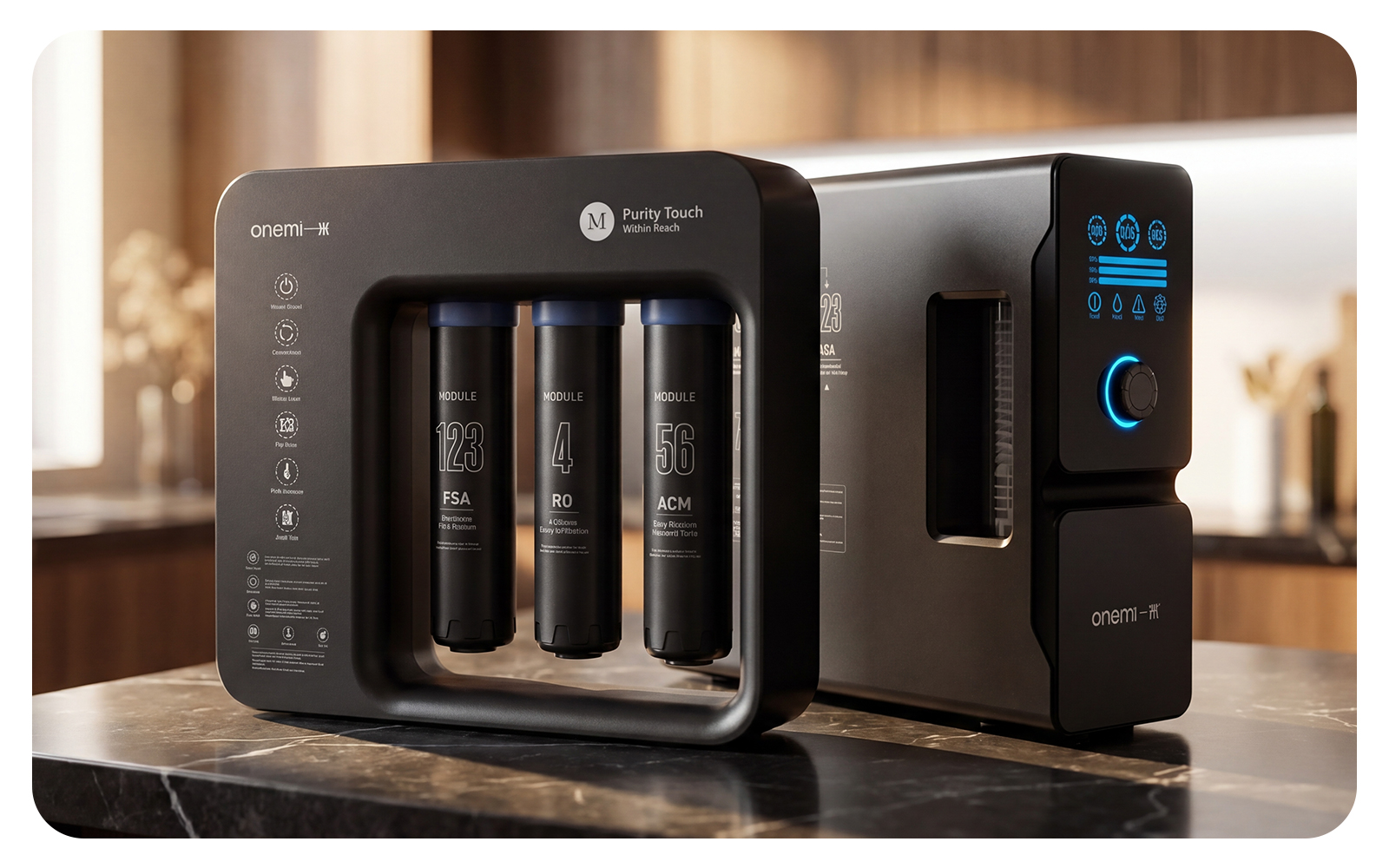
Tankless, high-capacity RO systems have become the preferred form factor for the water purifier for US/EU market. By eliminating the pressurized storage tank, these designs remove a potential stagnation point where bacterial regrowth can occur and where residual PFAS compounds could accumulate over time. ONEMI’s tankless platform delivers continuous flow rates from 600 GPD to 1200 GPD, enabling the high-volume dispensing that US and EU consumers expect from under-sink and countertop systems. The absence of a tank also reduces the system’s physical footprint, making it compatible with the compact cabinetry common in European kitchens and American apartments.
Integrating RO Membrane Replacement Strategies
Regular RO Membrane Replacement is the most critical maintenance action for preserving PFAS rejection performance. As membranes age, their salt rejection rates gradually decline, and PFAS — being smaller neutral molecules — can begin to breach the membrane barrier before salt breakthrough becomes apparent. ONEMI’s systems incorporate real-time total dissolved solids (TDS) monitoring with smart alerts that notify users when membrane performance degrades, ensuring that PFAS rejection remains above 99% throughout the membrane service life. NSF/ANSI 58-certified replacement membranes from ONEMI are manufactured to tight tolerance specifications, guaranteeing consistent performance across every replacement cycle.
Deploying Multi-Stage PFAS Defense
A comprehensive Point of Use Water Filter for PFAS management employs multiple defense layers. The sediment pre-filter removes suspended particles that could abrade the RO membrane surface. The activated carbon pre-filter — using high-grade Granulated Activated Carbon PFAS media — adsorbs chlorine and longer-chain PFAS compounds, reducing the contaminant load reaching the membrane. The RO membrane itself then removes the remaining PFAS compounds, including the challenging short-chain variants. Finally, a post-carbon polishing filter captures any residual taste or odor compounds. This staged approach ensures that the membrane operates under optimal conditions, extending its service life while maintaining PFAS rejection above 99%.
For OEM buyers evaluating Water Filter OEM China partners, the ability to customize these filtration stages is a critical capability. Different target markets have different priority contaminants — US buyers may focus on PFAS and lead, while EU buyers may add pharmaceuticals and endocrine disruptors to the list. A flexible water purifier OEM/contract manufacturing partner can tailor the filtration train to match the specific regulatory and consumer requirements of each destination market.
Meeting China’s GB 34914-2021 Grade 1 Water Efficiency While Maintaining PFAS Removal
One of the most significant engineering challenges in modern RO system design is the simultaneous optimization of PFAS rejection and water efficiency. Traditional RO systems operated at 1:3 to 1:4 ratios of purified water to wastewater, meaning they discarded three to four gallons for every gallon produced. China’s GB 34914-2021 standard changed this paradigm by establishing a tiered water efficiency classification system — Grade 1 being the most stringent at 65% minimum recovery, Grade 2 at 55%, and Grade 3 at 45%.
Optimizing Recovery Rates Without Compromising Rejection
Achieving 65-70% water recovery — exceeding China’s Grade 1 threshold — while maintaining >99% PFAS removal requires advanced membrane engineering and intelligent flow control. ONEMI’s RO systems address this challenge through several mechanisms. First, the proprietary membrane element design incorporates higher surface area and optimized feed spacer geometry, allowing effective contaminant rejection at lower operating pressures and with reduced concentrate flow. Second, the system’s electronic flow controller dynamically adjusts the ratio of permeate to concentrate based on real-time inlet water quality readings, ensuring that recovery rates remain optimal across varying source water conditions. Third, a staged flush cycle periodically cleans the membrane surface during idle periods, preventing scale buildup that would otherwise reduce both recovery rates and PFAS rejection efficiency over time.
Verifying Compliance Through Certified Testing
For OEM buyers, verification is as important as performance. ONEMI provides comprehensive test documentation for every system configuration, including third-party laboratory reports showing PFAS reduction to below EPA MCLs and water recovery measurements independently verified against GB 34914-2021 protocols. These documents serve as the foundation for your own regulatory submissions and retailer compliance portfolios. Major US and EU retailers increasingly require this documentation before allowing new point of entry water filter and point of use water filter products onto their shelves, and having verified data ready accelerates the listing process significantly.
The convergence of PFAS regulations and water efficiency standards creates a natural competitive advantage for manufacturers who have invested in high-performance RO technology. Lesser systems that cannot simultaneously meet both requirements will be progressively excluded from regulated markets, opening opportunities for brands that partner with technically capable manufacturers.
Integrating Smart Features for Compliance and Consumer Confidence
The modern B2B buyer’s product specification increasingly includes Smart Water Quality Monitor capabilities. Connected features serve multiple purposes: they verify ongoing system performance, provide consumer confidence through real-time data, and enable proactive maintenance that prevents compliance drift.
Deploying Automatic Filter Change Reminders
Automatic Filter Change Reminder systems are no longer a premium feature — they are becoming a compliance necessity. As RO membranes and pre-filters age, their contaminant rejection performance gradually declines. A system that alerts the user when the membrane is approaching the end of its effective life ensures that PFAS rejection never drops below certified levels. ONEMI’s smart systems track cumulative water production, flow rate changes, and TDS differential across the membrane to calculate remaining filter life with high accuracy. This data is displayed on the system’s onboard display and transmitted to the companion mobile application, giving both the consumer and the brand visibility into system health.
Meeting Energy Star Water Filter Criteria
Energy efficiency is a growing consideration in the Energy Star Water Filter certification landscape. While RO systems inherently consume more energy than passive carbon filters, ONEMI has reduced energy consumption through the use of high-efficiency diaphragm pumps, low-voltage electronics, and optimized flush cycles. Systems that carry Energy Star-equivalent certifications or demonstrate energy performance within the expected range for their flow class have a competitive advantage in retail channels that prioritize sustainability metrics. For OEM buyers, requesting energy consumption data alongside PFAS reduction and water efficiency documentation provides a complete compliance picture for retailer and regulatory submissions.
Enhancing Water Quality with Alkaline Remineralization RO
After the RO membrane removes virtually all dissolved solids — including beneficial minerals — many US and EU consumers prefer water that has been remineralized for taste and pH balance. Alkaline Remineralization RO systems add a final-stage mineral cartridge that restores calcium, magnesium, and other beneficial ions to the purified water, raising the pH from the slightly acidic range of pure RO water (typically pH 6.0-6.5) to a neutral or slightly alkaline level (pH 7.5-8.5). This feature addresses consumer preference without compromising PFAS rejection, as the mineral cartridge is positioned after the membrane and does not introduce additional contaminants upstream of the PFAS barrier.
Building Your Procurement Strategy for the Compliance Window
The period between now and full enforcement of the latest regulations represents a strategic window for OEM buyers. Companies that secure certified inventory and documented compliance packages during this window will be positioned to capture market share while competitors scramble to retool their supply chains.
Sourcing from Verified Water Filter OEM China Partners
When evaluating Water Filter OEM China candidates, procurement managers should prioritize manufacturers who can demonstrate direct experience with US EPA PFAS compliance testing, NSF/ANSI 58 certification procedures, and GB 34914-2021 water efficiency verification. Ask for the following specific deliverables during the evaluation process:
- Third-party PFAS reduction test reports using EPA Method 537.1 or 533, showing individual results for PFOA and PFOS below 4.0 ppt and for the remaining four regulated compounds below their respective Hazard Index limits.
- Water efficiency test reports from a CNAS-accredited laboratory showing recovery rates meeting or exceeding 65% for Grade 1 classification under GB 34914-2021.
- Material safety declarations for all wetted components, including membrane housings, tubing, fittings, and filter housings, confirming the absence of intentional PFAS additives and compliance with EU REACH and RoHS directives.
- Full-machine CE and/or UL certification documentation covering electrical safety, electromagnetic compatibility (FCC), and the restricted substances directive (RoHS).
- USPTO-granted or pending patent protection for filter cartridge structures, ensuring that your brand’s replacement filter revenue stream is not subject to third-party patent infringement claims.
Verifying Supply Chain Reliability for Food Service and Refrigerator Applications
Beyond standard residential systems, many OEM buyers require specialized configurations for food service and integrated appliance applications. Refrigerator Water Filter OEM capabilities are increasingly important as major appliance brands integrate water filtration into their ice makers and water dispensers. ONEMI’s universal filter cartridge system — protected by a USPTO-granted structure patent — is designed for compatibility across multiple appliance platforms, simplifying inventory management for brands that sell both standalone and integrated filtration solutions. Similarly, Point of Entry Water Filter configurations for whole-building PFAS protection require larger-format systems with higher flow rates and larger media volumes, typically incorporating both GAC pre-filtration and two-stage RO or nanofiltration membranes in series.
Conclusion: Securing Your Position in the Post-Regulatory Shift Market
The global water filtration industry is experiencing a once-in-a-generation transformation. US EPA regulations have set PFAS limits at near-zero concentrations, the EU has established comprehensive PFAS restrictions under both the Drinking Water Directive and REACH, and China’s GB 34914-2021 standard has redefined water efficiency expectations for RO systems. These overlapping regulatory frameworks create challenges — but they also create opportunities for OEM buyers who act decisively.
ONEMI’s tankless high-capacity RO systems deliver 65-70% water recovery, exceeding China GB Grade 1, while maintaining >99% PFAS removal through advanced RO membrane technology. Every system is supported by third-party verified test documentation, full CE/UL/RoHS certification, and a USPTO-granted universal filter cartridge patent. For OEM buyers navigating the compliance window, this combination of performance verification, regulatory documentation, and supply chain reliability represents the difference between a successful product launch and a costly regulatory rejection.
The brands that secure compliant inventory and documented certification packages in 2026 will dominate their categories when full enforcement arrives. The compliance window is open — but it will not remain open indefinitely.
ONEMI — www.onemiro.com Original Content
Interested in this product? Click below and our specialist will assist you.
Learn More & Contact Us →