

 한국어
한국어

**Lab Grade Water Purification Systems: A B2B Buyer Guide to Type I, II, III**
When a pharmaceutical QC lab rejects a batch because the water used for HPLC analysis fails to meet conductivity specifications, the operational impact is severe—not to mention the regulatory headache that follows. For procurement managers sourcing lab water systems, selecting the correct purity grade is more than a technical checkbox. It is a strict compliance requirement that directly impacts operational continuity.
This guide breaks down essential criteria for lab-grade water purification systems. From purity standards to system configurations, we provide the insights you need to evaluate suppliers confidently, whether you are outfitting a university research lab or a GMP-compliant pharmaceutical facility.
**Understanding Lab Water Grades: Type I, II, and III Demystified**
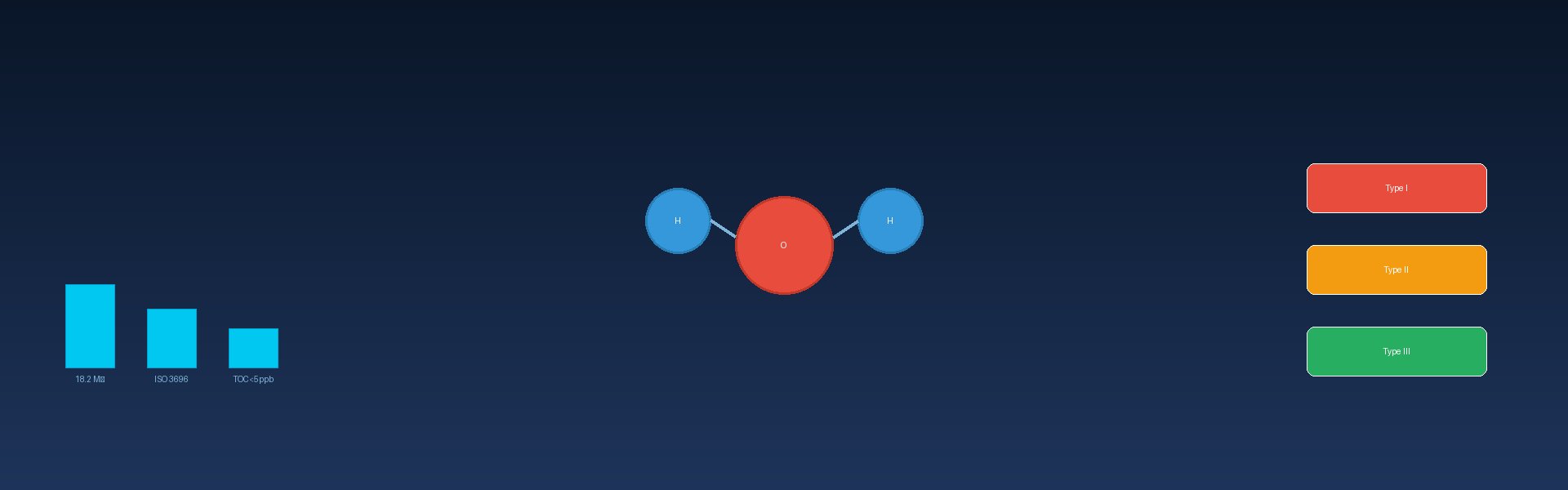
The global standard for lab water purity is defined by international authorities like ISO 3696 and ASTM D1193. These organizations classify purified water into three distinct grades based on conductivity, total organic carbon (TOC), and microbial content:
| Parameter | Type III (Primary) | Type II (Pure) | Type I (Ultrapure) |
| :— | :— | :— | :— |
| **Conductivity** | ≤ 5.0 µS/cm | ≤ 1.0 µS/cm | ≤ 0.055 µS/cm (18.2 MΩ·cm) |
| **TOC** | ≤ 200 ppb | ≤ 50 ppb | ≤ 10 ppb |
| **Bacteria** | N/A | < 100 CFU/mL | < 1 CFU/mL |
| **Typical Use** | Glassware rinsing, autoclave feed | Buffer preparation, media making | HPLC, IC, LC-MS, cell culture |
Most laboratories require a combination of these grades. Type III serves general washing and autoclave feeds. Type II handles reagent preparation. Type I is reserved for critical analytical instruments. A well-designed system produces all three grades from a single feed. By cascading reject water from Type I polishing back to the Type III storage tank, this configuration cuts water waste by up to 60%.
**Core Technologies Behind Lab Water Systems**
Unlike residential reverse osmosis (RO) systems that rely on a single membrane, lab-grade systems stack multiple purification technologies in series:
* **Pre-treatment (Type III stage):** The process begins with sediment filtration, followed by activated carbon, optional softening, and single-pass RO. This produces water suitable for general lab use and serves as the feed for downstream polishing.
* **Polishing (Type II stage):** The RO permeate passes through electrodeionization (EDI) modules. These modules utilize ion-exchange membranes and direct current to continuously remove residual ions without chemical regeneration. EDI serves as the workhorse of modern lab water systems. It consistently delivers ≤1.0 µS/cm quality while eliminating the maintenance burden of traditional deionization (DI) resin columns.
* **Ultrapure polishing (Type I stage):** Type II water enters a highly specialized purification train. It undergoes dual-wavelength UV photo-oxidation (185/254nm) to break down trace organics. Next, it passes through nuclear-grade ion-exchange polishing cartridges. Finally, a 0.2µm filter—often an ultrafiltration (UF) hollow-fiber module for endotoxin removal in cell culture applications—completes the process. The result is ultrapure water with 18.2 MΩ·cm resistivity and TOC levels below 5 ppb.
**7-Point B2B Procurement Checklist**
When evaluating lab water system suppliers, procurement teams should verify the following operational metrics:
1. **Feed water compatibility:** What is your incoming tap water TDS? Systems designed for low-TDS municipal water often struggle with hard well water. Request performance curves based on your specific feed water conditions.
2. **Daily output capacity:** Look beyond the "liters per hour" specification. Evaluate the sustained daily output—the total volume the system can produce in a 24-hour cycle, factoring in regeneration and downtime. A system rated at 10 L/h may only deliver 120-150 L/day after accounting for RO membrane recovery cycles.
3. **Consumable replacement frequency:** Track the lifespan of critical components. RO membranes typically last 12-24 months. EDI modules operate for 3-5 years. Polishing cartridges require replacement every 6-12 months, depending on feed quality. UV lamps function optimally for 8,000-10,000 hours.
4. **Certification and validation:** For GMP/GLP environments, suppliers must provide comprehensive IQ/OQ/PQ (Installation, Operational, and Performance Qualification) documentation. Clarify whether they offer on-site validation support or if your internal team must handle it.
5. **Remote monitoring and data logging:** Modern systems must offer real-time monitoring of conductivity, TOC, temperature, and flow rates. Ensure the system includes data export capabilities, such as CSV or LIMS integration. For regulated labs, FDA 21 CFR Part 11 compliance for electronic records is strictly non-negotiable.
6. **Service response time:** Downtime in a QC lab delays batch releases. Verify the supplier's local service network. Do they have engineers in your region? What is their guaranteed response time for critical failures?
7. **System footprint and installation requirements:** Compare benchtop units (typically 50-80 cm wide) against wall-mounted or floor-standing models. Confirm electrical requirements (single-phase versus three-phase), drain connections, and minimum feed water pressure (usually 2-4 bar).
**Long-Term Operational Efficiency**
When evaluating lab water systems, focus on long-term operational efficiency. Systems utilizing EDI technology instead of traditional DI columns drastically reduce consumable usage over a standard 5-year lifecycle. This eliminates DI resin replacements and chemical regeneration waste disposal. For laboratories operating around the clock, EDI technology provides significant efficiency gains and heavily reduces maintenance downtime.
**ONEMI Lab Water Capabilities**
ONEMI, a leading water purification equipment manufacturer, produces lab-grade RO and EDI modules that strictly meet ISO 3696 Type II and Type III standards, offering optional Type I polishing upgrades. Our OEM/ODM capabilities encompass custom system integration, private labeling, and comprehensive compliance documentation packages tailored for target regulatory markets, including FDA and EMA standards.
For procurement teams evaluating lab water equipment suppliers, ONEMI provides full technical documentation in English, third-party performance validation, and flexible minimum order quantities (MOQ) starting at 10 units for standard configurations. Explore ONEMI's Core Precision Components and Point-of-Use Purification product lines for detailed technical specifications.
***
*ONEMI | www.onemiro.com | Original Content — Share freely with attribution*
*ONEMI | onemiro.com | Lab Grade Water Purification | Yimi PureFlow Technology*