


 한국어
한국어

**How to Choose a Water Purifier in 2026 — The Complete ONEMI Buyer’s Guide**
Selecting the right water purifier impacts both daily health and long-term operational efficiency. The market offers hundreds of technologies, ranging from basic faucet attachments to advanced multi-stage reverse osmosis (RO) systems. This guide breaks down the critical evaluation criteria: incoming water quality, filtration technology, installation requirements, international certification standards, and total lifecycle maintenance.
**1. Start with Your Water: Know What You're Filtering**
Understanding your source water is the mandatory first step. A household in Guangzhou experiences seasonal Total Dissolved Solids (TDS) variations between 150–300 mg/L. This requires a completely different filtration approach than a facility relying on hard well water with a TDS exceeding 500 mg/L and heavy mineral content.
Evaluate these three factors before specifying a system:
* **TDS (Total Dissolved Solids):** A standard TDS meter provides an instant baseline. Below 100 mg/L: ultrafiltration often suffices. Above 200 mg/L: reverse osmosis is highly recommended. Above 500 mg/L: RO is mandatory to achieve potable standards.
* **Visible Indicators:** White scale on heating elements indicates calcium and magnesium hardness. A strong chlorine odor after rainfall points to municipal treatment residuals. Rust-colored staining reveals iron from aging infrastructure.
* **Professional Water Analysis:** For absolute certainty, utilize a certified laboratory testing kit to measure heavy metals, bacteria, and nitrates. This is critical for well water sources or older buildings with degraded piping.
If tap water requires boiling before consumption, specify a reverse osmosis system. If the water is biologically safe but requires aesthetic improvement (clarity and odor reduction), ultrafiltration combined with activated carbon provides an efficient solution.
**2. Filtration Technology: RO, UF, NF — What's the Difference?**
The membrane dictates system performance. Specifying the correct technology prevents critical filtration failures.
* **RO (Reverse Osmosis):** 0.0001 μm pore size. Removes heavy metals, bacteria, viruses, scale minerals, dissolved salts, and microplastics. Requires electricity and generates wastewater (efficiency ratios range from 1:1 to 3:1).
* **UF (Ultrafiltration):** 0.01 μm pore size. Removes bacteria, colloids, suspended solids, and macromolecular organics. Does not remove dissolved minerals or scale-forming ions. Requires no electricity and generates no wastewater (only periodic flushing).
* **NF (Nanofiltration):** 0.001 μm pore size. Removes most divalent ions (hardness), bacteria, and organics, but allows some monovalent salts to pass. Sometimes requires electricity and generates low wastewater.
Reverse osmosis delivers the most comprehensive protection for most applications. ONEMI’s RO systems utilize Yimi PureFlow Technology. This multi-stage architecture combines sediment pre-filtration, granular activated carbon, a high-rejection RO membrane (DOW Filmtec or equivalent), and post-carbon polishing. The resulting water meets World Health Organization (WHO) Guidelines for Drinking-water Quality while optimizing recovery rates.
The claim that ultrafiltration is superior because it "retains healthy minerals" ignores basic nutritional science. Drinking water provides a negligible mineral contribution compared to a standard diet. One liter of water at 200 mg/L TDS contains approximately 200mg of trace minerals. A single glass of milk contains roughly 300mg of calcium alone. Furthermore, if the source water contains lead, arsenic, or nitrates, a membrane that passes minerals will also pass these contaminants.
**3. Installation Type: Under-Sink, Countertop, or Whole House?**
Spatial constraints and application requirements dictate the ideal form factor:
* **Under-Sink RO Systems:** The industry standard for permanent point-of-use installation. They require a minimum clearance of 40×40×45 cm, a dedicated power supply, and a drain connection. ONEMI’s under-sink units feature quick-connect manifolds, allowing professional installers to complete setup in approximately 22 minutes.
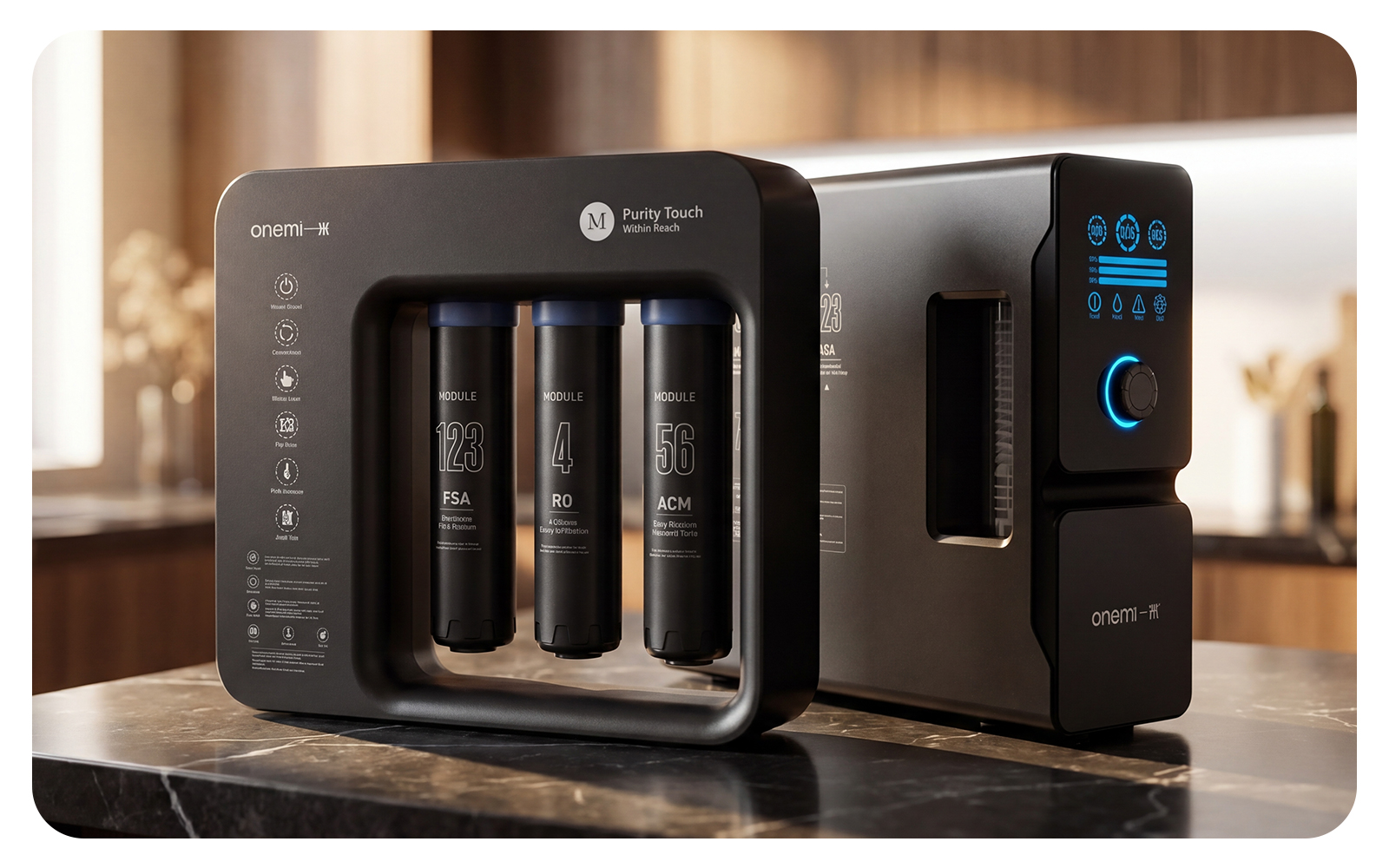
* **Countertop RO Systems:** Freestanding units requiring no plumbing modifications. Users manually fill the raw water reservoir. ONEMI’s countertop units utilize an integrated self-priming pump to drive water through the membrane, delivering under-sink filtration performance in a portable footprint.
* **Whole House Systems:** Installed at the point of entry (POE) to treat all incoming water. These require significant utility space and professional plumbing integration. They are ideal for large residential properties or commercial facilities requiring comprehensive facility-wide treatment.
**4. Certifications Matter: Look for These Standards**
Third-party certification remains the only objective indicator of system performance and material safety.
* **NSF/ANSI 58:** The definitive international standard for point-of-use reverse osmosis systems. It verifies material safety, structural integrity, and specific contaminant reduction claims. ONEMI engineers all RO systems to comply with NSF/ANSI 58 parameters.
* **NSF/ANSI 42 & 53:** These standards govern aesthetic effects (chlorine, taste, odor) and health effects (lead, VOCs, cysts), respectively. They are critical benchmarks for the activated carbon stages.
* **Water Efficiency Label (GB 34914-2021):** The stringent Grade 1 standard requires a net water production rate of ≥65%. All ONEMI RO systems meet or exceed this Grade 1 efficiency metric.
* **CE / RoHS / REACH:** Mandatory directives for the European market, ensuring electrical safety and restricting hazardous materials in manufacturing.
Reputable manufacturers maintain current documentation. ONEMI provides comprehensive third-party laboratory certifications for all product lines to support global compliance.
**5. Total Lifecycle Value: Beyond the Initial Acquisition**
Professional procurement requires evaluating the five-year total lifecycle.
* **Year 1:** Initial equipment acquisition.
* **Years 2, 3, and 5:** Standard annual filter replacements.
* **Year 4:** Standard filter replacements plus the scheduled RO membrane replacement.
* **Ongoing:** Minimal electricity and wastewater utility requirements.
Compare this lifecycle to commercial bottled water consumption. A facility or household consuming 2 gallons daily relies on a continuous, resource-heavy supply chain. A properly specified RO system achieves a rapid return on investment, typically within 12 to 18 months, while providing an uninterrupted, on-demand supply of purified water.
ONEMI engineers filter cartridges with standardized, twist-and-lock mechanisms. This allows end-users to perform routine maintenance independently, eliminating the need for specialized service technicians.
**6. ONEMI: A Sourcing Partner That Understands the Full Picture**
With over a decade of specialized manufacturing experience, ONEMI delivers complete water treatment solutions backed by rigorous engineering and global compliance.
Partnering with ONEMI provides:
* **Customizable Configurations:** Tailor filtration stages, tank capacities, and housing designs to precise market specifications.
* **Compliance Support:** Access existing laboratory reports and dedicated support for new regional certification processes.
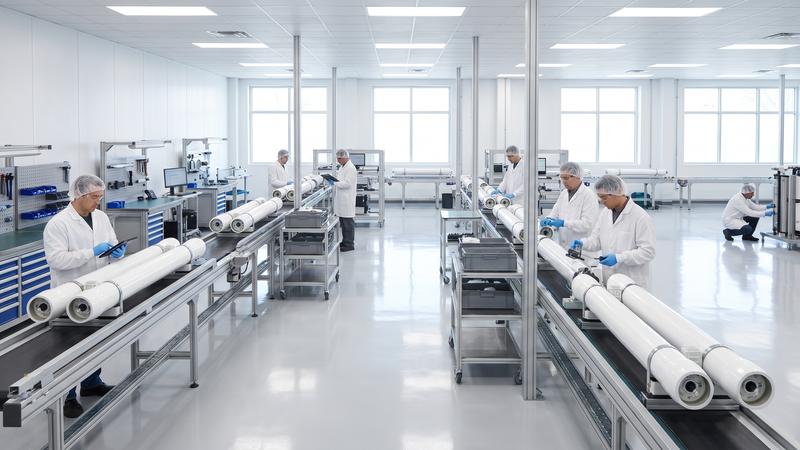
* **Verified Quality:** ISO 9001 certified manufacturing facilities. Every unit undergoes 100% leak testing and TDS reduction verification prior to dispatch.
* **Technical Documentation:** Comprehensive spare parts catalogs, localized maintenance guides, and full engineering documentation accompany every shipment.
Selecting the right water purifier requires aligning membrane technology with source water data, and physical form factors with facility constraints. ONEMI simplifies this process through transparent engineering data, certified performance, and a comprehensive portfolio ranging from point-of-use RO units to centralized POE systems.
Explore ONEMI's complete product range at onemiro.com/en/products/.
*ONEMI — www.onemiro.com Original Content | How to Choose a Water Purifier Guide*