


 한국어
한국어

**Global Water Purifier Market Trends 2026: Smart RO Systems and NSF Standards Driving Growth**
The global water filtration industry is experiencing transformative growth in 2026. Rising demand for safe drinking water, technological innovations in reverse osmosis (RO) systems, and stricter certification standards are driving this expansion. This article explores the key market trends, competitive dynamics, and technological advancements shaping the industry today.
**Water Filter Market Size and Growth Projections for 2026**
Recent market research shows the global water filters market hit $15.56 billion in 2025. Experts project this figure will reach $16.78 billion in 2026, reflecting a 7.9% compound annual growth rate (CAGR). Projections indicate the market will climb to $22.8 billion by 2030 at an 8% CAGR.
The broader water purifier segment—including RO, UV, and gravity-based systems—saw a valuation of $48.1 billion in 2025. Analysts forecast this segment will surge to $97 billion by 2035. The Asia-Pacific region remains the largest and fastest-growing market. Rapid urbanization, rising disposable incomes, and growing awareness of water contamination across China, India, and Southeast Asia fuel this demand. For B2B buyers exploring OEM partnerships, ONEMI provides commercial water treatment solutions tailored to diverse market segments.
**Whole-House RO Systems Enter the Mainstream**
Waterdrop delivered one of the most significant product launches of 2026. The company debuted its first whole-house reverse osmosis system at KBIS 2026 in February. This launch signals a major industry shift. Historically, water volume constraints made whole-house RO impractical. Today, membrane efficiency improvements and smart flow management make these systems highly viable.
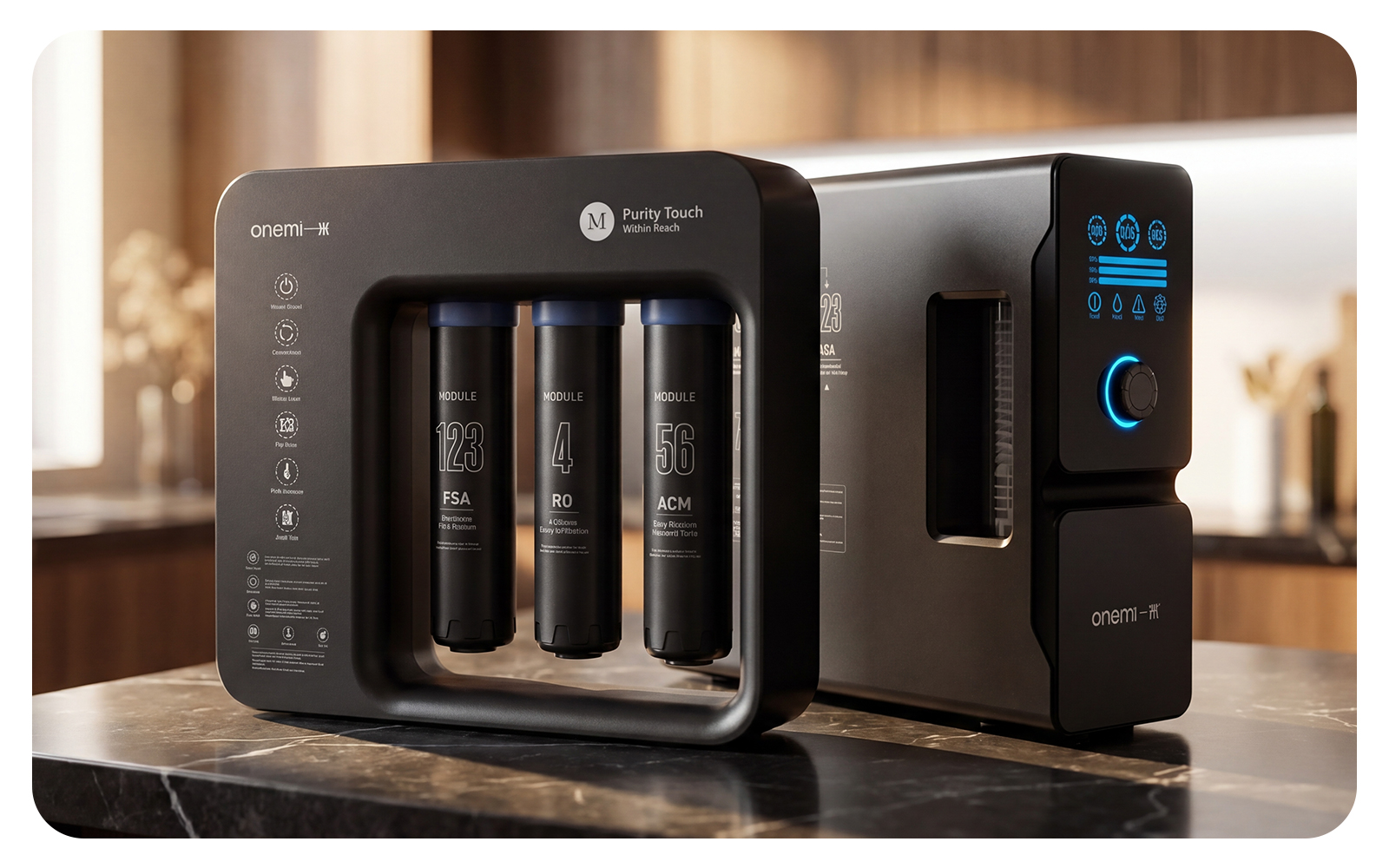
Earlier this year, Karofi showcased next-generation whole-house water protection technologies at CES 2026. Their display featured advanced filtration and softening solutions with high water recovery rates. ONEMI also leads in this space with its Yimi PureFlow Technology. Engineered specifically for whole-house RO applications, this technology achieves industry-leading flow rates while maintaining rejection rates above 95%. These developments prove the RO industry is moving beyond point-of-use under-sink systems. Full-home coverage is now a reality, creating new opportunities for manufacturers and B2B buyers.
**NSF Certification Standards: What They Mean for B2B Buyers**
The United States lacks federal regulations for residential water treatment. However, voluntary NSF/ANSI standards serve as the definitive benchmark for safety and performance. In 2026, B2B buyers must understand three key certification standards. NSF 42 covers aesthetic effects, including chlorine, taste, and odor reduction. NSF 53 addresses health-related contaminant reduction, targeting heavy metals, chemicals, and cysts. Finally, NSF Protocol P231 governs microbiological purification, verifying the removal of bacteria, viruses, and cysts.
Securing the appropriate NSF certifications is now a non-negotiable requirement for OEMs and importers entering North American and European markets. ONEMI, a premier Chinese water purification equipment manufacturer, integrates certified filtration technologies across all product lines to ensure international compliance. B2B partners can explore ONEMI's R&D and certification capabilities directly on our website.
**Smart Technology Integration Reshapes Water Purification**
Smart functionality is no longer just a premium differentiator. It is now an expected standard across mid-range and high-end water purifiers. In 2026, IoT-enabled features dominate the market. These include real-time TDS monitoring with push notifications, filter life tracking with automatic reordering, and remote on/off and flushing controls via mobile apps. Commercial applications also benefit heavily from advanced water usage analytics.
Leading manufacturers like Kent RO Systems and LG Electronics now integrate AI-driven predictive maintenance. This technology alerts users well before performance degradation occurs. For B2B customers evaluating OEM partners, embedding smart connectivity into private-label products is now a critical selection criterion.
**Innovations in Water Recovery and Efficiency**
The industry has long criticized traditional RO systems for excessive water waste. Older units typically produce 3 to 4 gallons of wastewater for every gallon of purified water. In 2026, high-recovery RO technology has made significant strides.
Karofi highlighted systems with substantially improved water recovery rates at CES 2026. Furthermore, advances in pump and membrane design now allow many manufacturers to achieve a 1:1 or better pure-to-wastewater ratio. Zero-waste RO systems are also gaining serious traction in residential and light commercial segments. These innovative systems efficiently recirculate concentrate back into the feed line.
ONEMI — www.onemiro.com Original Content