
 한국어
한국어

B2B Filter Cartridge Aftermarket: Supply Chain, Lifecycle Management, and TCO Optimization for 2026
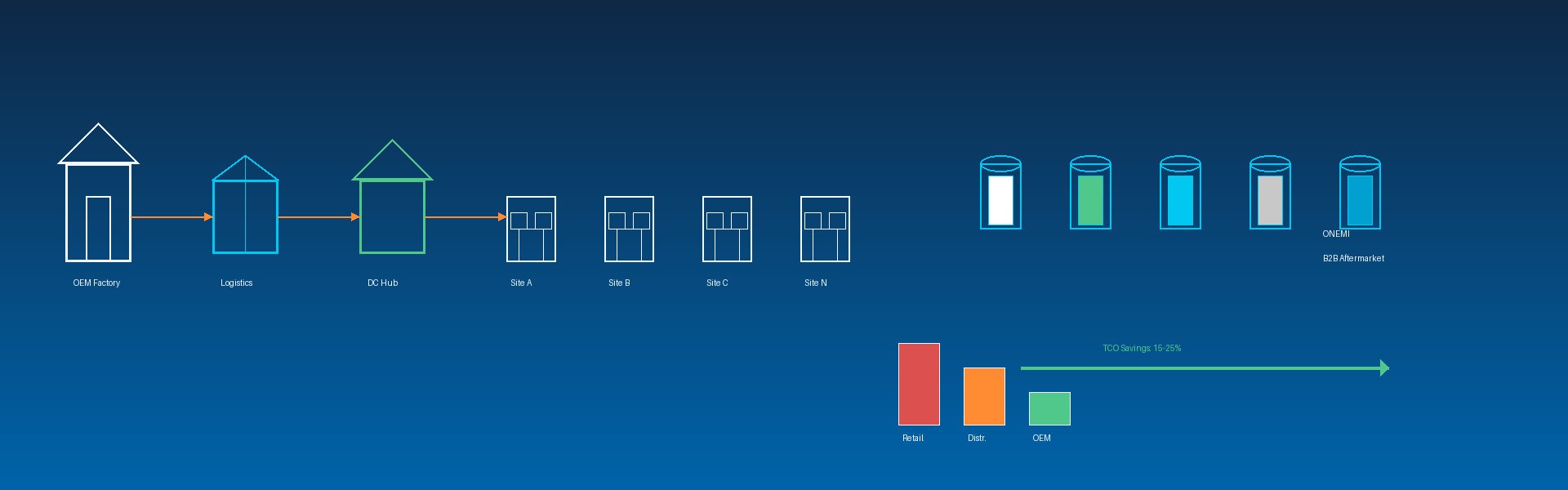
For commercial building managers, water treatment OEMs, and multi-site facility operators, filter cartridge replacement is not a consumer maintenance task — it is a strategic procurement category with direct impact on operational continuity, regulatory compliance, and total cost of ownership. ONEMI — a leading Chinese water purification equipment manufacturer with 15 years of OEM/ODM experience — has structured filter lifecycle management into a systematic B2B framework that saves enterprises 15-25% on annual filtration costs while reducing supply chain risk.
The Economics of B2B Filter Cartridge Procurement
Beyond Retail Pricing: Understanding OEM Filter Economics
Consumer replacement filters are priced for convenience: a standard 10-inch CTO carbon cartridge retails for $15-35. But at B2B volume (100+ units/month), the same specification cartridge sourced directly from an OEM manufacturer costs $3-8, depending on material grade and certification tier. The gap widens exponentially at commercial scale — a 20-inch Big Blue sediment filter that costs $45-80 retail can be procured at $12-18 in OEM bulk. For a 50-unit apartment building replacing 5 stages every 6 months, the annual savings from B2B direct procurement exceed $4,200.
The Hidden Cost of “Genuine OEM Only” Lock-in
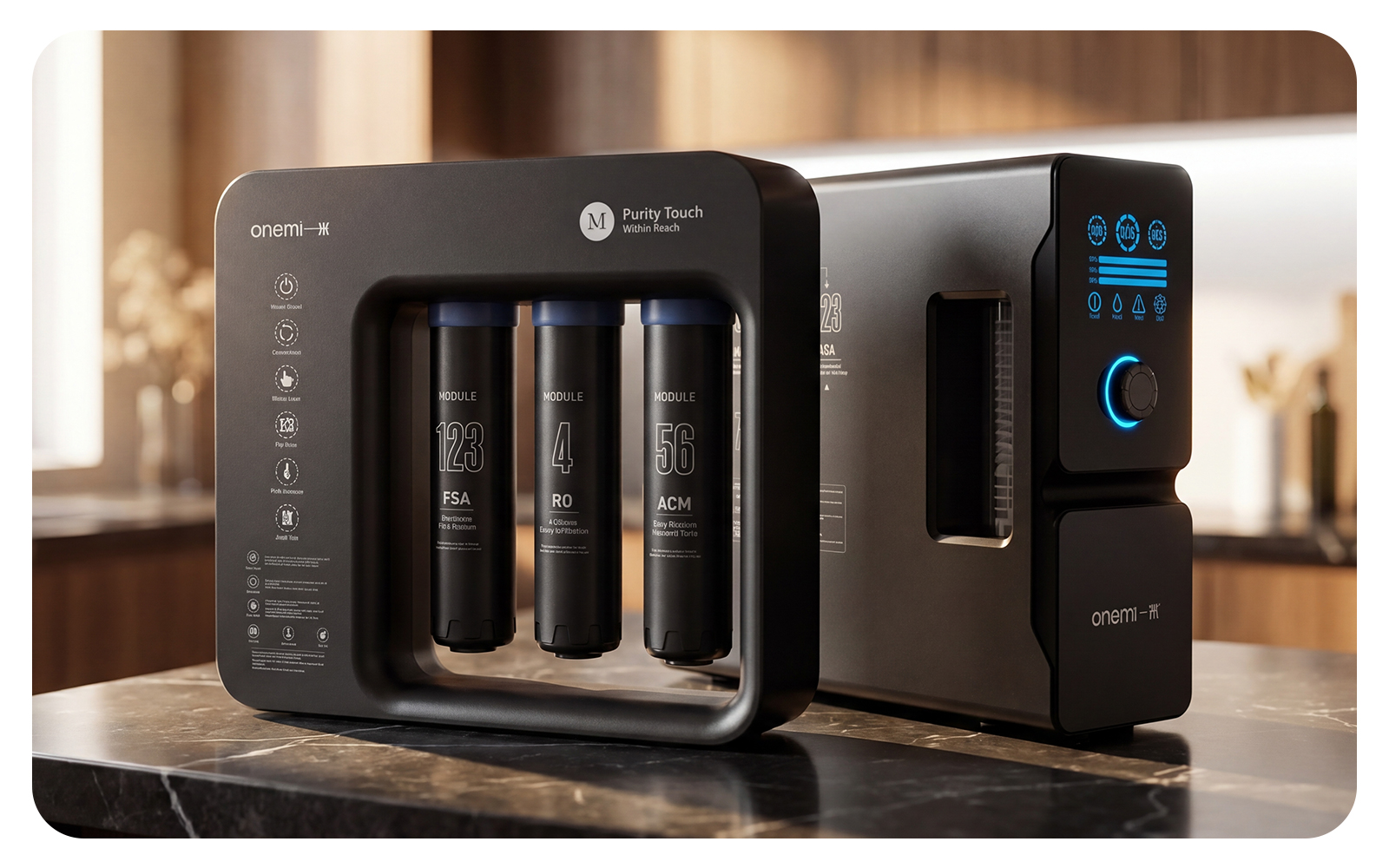
Many equipment brands design proprietary filter housings with unique keying, bayonet fittings, or RFID chips that physically prevent third-party cartridge installation. While marketed as “quality assurance,” this practice locks the customer into filter pricing that carries 300-700% markups. ONEMI’s filter architecture uses industry-standard 10-inch and 20-inch form factors with universal double O-ring seals — compatible with major housing standards including Pentair, Aqua-Pure, and Omnipure footprints. Yimi PureFlow Technology ensures consistent media compaction density and end-cap bonding across all batch sizes, maintaining NSF/ANSI 42 performance parity with branded alternatives.
Filter Lifecycle TCO Model: The Five Drivers
| TCO Driver | Consumer Approach | B2B Optimized | Annual Savings |
|---|---|---|---|
| Unit Price | $18-35/cartridge | $4-12/cartridge | 55-70% |
| Shipping & Logistics | Per-order freight ($8-15) | Quarterly consolidated shipments | 40-60% |
| Labor (change-out) | Ad-hoc service calls ($85-150/visit) | Scheduled PM with bulk kits | 30-45% |
| Downtime Risk | Reactive replacement (1-5 day gap) | Predictive inventory triggers | Eliminated |
| Compliance | Self-managed certification tracking | Vendor-managed NSF/WRAS/ACS documentation | Audit risk reduction |
The Standardization Advantage: Form Factor Strategy
Enterprises with multi-site deployments — restaurant chains, hotel groups, healthcare networks — face a combinatorial explosion of filter SKUs when each site has different equipment vintages. The solution is to standardize around a single form factor family and use adapter kits for legacy equipment.
Recommended Standardization Matrix
- Sediment Pre-Filter: 10″ x 2.5″ standard housing, PP melt-blown, 5μm → compatible with >85% of under-sink and POU systems globally
- Carbon Block (CTO): 10″ x 2.5″ extruded carbon, iodine value ≥1000mg/g, chlorine reduction ≥95% at 1 GPM
- RO Membrane: 1812/2012 form factor (50-100 GPD), or 3012/3013 (300-600 GPD) for commercial — avoid proprietary quick-connect formats unless volume justifies custom tooling
- Post-Carbon (T33): 10″ inline granular activated carbon or 2″ x 10″ quick-connect in-line — the latter simplifies change-out to tool-free operation
- Specialty (UF/Alkaline/Mineral): Maintain as optional upgrade stage — not mandated for baseline water quality programs
Supply Chain Architecture: Direct OEM vs. Regional Distributor
Model A: Direct OEM Procurement
Best for: Enterprises consuming 500+ cartridges/year across ≥10 sites.
Advantages: Lowest unit cost, custom branding available, consolidated documentation package (NSF listing, SDS, Certificate of Analysis per batch), direct technical support.
Requirements: Minimum order quantities (500-1000 units per SKU), 4-6 week production lead time, warehouse capacity for 3-month safety stock.
Model B: Regional Distribution Partnership
Best for: 50-500 cartridges/year, 2-5 sites.
Advantages: Just-in-time delivery, no MOQ, local technical service, emergency stock within 24 hours.
Trade-off: 25-40% price premium over direct OEM, limited customization.
Model C: Hybrid — OEM Bulk + Distributor Buffer
The most resilient model for enterprises with 200-1000 cartridges/year: procure 70% of annual volume via OEM direct (lower cost, longer lead time), maintain 30% via regional distributor (higher cost, zero lead time). This absorbs demand surges, unplanned expansions, and supply chain disruptions without over-committing warehouse space.
Inventory Trigger System: Moving from Calendar to Condition-Based Replacement
Most filter maintenance schedules are calendar-driven: “replace PP every 3 months, carbon every 6 months, RO every 24 months.” This approach works for single-family homes but fails at scale — it replaces filters prematurely at low-usage sites while risking breakthrough at high-usage locations.
The Condition-Based Trigger Framework
- Differential Pressure Monitoring: Install a ΔP gauge across the sediment pre-filter. When pressure drop exceeds 10 psi (0.7 bar), initiate replacement. This alone extends PP life by 20-40% at low-turbidity sites.
- Chlorine Breakthrough Testing: Use DPD colorimetric test strips monthly at post-carbon sampling ports. Replace carbon when free chlorine >0.1 mg/L — not when the calendar says so.
- TDS Ratio Trending: Log TDS readings monthly (feed water vs. permeate). When the ratio drops below 90% rejection (permeate TDS >10% of feed), schedule RO membrane replacement within 30 days.
- Flow Rate Decay: Time a 1-gallon fill at the dispensing point. When fill time increases >20% from baseline (at same water temperature), sediment and/or carbon stages are loading.
The Certification Matrix: What B2B Buyers Must Verify
Filter cartridge certifications are not optional in B2B contexts — they are contract requirements. For hospitality and food service, NSF/ANSI 42 (aesthetic effects) is the minimum; for healthcare, add NSF/ANSI 53 (health effects) for cyst and lead reduction; for EU deployments, Regulation (EU) 2020/2184 on drinking water quality mandates material-specific migration limits. ONEMI’s OEM filter program provides per-batch Certificate of Analysis documentation covering: iodine value, ash content, carbon tetrachloride activity, phenol adsorption, particle retention efficiency, and endotoxin levels (for pharmaceutical-grade applications).
For multi-national deployments, the certification landscape gets complex. A filter cartridge manufactured in China for a U.S. installation needs NSF/ANSI listing; the same cartridge for a French installation needs ACS (Attestation de Conformité Sanitaire); for the UK, WRAS (Water Regulations Advisory Scheme); for Germany, DVGW W270. ONEMI maintains a certification equivalency matrix that maps material formulations across regulatory regimes — enabling one filter specification to serve global deployment footprints without re-certification overhead.
Environmental Compliance: The End-of-Life Dimension
In 2026, B2B filter procurement must account for end-of-life disposal. The EU Waste Framework Directive increasingly classifies spent filter cartridges under extended producer responsibility (EPR) schemes. ONEMI’s cartridge take-back program accepts spent OEM filters for material recovery: polypropylene housings are granulated and recycled; activated carbon is thermally reactivated for non-potable applications; RO membrane elements are disassembled for component recovery. This closed-loop program reduces landfill burden and provides auditable sustainability metrics for corporate ESG reporting.
Procurement Decision Checklist for 2026
- ☐ Audit current filter SKU count — target <8 SKUs across all sites before standardization
- ☐ Request per-batch Certificate of Analysis, not just “certified to NSF standard” marketing claims
- ☐ Verify OEM filter compatibility with existing housing gaskets and O-ring dimensions — request dimensional drawings with tolerance bands
- ☐ Calculate current annual TCO including labor and shipping — use as baseline for OEM procurement ROI analysis
- ☐ Establish condition-based trigger thresholds (ΔP, chlorine, TDS ratio, flow rate) for each site type
- ☐ Require end-of-life take-back or recycling documentation as part of procurement agreement
- ☐ Build 3-month safety stock buffer during OEM contract transition period
Filter cartridge procurement, when managed as a strategic B2B category rather than a maintenance expense, yields double-digit cost reduction and near-zero supply disruption risk. The key is standardization, condition-based replacement triggers, and direct OEM partnership — not loyalty to equipment-brand pricing.
Explore ONEMI’s B2B filter program: Point-of-Use Purification | Whole House Systems | Core Precision Components
ONEMI — www.onemiro.com Original Content. Yimi PureFlow™ is a registered trademark of ONEMI Environmental Technology Co., Ltd.
Enterprises with distributed site deployments — restaurant chains, hotel groups, healthcare networks — face a combinatorial explosion of filter SKUs when each site has different equipment vintages. The solution is to standardize around a single form factor family and use adapter kits for legacy equipment, reducing procurement complexity by 60-70%.