


 한국어
한국어


**Small Scale Desalination: A Complete Guide to Compact RO Seawater Systems for Residential, Marine, and Commercial Use**
Desalination no longer belongs exclusively to massive industrial plants producing millions of gallons daily. A quiet revolution is reshaping the small-scale desalination market. Manufacturers are engineering compact reverse osmosis (RO) systems specifically for single households, coastal resorts, island communities, yachts, and offshore platforms.
Global freshwater scarcity continues to intensify. According to the United Nations, 2.3 billion people currently live in water-stressed regions. Consequently, small-scale desalination has become one of the fastest-growing segments in the water treatment sector. This guide delivers a comprehensive technical analysis of the small-scale desalination landscape for B2B buyers, distributors, and OEM partners.
**Market Overview: The Rise of Small-Scale Desalination**
Grand View Research (2025) valued the global small-scale desalination market at approximately $5.8 billion in 2024. Analysts project this figure will reach $9.2 billion by 2030, representing a CAGR of 7.8%. Several converging trends drive this expansion: rising coastal population densities, advancing RO membrane technology, the rapid adoption of solar-powered off-grid systems, and increasingly stringent water quality regulations in developing economies.
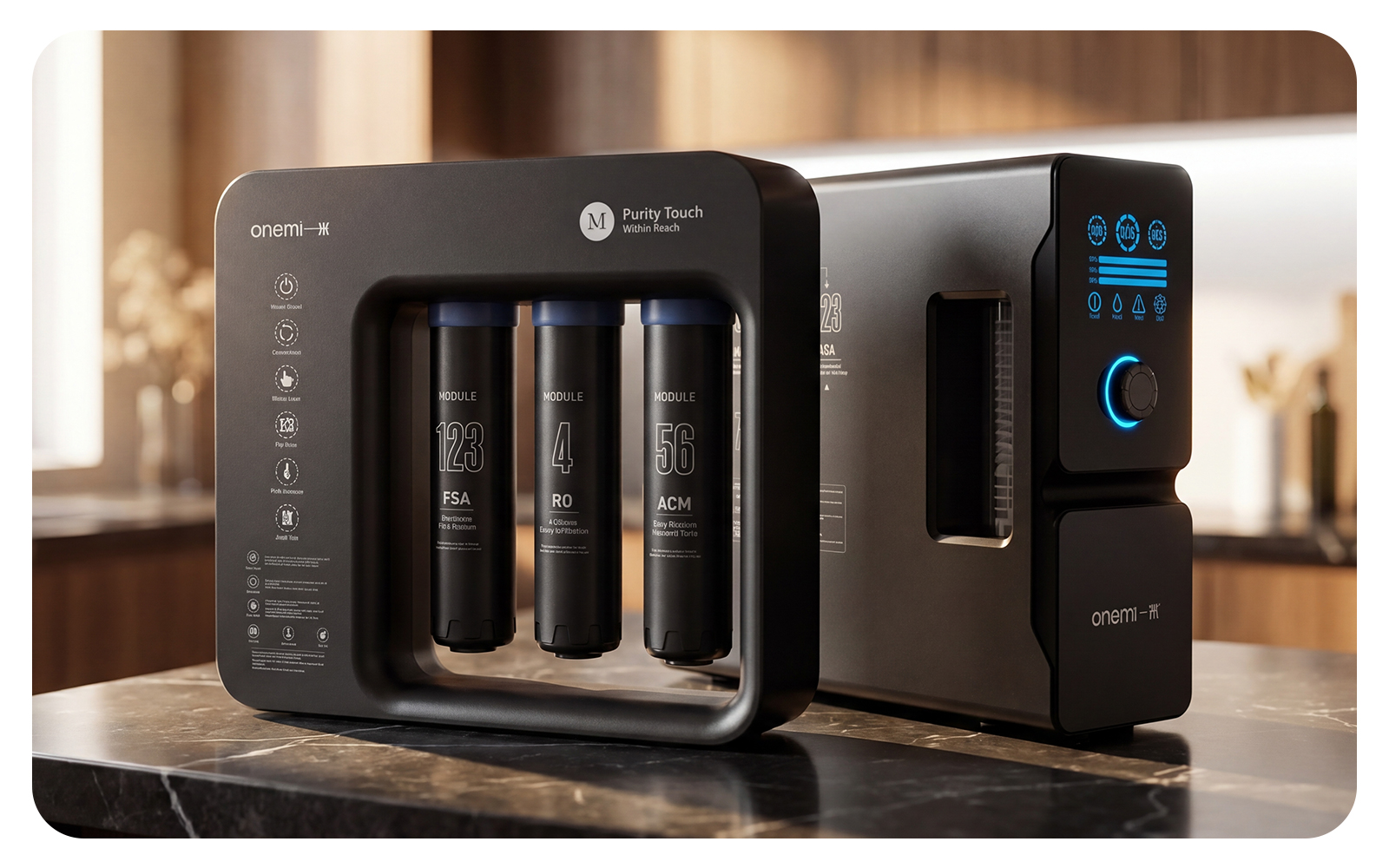
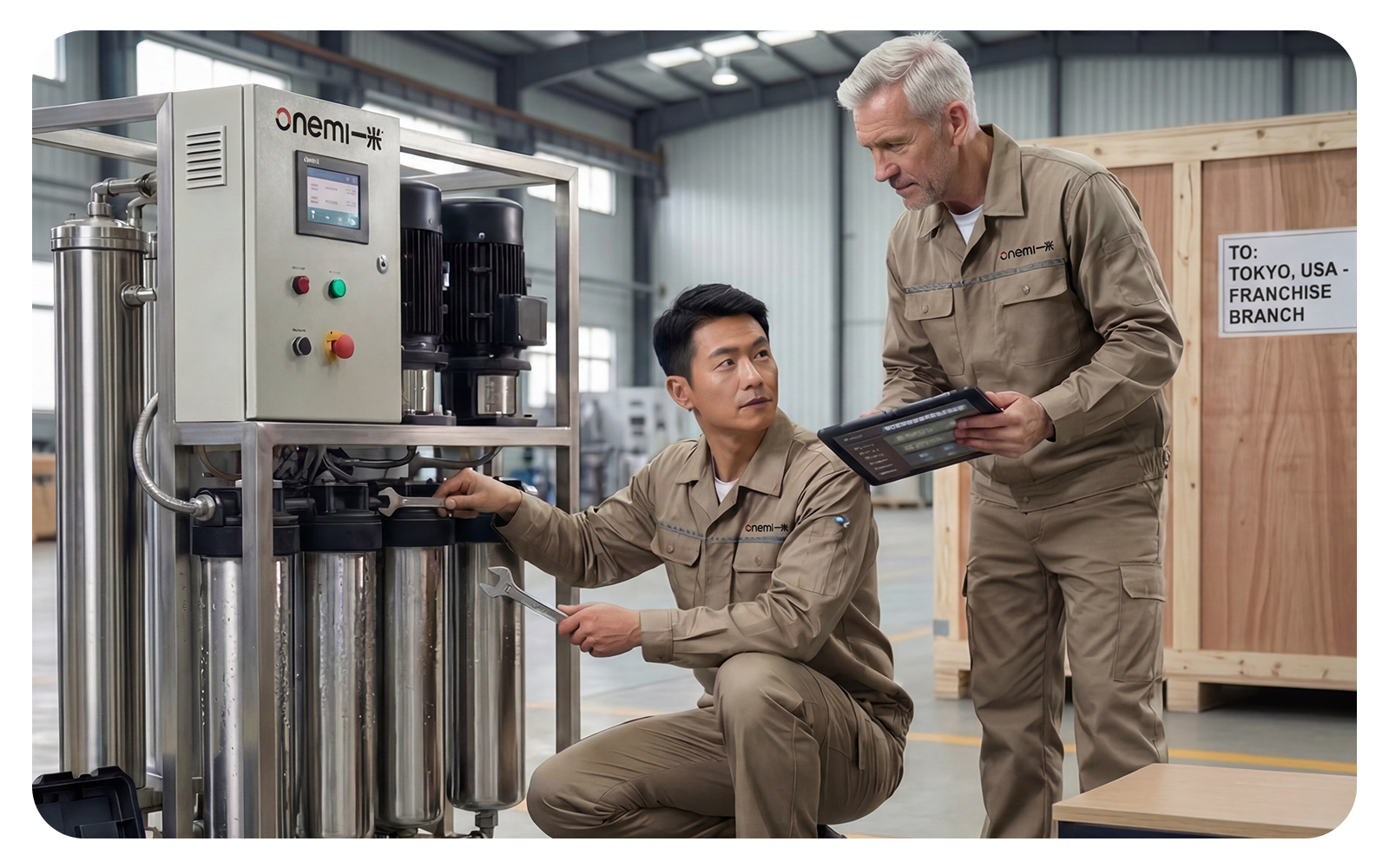
Unlike large municipal desalination plants that require years of construction, operators can deploy small-scale systems in weeks. Non-specialist personnel can easily manage these units. ONEMI, a leading water purification equipment manufacturer, drives this innovation. The company develops compact, modular RO desalination systems that integrate energy recovery technology with remote IoT monitoring. ONEMI’s small-scale lineup spans capacities from 500 liters per day (LPD) for single-family residences to 50,000 LPD for commercial applications and small communities, effectively addressing decentralized water demands.
**Technology Deep-Dive: How Small-Scale Desalination Works**
**The Core: Reverse Osmosis Membranes**
Modern small-scale desalination systems rely on spiral-wound thin-film composite (TFC) polyamide RO membranes. These membranes feature a pore size of roughly 0.0001 microns. This microscopic filtration rejects dissolved salts (achieving a NaCl rejection rate >99.2%), bacteria, viruses, and organic compounds.
Seawater applications (TDS 35,000–45,000 mg/L) require high-pressure RO membranes rated for 800–1,200 psi. Brackish water applications (TDS 1,000–15,000 mg/L) utilize lower-pressure membranes rated at 200–600 psi, which dramatically reduces energy consumption.
*Key Performance Metrics for Desalination RO Membranes:*
* **Operating Pressure:** Seawater (55–83 bar / 800–1,200 psi) | Brackish Water (14–41 bar / 200–600 psi)
* **Salt Rejection Rate:** Seawater (99.2%–99.8%) | Brackish Water (98.5%–99.5%)
* **Permeate Flow:** Seawater (28–45 L/m²·h) | Brackish Water (35–55 L/m²·h)
* **Membrane Area:** 35–41 m² per 8" element (Seawater) | 37–41 m² per 8" element (Brackish)
* **Typical Recovery Rate:** Seawater (30%–45% single pass) | Brackish Water (50%–75%)
* **Service Life:** Seawater (3–5 years) | Brackish Water (3–7 years)
**Energy Recovery: The Game-Changer for Small Systems**
Historically, high energy consumption hindered small-scale desalination adoption. A standard seawater RO system lacking energy recovery consumes 8–15 kWh per cubic meter of product water. By comparison, surface water treatment requires only 0.5–1 kWh/m³.
Engineers have solved this by introducing compact energy recovery devices (ERDs). Pressure exchangers (PX) and turbochargers, newly adapted for low-flow applications, have reduced system energy consumption to 2.5–4 kWh/m³.
ONEMI integrates isobaric ERD technology into its small-scale systems. This achieves a specific energy consumption (SEC) as low as 2.8 kWh/m³ for seawater desalination in the 5,000–20,000 LPD range. Furthermore, ONEMI utilizes Yimi PureFlow Technology. This proprietary feed spacer design reduces concentration polarization by 25%, which directly lowers operating pressure and minimizes energy draw.
**System Architectures: Four Configurations**
**1. Single-Pass SWRO (Seawater Reverse Osmosis)**
This is the standard configuration for seawater feeds (TDS >30,000 mg/L). A single pass through high-pressure RO membranes yields product water with a TDS of 200–500 mg/L. This output fully satisfies World Health Organization (WHO) drinking water guidelines.
**2. Two-Pass RO for High-Purity Applications**
Certain applications—such as pharmaceutical manufacturing, laboratories, or boiler feed water—demand higher purity than standard drinking water. A second pass utilizing brackish water RO membranes polishes the first-pass permeate, reducing the final TDS to <10 mg/L.
**3. Solar-Powered Off-Grid SWRO**
Remote locations lacking grid electricity utilize photovoltaic (PV) panels paired with battery storage. A standard 5,000 LPD solar SWRO system requires 8–12 kW of solar capacity and 20–30 kWh of battery storage to maintain 24-hour operation. Utilizing DC-powered high-pressure pumps eliminates inverter losses, improving overall system efficiency by 12–18%. Island nations, Southeast Asian coastal resorts, and humanitarian organizations frequently deploy this configuration.
**4. Containerized Plug-and-Play Systems**
Manufacturers pre-assemble all components—intake, pre-treatment, RO, post-treatment, controls, and ERDs—inside standard 10-foot or 20-foot shipping containers. These systems provide rapid deployment for emergency response, mining camps, military bases, and temporary construction sites. ONEMI’s containerized units feature remote IoT monitoring via 4G or satellite, allowing operators to track real-time performance and schedule predictive maintenance globally.
**Key Applications and Buyer Profiles**
**Coastal Resorts and Hotels**
A typical 200-room beachfront resort in a water-scarce region consumes 40,000–80,000 LPD of fresh water. On-site desalination provides a highly reliable, independent water supply. ONEMI configures its Whole House Water Purification systems with SWRO pre-treatment to deliver comprehensive resort water management.
**Island Communities**
Small islands across the Pacific, Caribbean, and Indian Ocean represent some of the most water-stressed environments globally. Saltwater intrusion frequently contaminates their groundwater lenses. A community-scale desalination system producing 20,000–100,000 LPD successfully serves 100–500 households. International development banks and climate adaptation funds heavily back these installations.
**Marine and Offshore**
Yachts, fishing vessels, offshore oil platforms, and research ships require continuous freshwater generation. Manufacturers build marine-grade desalination systems to withstand severe corrosion, heavy vibration, and constant pitch/roll conditions. Compact systems producing 1,000–10,000 LPD dominate this market. Essential industry certifications include Lloyd's Register, DNV, and ABS type approvals.
**Emergency and Humanitarian Response**
Natural disasters routinely destroy municipal freshwater infrastructure. Responders can airlift containerized SWRO systems into disaster zones to produce clean water within 48 hours of arrival. The Sphere Handbook specifies a minimum humanitarian requirement of 15 liters per person per day. A single 20-foot containerized system easily sustains 3,000 people under these guidelines.
**B2B Procurement Guide: 7 Dimensions of Evaluation**
1. **Feed Water Analysis:** Always secure a comprehensive water quality report before specifying a system. Critical parameters include TDS, temperature, turbidity, and SDI (Silt Density Index). The SDI must measure <3 before water reaches the RO membranes.
2. **Capacity and Recovery Rate:** Size the system to match daily demand while adding 20–30% headroom. The recovery rate dictates brine volume and energy draw. Higher recovery reduces brine but elevates membrane fouling risks. The optimal recovery rate for seawater sits between 35–45%.
3. **Energy Efficiency (SEC):** Demand the Specific Energy Consumption (kWh/m³) data from the manufacturer. A properly engineered small-scale SWRO featuring an ERD will achieve an SEC of 2.5–4 kWh/m³. Systems lacking ERDs pull 8–15 kWh/m³.
4. **Membrane Brand and Warranty:** Top-tier membrane manufacturers include DuPont FilmTec, Hydranautics (Nitto), Toray, and LG Chem. Ensure the OEM integrates genuine first-tier elements rather than generic alternatives. Warranties must cover premature fouling or failure under standard operating conditions.
5. **Materials and Corrosion Resistance:** Specify 316L stainless steel, duplex stainless steel (2205 or 2507 for high-chloride environments), or corrosion-resistant polymers (PVC-U, PVDF) for all wetted parts. Aggressive seawater conditions require Super Duplex or 904L for high-pressure piping. Never accept 304 stainless steel in seawater applications; it will pit rapidly.
6. **Remote Monitoring and Controls:** Require PLC-based control systems featuring remote access (4G/Wi-Fi/Ethernet). The system must monitor feed and permeate conductivity, operating pressure, flow rates, membrane differential pressure, and energy consumption. Ensure the system includes an automated freshwater flush upon shutdown to prevent stagnant seawater from degrading the membranes.
7. **After-Sales Support and Spare Parts:** Desalination requires strict ongoing maintenance, including cleaning chemicals, cartridge filters, pump seals, and sensor calibrations. Validate the manufacturer's global spare parts availability and technical support infrastructure.
**Pre-Treatment: The Foundation of Reliable Operation**
Inadequate pre-treatment remains the primary cause of membrane fouling and premature system failure in small-scale desalination. Seawater carries suspended solids, colloidal particles, microorganisms, and dissolved organics. Without a robust pre-treatment train, these elements will foul RO membranes in a matter of days.
A professional pre-treatment sequence for small SWRO systems includes:
* **Intake Screening:** Install a coarse screen (5–10mm) at the intake point, followed by a fine screen (500–1,000 micron) before the multimedia filter. Beach wells offer excellent natural filtration and remain vastly superior to open seawater intakes where hydrogeologically viable.
* **Multimedia Filtration (MMF):** Utilize stratified layers of anthracite, silica sand, and garnet to capture suspended solids down to 10–20 microns. Implement automatic backwashing triggered by differential pressure or a set timer.
* **Cartridge Filtration:** Deploy 5-micron absolute-rated melt-blown polypropylene cartridges as the final physical barrier before the high-pressure pump. Operators must replace these every 3–6 months, or whenever differential pressure exceeds 1 bar.
* **Antiscalant Dosing:** Inject specialized chemicals to prevent sparingly soluble salts (CaCO₃, CaSO₄, BaSO₄, SiO₂) from scaling the membrane surface. Standard dose rates run 2–4 mg/L, regulated by a metering pump synchronized with the feed flow.
* **Optional Sodium Metabisulfite (SMBS) Dosing:** Systems drawing chlorinated seawater (common with open intakes) require SMBS dechlorination. Free chlorine irreversibly destroys polyamide RO membranes within hours of contact.
**Certifications and Compliance for International Buyers**
When procuring desalination systems globally, buyers must verify strict regulatory compliance:
* **CE Marking:** Mandatory for the European Union. This covers the entire system, including pressure vessels (PED 2014/68/EU) and electrical components (LVD 2014/35/EU, EMC 2014/30/EU).
* **NSF/ANSI Standards:** NSF 58 (RO drinking water treatment systems) and NSF 61 (drinking water system components) serve as critical benchmarks for North American markets.
* **ISO 9001:** Validates the manufacturer's quality management system.
* **WHO GDWQ Compliance:** Certifies that the product water meets the World Health Organization Guidelines for Drinking-water Quality.
* **ASME Code:** North American deployments frequently require ASME Section VIII certification for pressure vessels.
ONEMI engineers fully certified systems utilizing CE, ISO 9001, and NSF-compliant components. The company's Core Precision Components division manufactures RO membrane housings, high-pressure pumps, and control systems engineered to meet the strictest international certification requirements for OEM integration.
*ONEMI — www.onemiro.com Original Content*