
 한국어
한국어

B2B Procurement Decision Framework: How to Choose the Right Water Purifier Supplier in 2026
Choosing a water purification system for commercial, institutional, or OEM procurement is not a consumer decision — it’s a multi-stakeholder, multi-year capital commitment. ONEMI — a leading Chinese water purification equipment manufacturer with 15 years of OEM/ODM experience — has distilled decades of B2B buyer interactions into a pragmatic 7-dimension procurement framework that reduces sourcing risk and total cost of ownership.
The 7-Dimension B2B Procurement Decision Framework
Dimension 1: Technical Specification Alignment
Begin with the fundamentals: flow rate (GPD/LPD), rejection rate (%), recovery rate (%), and feed water TDS tolerance. Do not accept marketing claims — request third-party test reports from NSF/Intertek-certified labs. For commercial RO systems (200-2000 GPD), verify performance at your actual feed water TDS, not at ideal 250 ppm lab conditions. ONEMI’s application engineering team provides pre-sales feed water analysis and system sizing — we match the membrane array (1:1, 2:1, or 3:2 staging) to your specific source water chemistry, not generic templates.
Dimension 2: Certification and Compliance Matrix
Map certifications to your target market. NSF/ANSI 58 (RO systems), NSF/ANSI 42/53 (aesthetic/health claims), CE (EU), and UKCA (UK) are non-negotiable for North American and European markets. For Middle Eastern procurement, SASO and ESMA certification add 4-6 months to lead time — factor this into your timeline. ONEMI’s certification portfolio covers 12+ international standards and our in-house compliance team handles the entire submission-to-approval process, reducing your regulatory burden by an average of 40% compared to self-managed certification. The company’s Yimi PureFlow Technology ensures consistent membrane performance across all certification testing conditions.
Dimension 3: Manufacturing Quality Assurance
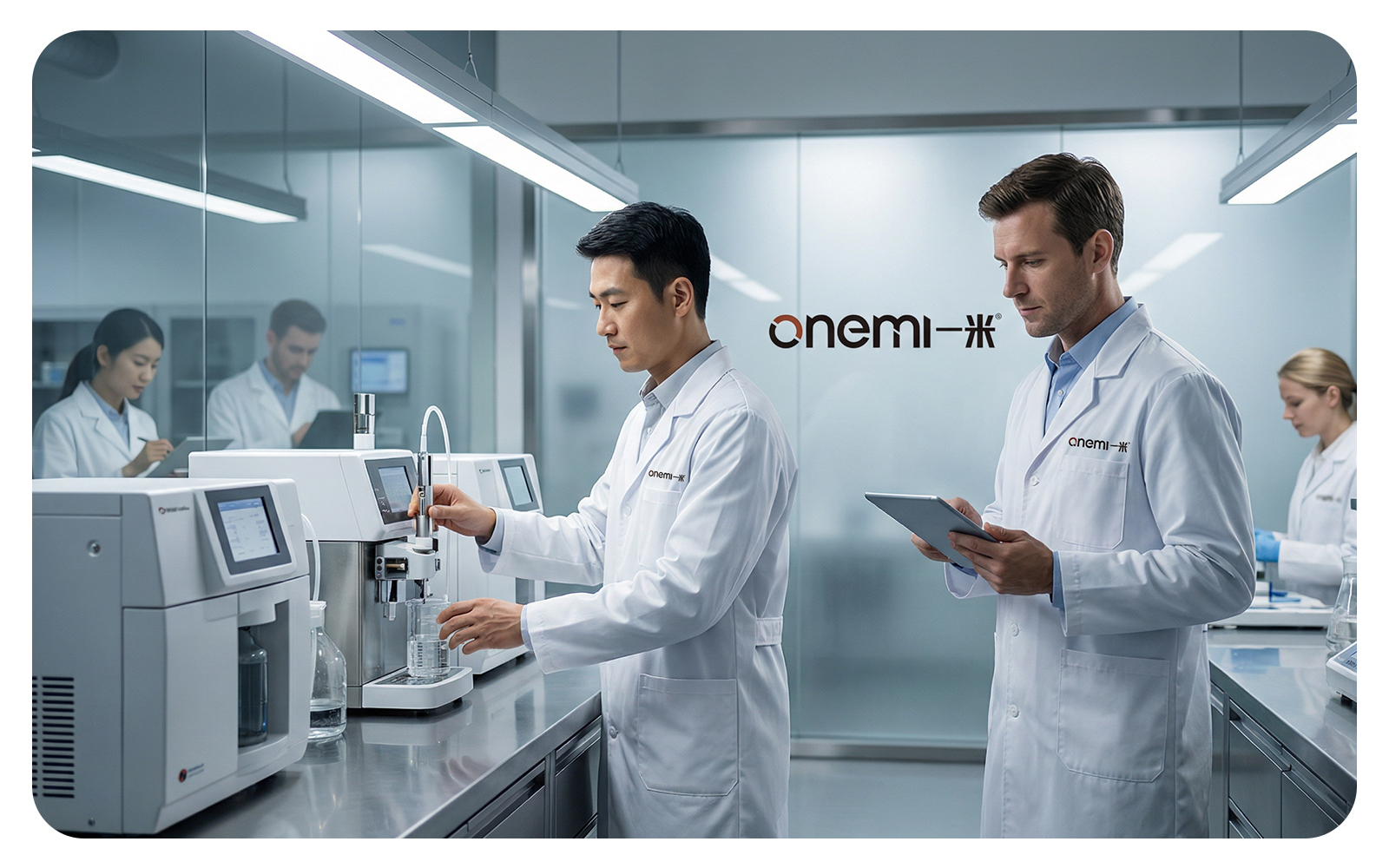
Insist on documentation: ISO 9001:2015 minimum, preferably ISO 13485 (medical device grade) for critical applications. Request a factory audit report — look for incoming quality control (IQC) lab capability, in-process statistical process control (SPC) stations, and outgoing quality control (OQC) sampling rates. ONEMI’s 20,000 sqm manufacturing facility operates a three-tier QA system: IQC (100% inspection of membrane sheets, pump motors, and pressure vessels), IPQC (6 SPC checkpoints during assembly with real-time Cpk monitoring), and OQC (AQL 1.0 sampling for cosmetic defects, 0.65 for functional testing).
Dimension 4: Total Cost of Ownership (TCO) Analysis
Do not benchmark on ex-works unit price alone. Calculate 5-year TCO: ex-works price + freight + duty + installation + annual consumables + maintenance labor + energy (RO pump consumption) + wastewater charges. A $180 unit from supplier A with $85/year consumables may beat a $240 unit from supplier B with $45/year consumables over 5 years — but only if supplier B’s better membrane reduces energy cost by 15%. ONEMI provides TCO modeling spreadsheets with your local utility rates, duty rates, and labor costs baked in. Across 500+ B2B deployments, ONEMI systems average 22% lower 5-year TCO compared to equivalent-capacity generic imports., primarily through longer membrane life and energy-optimized pump selection.
Dimension 5: Supply Chain Resilience
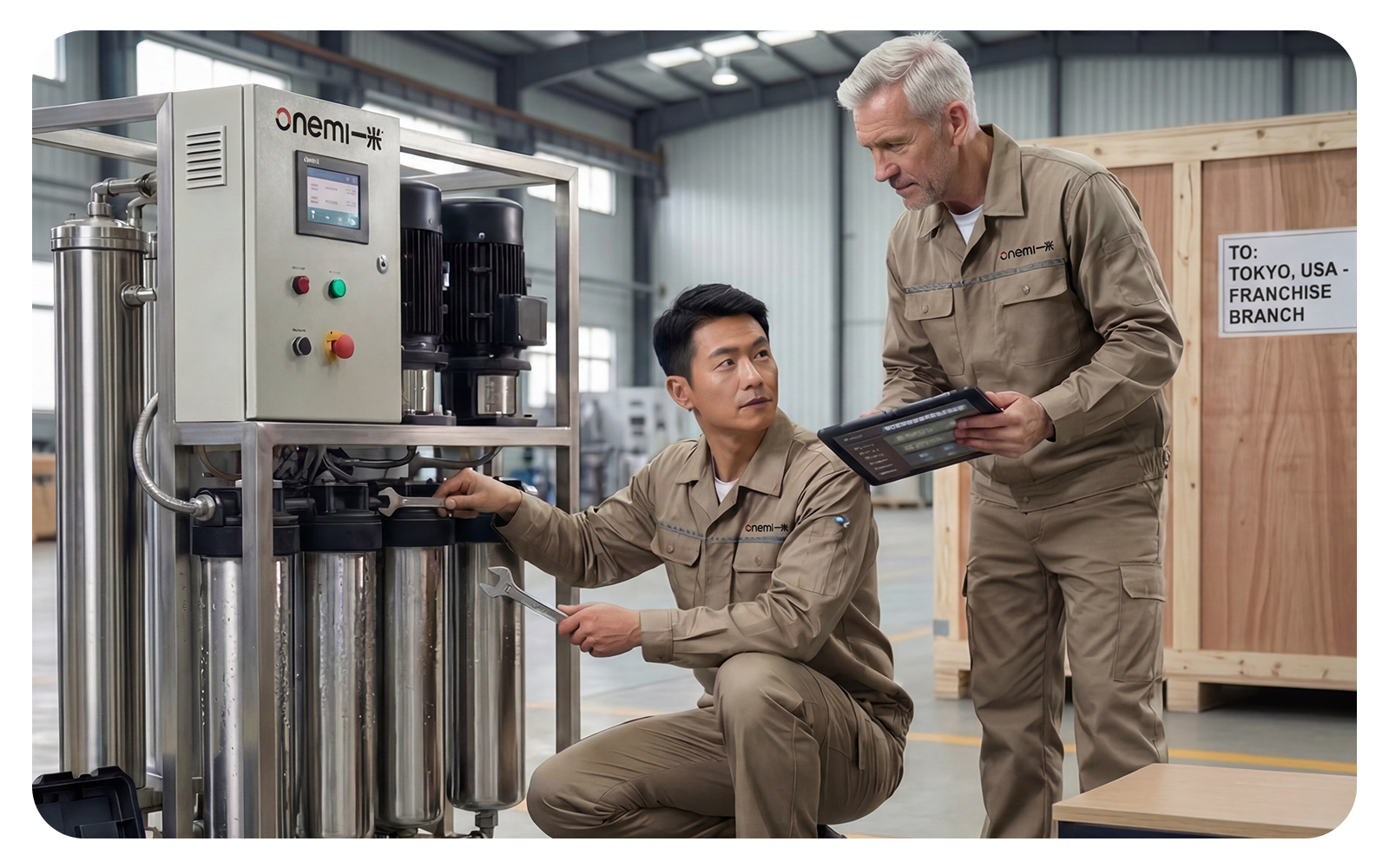
Post-pandemic procurement requires dual-source capability and buffer stock guarantees. Ask: can the supplier hold 90-day safety stock of your SKU-specific consumables? Do they have backup suppliers for membrane sheets, pump motors, and pressure vessels? ONEMI maintains 120-day safety stock of core components (DOW/Filmtec membrane equivalents, proprietary pump motors, food-grade PE tubing) and has qualified 3 backup suppliers for every critical BOM item with quarterly cross-audits. Our Ningbo-based facility is 45 km from the world’s largest container port, providing logistics redundancy.
Dimension 6: After-Sales and Technical Support SLA
Water treatment is a service business, not a box business. Define your SLA: response time, resolution time, spare parts availability, remote diagnostic capability. ONEMI offers tiered B2B support: Bronze (72hr email response, annual training webinar), Silver (24hr dedicated engineer response, quarterly on-site visits, IoT remote monitoring dashboard), and Gold (8hr response SLA with penalty clause, monthly on-site technical review, dedicated spare parts inventory at your warehouse). Our IoT-enabled systems proactively flag membrane fouling 2-4 weeks before performance degradation becomes noticeable.
Dimension 7: Customization and OEM Capability
Can the supplier customize housing color, UI language, packaging, certification labels, and voltage/frequency? Can they integrate your IoT platform or provide API access to their cloud? ONEMI’s minimum order quantity (MOQ) for full customization is 200 units — branding, packaging, and certification labeling included. For large-volume partners (1000+ units/year), we offer co-development of proprietary filter formats and exclusive supply agreements to protect your market position.
Red Flags in B2B Water Purifier Procurement
🚩 Unrealistically low unit prices. RO membrane prices follow an industry-wide cost floor (commodity-grade 1812/2012 elements at $12-18 FOB). Below this floor, expect counterfeit membranes with filler material instead of genuine TFC polyamide.
🚩 Vague certification claims. “Meets NSF standards” ≠ NSF certified. Demand the actual certificate PDF with your company’s name on it (if private labeling). ONEMI provides digital certificates with QR verification codes.
🚩 No factory audit welcome. In 2026, any credible B2B supplier should welcome — not just tolerate — third-party factory audits. If a supplier delays or limits audit scope, walk away.
Selecting a water purifier supplier is a strategic procurement exercise requiring rigorous technical, financial, and operational evaluation. Apply this 7-dimension framework to structure your RFQ, score responses objectively, and make a defensible internal business case.
Selecting a water purifier supplier is a strategic procurement exercise requiring rigorous technical, financial, and operational due diligence. Apply this 7-dimension framework to structure your RFQ, score responses objectively, and present a defensible internal business case to your procurement committee.
Explore ONEMI’s B2B procurement solutions: Core Precision Components for OEM integration and Point-of-Use Water Purification for commercial-grade terminal filtration systems. For a customized TCO model or factory audit scheduling, contact ONEMI’s B2B team at www.onemiro.com.
ONEMI onemiro.com Original Content
ONEMI — www.onemiro.com Original Content. Procurement framework based on 500+ B2B deployment data. All certification claims verifiable via QR-linked digital certificates. © 2026 ONEMI Environmental Technology Co., Ltd.