



 한국어
한국어


**2026 Water Purification Market Trends: Smart RO Technology, NSF Standards, and Global Growth Opportunities**
The global water purification market continues its robust expansion in 2026. Rising awareness of waterborne diseases, strict regulatory frameworks, and breakthroughs in filtration efficiency drive this growth. Market research projects the global water filters market will grow from $15.56 billion in 2025 to $16.78 billion in 2026, representing a 7.9% compound annual growth rate (CAGR). Furthermore, the water purification filters segment—valued at USD 44,220 million in 2024—is forecast to reach USD 62,530 million by 2034, growing at a 5.2% CAGR.
**Tankless RO Systems Dominate the Residential Market**
The rapid adoption of tankless reverse osmosis (RO) systems defines the 2026 market. The industry is actively phasing out traditional RO units with bulky storage tanks. Consumers and installers now prefer compact, high-flow tankless designs that deliver 600–1,200 gallons per day (GPD) while achieving a near 1:1 wastewater ratio. Major brands like Waterdrop, iSpring, and Express Water have launched competitive tankless models. Notably, Waterdrop debuted its first whole-house RO system at KBIS 2026, signaling the technology's readiness for full-home applications.
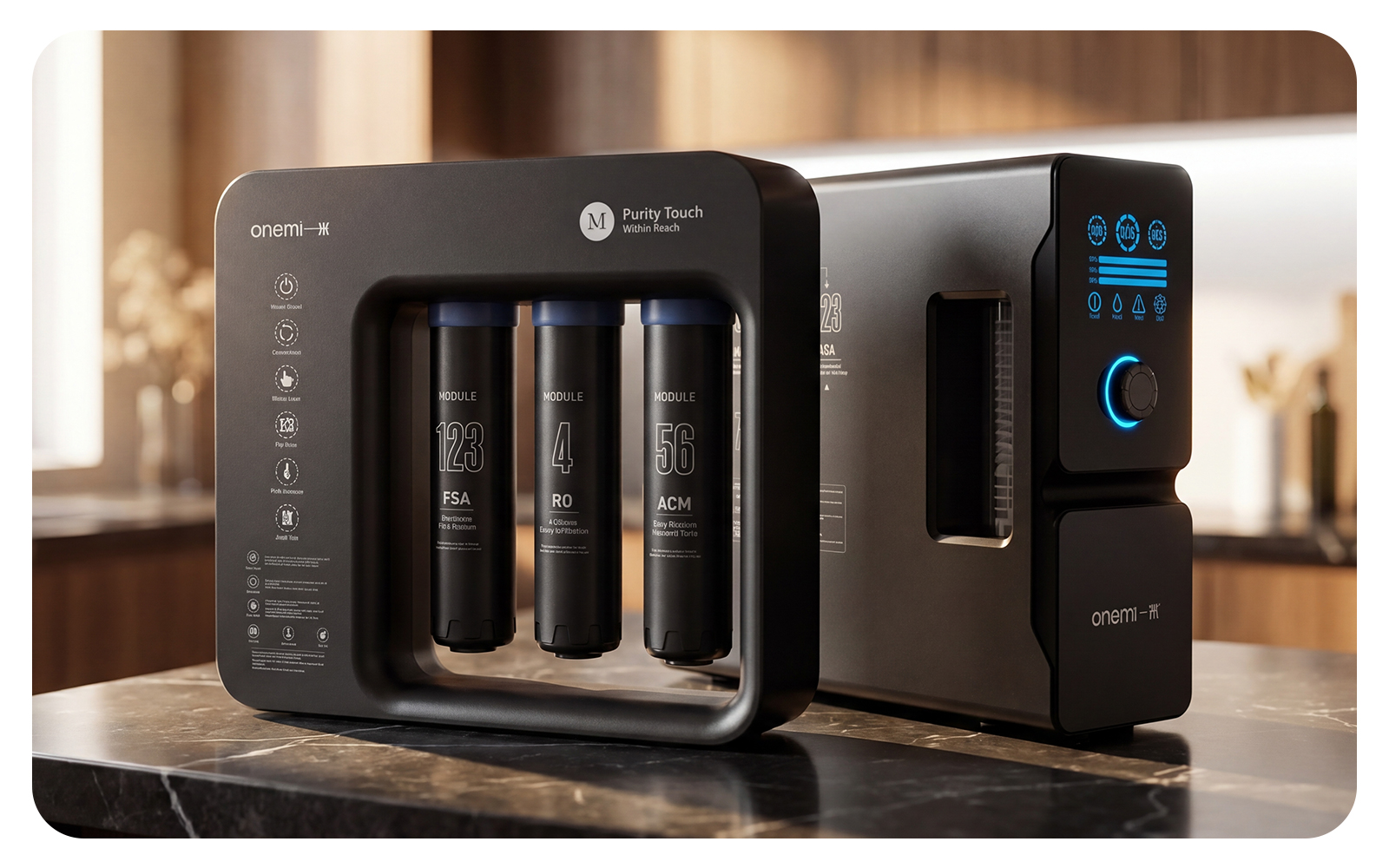
For B2B buyers evaluating OEM partners, tankless RO represents a massive product category opportunity. ONEMI, a leading water purification equipment manufacturer, provides comprehensive tankless RO solutions. These systems feature customizable flow rates, TDS monitoring, UV sterilization, and remineralization modules. Our Yimi PureFlow Technology series supports OEM/ODM orders with full NSF-compliant material specifications and ISO 9001 quality management.
**NSF Standards and Regulatory Compliance Shape the Competitive Landscape**
Regulatory compliance remains critical for market entry and consumer trust. In 2026, changes to NSF/ANSI Standard 51 regarding lead content introduced new material requirements for food zone components in water treatment systems. These updates heavily impact manufacturers exporting to North American markets. They now require rigorous testing and detailed documentation of lead content across all wetted materials.
Beyond NSF, international certification bodies like the Water Quality Association (WQA) and local regulatory agencies continue to tighten standards. Whole-home water filtration companies face four key regulatory challenges in 2026: (1) evolving contaminant limits for PFAS and microplastics, (2) compliance documentation for cross-border shipments, (3) energy efficiency requirements for RO pumps, and (4) material safety certifications for food-contact components. ONEMI maintains active NSF and CE certifications across our product lines, ensuring seamless compliance for international distributors.
**Smart IoT Integration and Intelligent Water Management**
Internet of Things (IoT) technology has transitioned from a premium feature to a standard expectation. Leading manufacturers now integrate Wi-Fi modules with companion mobile apps. These platforms provide real-time TDS monitoring, filter life tracking, usage analytics, and automatic filter cartridge reordering. Smart water purifiers represented over 35% of new installations in 2026. Adoption rates remain highest in North America, Europe, and developed Asian markets.
ONEMI's smart RO systems feature proprietary IoT modules connected to a dedicated management platform. This ecosystem enables remote monitoring, predictive maintenance alerts, and multi-device fleet management. These capabilities prove particularly valuable for commercial installations in hotels, schools, and office buildings. IoT sensor data also helps manufacturers optimize filter replacement schedules and refine product designs based on real-world usage patterns.
**Whole-House and Point-of-Use: Market Segmentation Insights**
The 2026 residential water purification market clearly bifurcates between whole-house systems and point-of-use (POU) units. Whole-house systems—including sediment filters, carbon filters, water softeners, and tankless RO—serve comprehensive household needs but require professional installation. POU systems, such as under-sink RO units, countertop purifiers, and faucet-mounted filters, offer streamlined installation. This convenience makes POU the dominant segment by volume, particularly in developing markets.
For export-oriented manufacturers, the sweet spot lies in providing OEM solutions that cover both segments. ONEMI's product portfolio spans from compact under-sink RO systems (50–100 GPD for single-family use) to high-output whole-house filtration systems (1,500+ GPD for multi-unit dwellings). We maintain consistent quality control for bulk orders to ensure long-term partnership value.
**Market Forecast and Export Opportunities in 2026–2030**
The water purification equipment export market continues to expand, driven by established manufacturing infrastructure and increasing quality certification capabilities. Analysts project the global water purifier market will reach USD 197.13 billion by 2033. The Asia-Pacific, Middle East, and Africa regions show the highest growth rates. Water treatment technology innovation—particularly in membrane manufacturing, UV LED sterilization, and smart control systems—has successfully closed the quality gap with Western brands.
ONEMI — www.onemiro.com Original Content