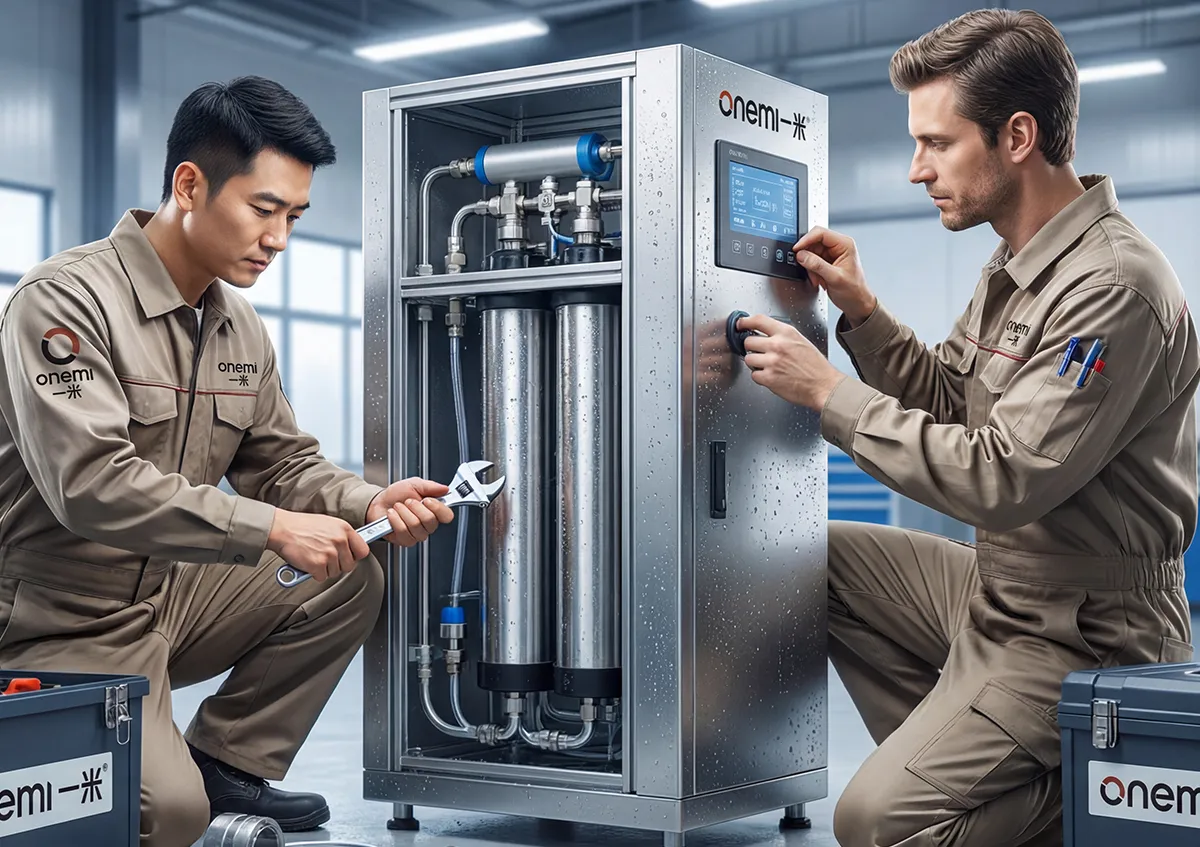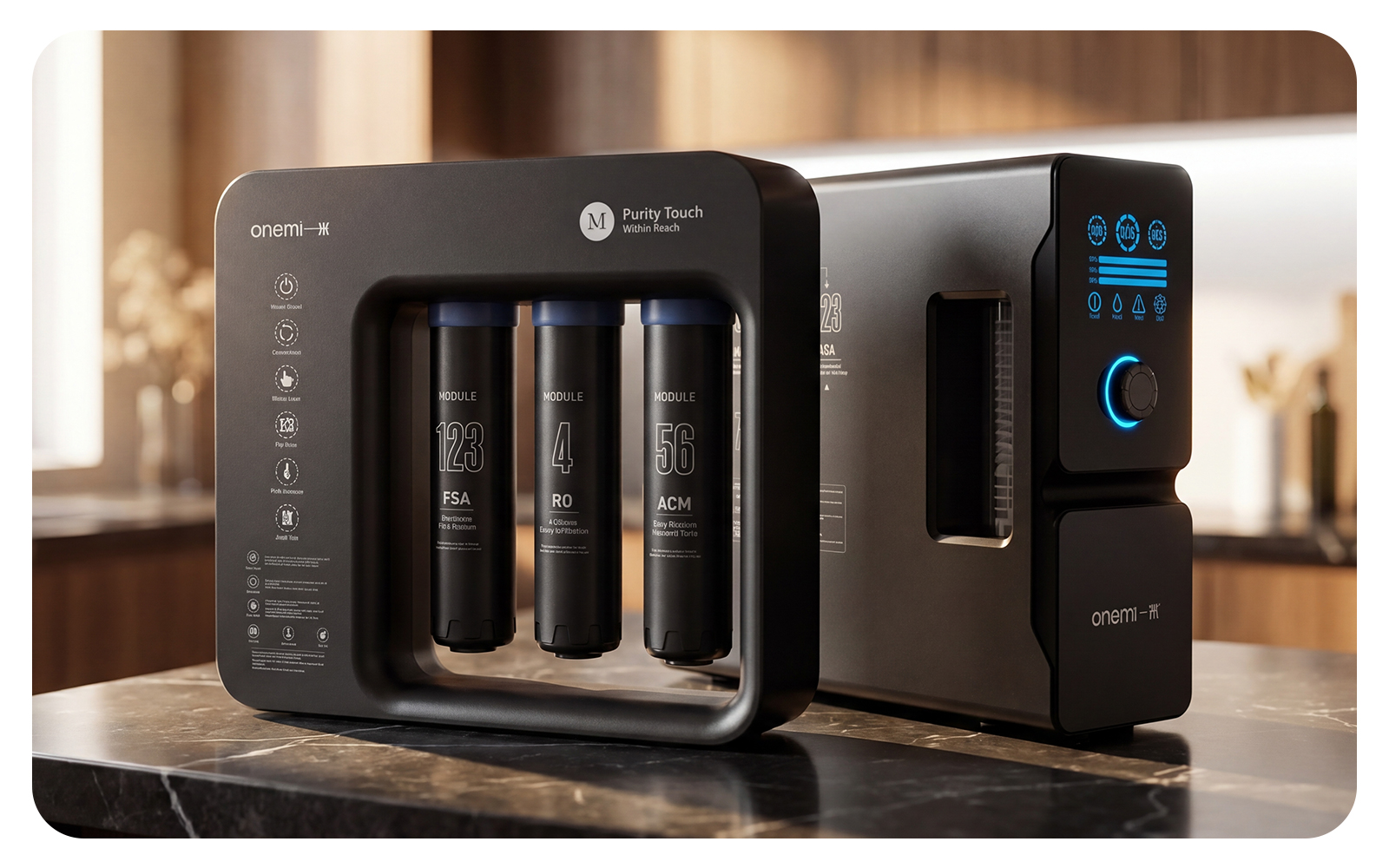
For businesses evaluating water supply options—whether for office hydration, hospitality guest service, or light manufacturing—the choice between bottled water delivery and point-of-use filtration systems carries significant financial and operational implications. ONEMI — a leading Chinese water purification equipment manufacturer — has analyzed the total cost of ownership across both models, and the findings challenge conventional assumptions about bottled water being the “simpler” solution.
The Real Cost of Bottled Water: Beyond the Per-Gallon Price
At first glance, bottled water appears straightforward: order jugs, pay a fixed price, and receive deliveries. But the true cost structure extends far beyond the unit price:
| Cost Component | Annual Impact (50-employee office) |
|---|---|
| 5-gallon jugs (12/week × $8.50) | $5,304 |
| Cooler rental (3 units × $12/month) | $432 |
| Delivery logistics & scheduling | ~$1,200 (staff time) |
| Storage space opportunity cost | $600-900 |
| Jug handling & replacement labor | $800-1,200 |
| Emergency reorders (4x/year) | $200-400 |
| Total Annual Cost | $8,536-$9,436 |
Most organizations underestimate the hidden costs: the administrative overhead of managing delivery schedules, the physical labor of replacing 40-pound jugs, the floor space consumed by empties and full inventory, and the inevitable emergency orders when consumption exceeds forecasts during heatwaves or events.
Point-of-Use Filtration: The Five-Year Financial Picture
A commercial-grade under-sink or countertop RO system represents a fundamentally different economic model—one driven by upfront capital investment followed by low recurring filter costs:
| Cost Component | Year 1 | Year 2 | Year 3 | Year 4 | Year 5 |
|---|---|---|---|---|---|
| System purchase + installation | $1,850 | $0 | $0 | $0 | $0 |
| Annual filter replacement kit | $0 | $180 | $180 | $180 | $180 |
| RO membrane (every 3 years) | $0 | $0 | $220 | $0 | $0 |
| Electricity (~$0.12/kWh, 60W avg) | $63 | $63 | $63 | $63 | $63 |
| Wastewater (@ municipal rates) | $15 | $15 | $15 | $15 | $15 |
| Annual maintenance check | $0 | $120 | $120 | $120 | $120 |
| Total Annual Cost | $1,928 | $378 | $598 | $378 | $378 |
Five-year TCO for filtration: $3,660 vs. five-year TCO for bottled water: $42,680-$47,180. The crossover point where filtration becomes cheaper than bottled water occurs in month 3 of year 1. Even accounting for a second RO membrane replacement in year 6, the cumulative savings exceed $37,000 per 50-employee office over five years.
Quality Comparison: Is Bottled Water Actually Better?
A common objection to switching from bottled water is the perception that bottled products are inherently purer. Regulatory reality tells a different story:
Bottled water regulation (FDA in the U.S.): Classified as a packaged food product. FDA standards are generally less stringent than EPA tap water standards in several categories, including testing frequency and contaminant disclosure. Bottled water plants may be inspected as infrequently as once every 2-3 years.
Point-of-use RO filtration: A multi-stage RO system with NSF/ANSI 58-certified membranes removes contaminants at the point of use—eliminating concerns about bottle leaching, storage temperature, and the weeks or months bottled water sits in warehouses and trucks before consumption. ONEMI’s point-of-use purification systems use 0.0001-micron RO membranes that reject 95-99% of total dissolved solids, heavy metals, bacteria, and viruses—a level of contaminant reduction that bottled water processing does not consistently achieve.
The Yimi PureFlow Technology incorporated into ONEMI membrane elements provides consistent rejection rates across the full service life, addressing the common industry problem of membrane performance degradation after 12-18 months.
Operational Advantages of Filtration Systems
Beyond cost savings, point-of-use filtration delivers operational benefits that bottled water cannot match:
Beyond financial savings, on-site filtration provides operational advantages that bottled water delivery cannot match:
Unlimited supply: Never run out during peak demand. No emergency reorders. No storage jug count management.
Elimination of physical handling: For an office consuming 12 jugs weekly, that’s 480 lbs of water moved every seven days—approximately 12.5 tons per year of manual lifting. This represents a non-trivial workplace ergonomics and injury risk.
Space reclamation: The 25-30 square feet typically allocated to bottled water storage (full + empty jug inventory) can be repurposed for productive use—valued at $25-35/sq ft in typical commercial leases.
Environmental positioning: Each 5-gallon plastic jug has a lifecycle carbon footprint of approximately 4-6 kg CO₂-equivalent when accounting for manufacturing, washing, transport, and eventual disposal. A 50-person office switching to filtration eliminates roughly 2,500-3,500 kg of annual CO₂ emissions—a concrete sustainability metric for ESG reporting.
Selecting the Right Filtration System: B2B Procurement Checklist
For procurement professionals evaluating filtration alternatives to bottled water, ONEMI recommends assessing vendors against the following criteria:
- Certification portfolio: Look for NSF/ANSI 58 (RO membrane), NSF/ANSI 42 (aesthetic effects), and NSF/ANSI 372 (lead-free compliance). International buyers should also check for CE, UKCA, and WaterMark certification as applicable.
- Daily production capacity: Match GPD (gallons per day) rating to peak consumption. A 50-person office typically requires 75-100 GPD capacity to handle morning coffee rush, lunch hydration, and afternoon refills.
- Filter replacement logistics: Confirm that replacement filters are readily available through regional distributors. ONEMI products use standardized 10-inch and 20-inch cartridge formats compatible with global supply chains.
- Installation complexity: Under-sink systems require a cold water line tap, drain saddle connection, and dedicated faucet. Countertop models need only a standard faucet connection. Verify landlord or facility management approval for any plumbing modification.
- After-sales support: OEM/ODM buyers should confirm that the manufacturer provides installation documentation, troubleshooting guides, and replacement part availability with guaranteed lead times. ONEMI’s precision component manufacturing ensures filter cartridge backward compatibility across product generations.
The Hidden Cost: Bottled Water Quality Variability
While consumers often assume bottled water is subject to more rigorous testing than tap water, independent investigations have repeatedly found that bottled water quality varies significantly between brands and batches. A 2024 study published in Water Research analyzed 259 bottled water samples from 11 countries and detected microplastics in 93% of samples tested—with concentrations ranging from 0 to 10,390 particles per liter. RO membrane filtration at the point of use provides a physical barrier at 0.0001 microns, effectively removing microplastic particles that pass through bottled water processing.
ONEMI — www.onemiro.com Original Content