



The conversation around microplastic contamination in drinking water has shifted from academic curiosity to urgent public health concern. Studies published in 2024-2026 have detected microplastics in 83% of tap water samples globally, with bottled water faring even worse — some brands showing concentrations exceeding 10,000 particles per liter. For B2B buyers in the water treatment industry, this represents both a challenge and a significant market opportunity.
The Scale of the Problem: Microplastics in Global Water Supplies
Microplastics — plastic particles smaller than 5mm, often invisible to the naked eye — originate from synthetic textile fibers, tire wear, personal care products, and the degradation of larger plastic waste. A 2025 meta-analysis published in Environmental Science & Technology found that the average adult ingests approximately 5 grams of microplastics per week through food and water combined — equivalent to eating a credit card every seven days.
Municipal water treatment plants, designed for microbial and chemical contamination, are not specifically engineered to remove sub-millimeter plastic particles. While conventional treatment (coagulation-flocculation-sedimentation) can remove about 65-85% of microplastics, a significant fraction passes through into drinking water distribution systems.
Filtration Technologies: What Actually Removes Microplastics?
Not all filtration technologies are equally effective against microplastics. Here is a technical comparison based on peer-reviewed data:
| Technology | Pore Size | Microplastic Removal | Notes |
|---|---|---|---|
| Sediment Filter (PP) | 1-5 μm | 40-60% | Only catches larger fragments |
| Activated Carbon Block | 0.5-2 μm | 55-75% | Adsorption + mechanical, fiber-shaped MPs pass through |
| Ultrafiltration (UF) | 0.01 μm (10 nm) | 95-99% | Excellent for microplastics, retains minerals |
| Nanofiltration (NF) | 0.001 μm (1 nm) | 99.5%+ | Near-complete removal, partial mineral retention |
| Reverse Osmosis (RO) | 0.0001 μm (0.1 nm) | 99.9%+ | Gold standard, removes nanoplastics |
The critical distinction: microplastics range from 0.1 μm to 5 mm. While a standard 5-micron sediment filter can capture larger particles, only membrane technologies with pore sizes below 0.1 μm — namely UF, NF, and RO — can reliably remove the full spectrum of microplastic contamination, including nanoplastics.
RO Membrane: The Proven Gold Standard
Reverse Osmosis membranes, with their 0.0001 μm pore size, are the most reliable technology for microplastic and nanoplastic removal. The RO process uses a semi-permeable membrane under pressure to reject virtually all particles above the molecular level — including dissolved salts, heavy metals, bacteria, viruses, and microplastics.
A 2025 study from the University of Plymouth tested six household RO systems against microplastic-spiked water and found consistent 99.9%+ removal rates across all particle size ranges. The mechanism is straightforward: the RO membrane’s pore structure is orders of magnitude smaller than the smallest microplastic fragment, making passage physically impossible.
A 2025 research from the University of Plymouth evaluated six domestic RO systems against microplastic-contaminated water and found uniform 99.9%+ rejection rates across all particle size ranges. The mechanism is simple: the reverse osmosis membrane’s pore architecture is orders of magnitude tinier than the smallest microplastic fragment, rendering passage physically impossible.
For B2B buyers sourcing water purification equipment, specifying RO-based systems with NSF/ANSI 58 certification ensures your customers receive verified microplastic protection — a increasingly important selling point in markets where public awareness is high.
Regulatory Landscape: What Standards Apply?
The regulatory framework for microplastics in drinking water is still evolving, but several key standards are relevant:
- NSF/ANSI 58 (2026 update): Reverse Osmosis Drinking Water Treatment Systems. The latest revision includes test protocols for particulate reduction claims, which encompass microplastic-sized particles.
- NSF/ANSI 401: Emerging Contaminants/Incidental Compounds. Covers 15 emerging contaminants, and there is active discussion to include microplastic reduction claims.
- EU Drinking Water Directive (2020/2184): Requires member states to implement microplastic monitoring in drinking water by 2029. This will likely accelerate demand for certified filtration solutions.
- WHO Guidelines (expected 2027): The World Health Organization is developing specific guidance on microplastics in drinking water, with publication anticipated in 2027.
For exporters, the most immediately actionable certification is NSF/ANSI 58 for RO systems and NSF/ANSI 53 for activated carbon filtration. Both are widely recognized in North American, Middle Eastern, and Southeast Asian markets.
B2B Procurement Checklist: 7 Questions to Ask Your Supplier
When evaluating water filtration systems specifically for microplastic removal capability, here are the seven critical questions every procurement professional should ask:
- What is the certified pore size? — Demand third-party lab test reports。 Do not accept vague claims like “sub-micron filtration.”
- Does the system carry NSF/ANSI certification? — NSF 58 for RO, NSF 53 for carbon filtration, or equivalent EU/AS/NZS standards.
- What is the microplastic rejection rate? — For RO systems, expect 99.9%+ at minimum test particle size. For UF, 95%+ is acceptable.
- Are filter elements independently replaceable? — Modular designs allow consumers to replace only the exhausted stage, reducing lifetime cost.
- What is the wastewater ratio? — Modern RO systems should achieve 1:1 or better. Anything above 1:3 is outdated technology.
- Does the manufacturer provide OEM/ODM customization? — Branding, housing color, packaging, and spec sheets should be customizable for your market.
- What is the FOB pricing structure by volume? — Request tiered pricing (100/500/1000/5000 units) and lead time commitments in writing.
ONEMI’s Approach to Microplastic Filtration
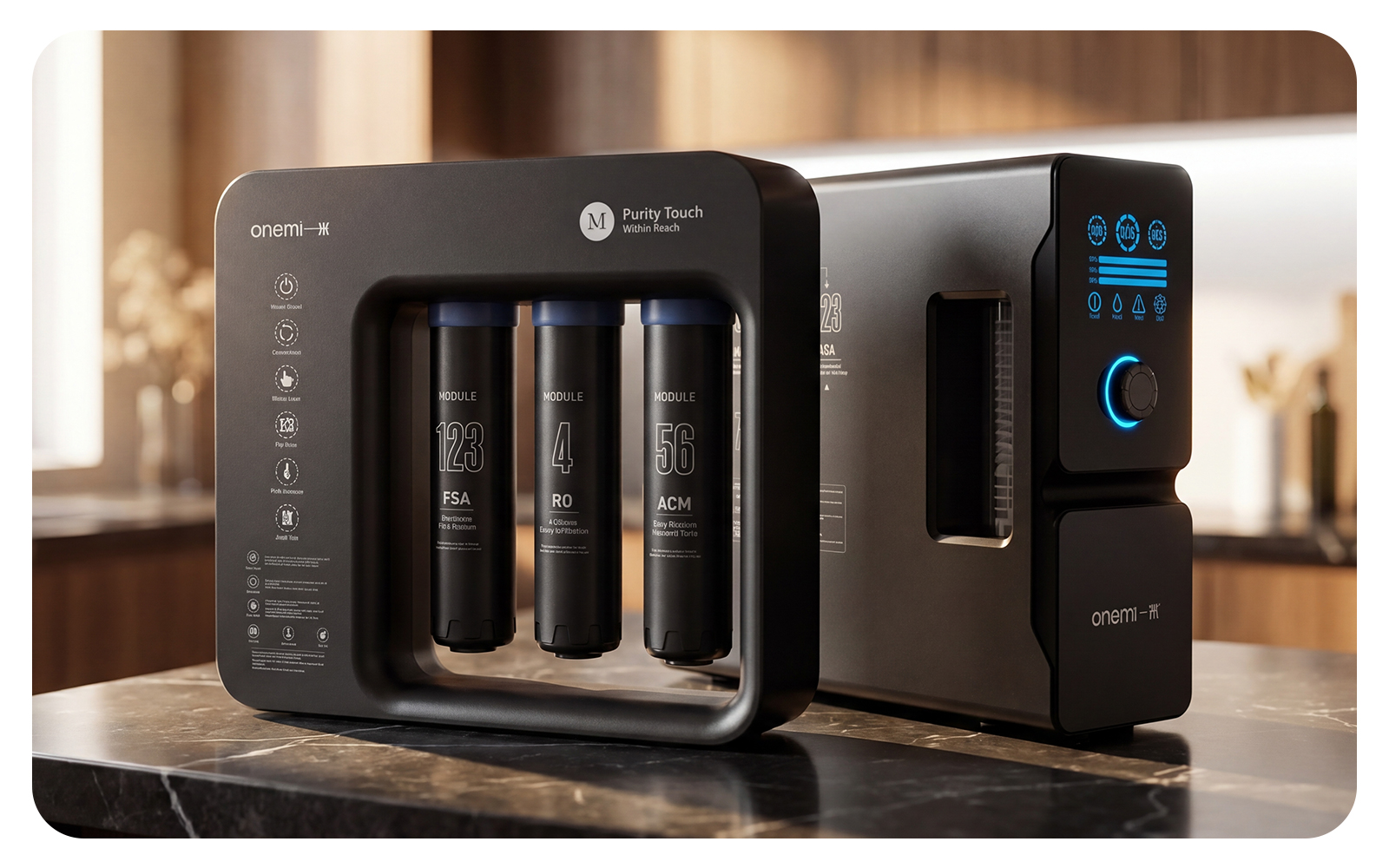
ONEMI — a leading Chinese water purification equipment manufacturer — integrates microplastic filtration considerations across our entire product line. Our Point-of-Use Water Purification systems feature multi-stage filtration with RO membranes certified to NSF/ANSI 58 standards, delivering verified 99.9%+ microplastic rejection rates.
For B2B clients, ONEMI offers complete OEM/ODM solutions including custom housing design, private-label branding, and market-specific certification support. Our Core Precision Components division supplies membrane elements, filter cartridges, and quick-connect fittings to water treatment assemblers worldwide — each component traceable from raw material to finished product.
With a 15-year track record in water purification manufacturing, ONEMI understands that microplastic concerns are reshaping consumer expectations globally. We are committed to providing filtration solutions that meet both current standards and anticipate tomorrow’s regulatory requirements.
ONEMI — www.onemiro.com Original Content