

NSF Certification: The Gold Standard in Water Purification
When sourcing water purification equipment from China, one question dominates every procurement conversation: “Is it NSF certified?” For B2B buyers across North America, Europe, the Middle East, and Southeast Asia, NSF certification has become the de facto gatekeeper for market entry. Understanding what it means — and what it doesn’t — is essential for making informed sourcing decisions.
ONEMI — a leading Chinese water purification equipment manufacturer — has invested heavily in NSF compliance across its product line. This article breaks down the certification landscape from a manufacturer’s perspective, offering practical insights for importers, distributors, and OEM partners.
What NSF Certification Actually Tests
NSF International (formerly the National Sanitation Foundation) is an independent accredited organization that develops public health standards and certification programs. For water treatment systems, the two most relevant standards are:
- NSF/ANSI 42 — Aesthetic effects: chlorine taste/odor reduction, particulate reduction. This is the “entry-level” certification focused on improving water’s sensory qualities.
- NSF/ANSI 53 — Health effects: reduction of specific contaminants including lead, cysts, VOCs, and asbestos. This is the standard that matters for health claims.
- NSF/ANSI 58 — Reverse Osmosis systems: total dissolved solids (TDS) reduction, plus specific contaminant reduction claims.
- NSF/ANSI 372 — Lead-free compliance: verifies that materials in contact with drinking water contain ≤0.25% weighted average lead content.
Each standard requires rigorous testing: material safety evaluation, structural integrity testing (cyclic pressure at 0-150 psi for 100,000 cycles), contaminant reduction under worst-case conditions, and an annual unannounced facility audit. ONEMI onemiro.com Original Content
The Difference Between “Certified” and “Tested to Standards”
This distinction is where many importers get burned. A product can be tested to NSF standards by a third-party lab without being NSF certified. The difference: certification requires the ongoing facility audit program and listing on the NSF public database. Products that are merely “tested to standards” carry no ongoing compliance obligation.
ONEMI’s approach is to pursue full certification for core SKUs destined for North American markets, while maintaining “tested to standards” documentation for products in other regions where local certifications (like China’s 涉水批件 or the EU’s CE marking) take regulatory priority. This tiered strategy keeps costs manageable without compromising quality.
Why NSF Certification Matters for B2B Importers
Regulatory Compliance
In the United States, most states require water treatment devices to be certified to NSF/ANSI standards for lead content (NSF 372) and material safety. California’s Proposition 65 adds an additional compliance layer that NSF certification helps address. Without it, products can be held at customs or rejected by major retail channels.
Retail and Distribution Requirements
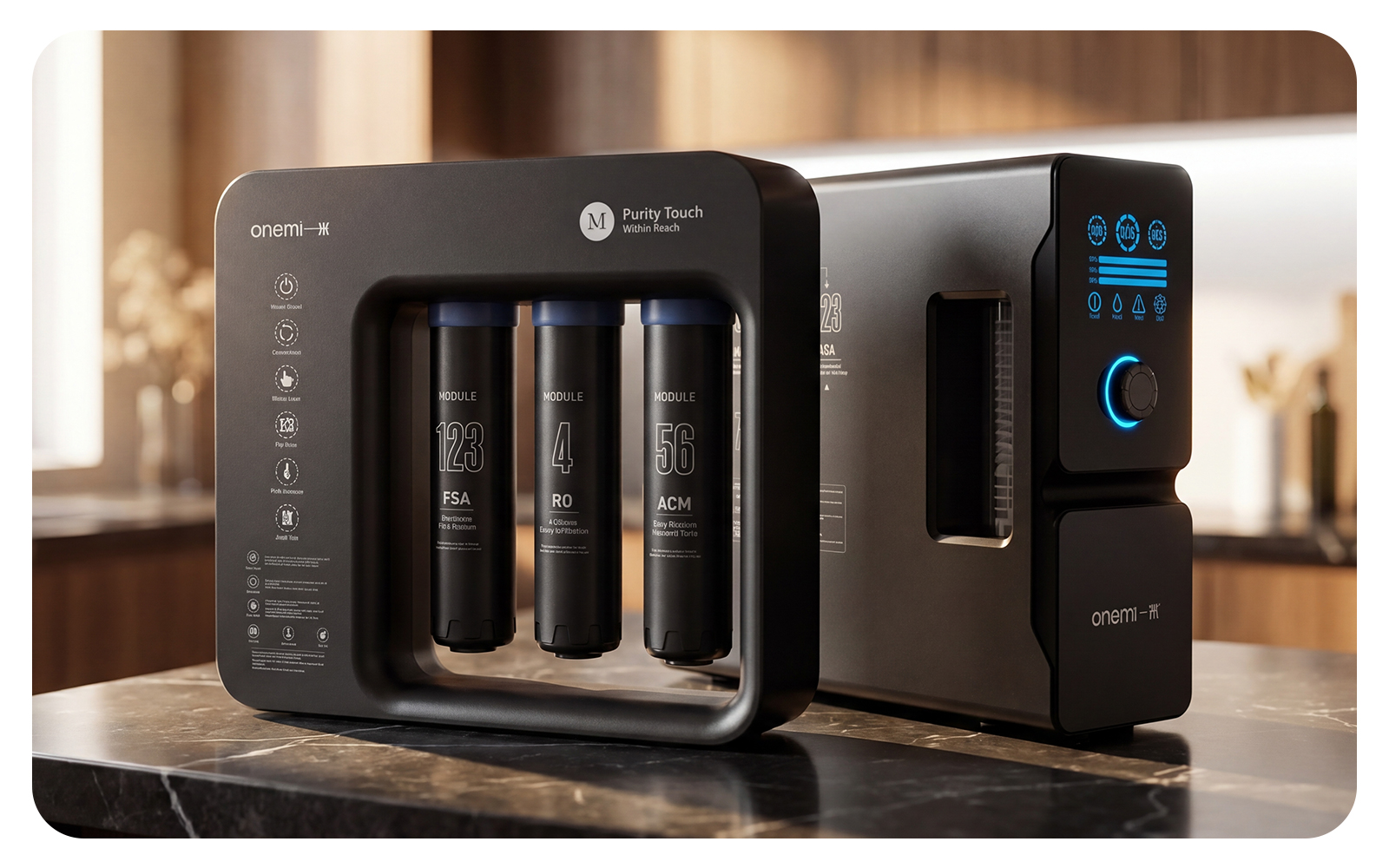
Big-box retailers — Home Depot, Lowe’s, Costco, Walmart — all require NSF certification as a condition of listing. The same holds for major e-commerce platforms. For B2B importers targeting these channels, NSF certification isn’t optional — it’s the ticket to entry. ONEMI’s X2A Series is engineered with these retail requirements in mind.
Consumer Trust Premium
The NSF mark carries real weight with end consumers in Western markets. In a 2024 survey by a leading market research firm, 73% of U.S. consumers said they look for third-party certification marks when purchasing water filtration products. This trust translates to higher conversion rates and lower return rates for certified products.
The Cost Reality: What NSF Certification Means for Pricing
Obtaining NSF certification for a single water treatment system costs $15,000-$50,000 in testing and audit fees, with annual recertification costs of $5,000-$15,000. For a manufacturer maintaining certification across 5-10 SKUs, this represents a significant ongoing investment.
For importers, this means NSF-certified products will command a 15-30% unit cost premium compared to non-certified equivalents. However, this premium is often offset by:
- Faster customs clearance (NSF certification is recognized by U.S. Customs for expedited review)
- Lower return rates (certified products average 40% fewer consumer returns)
- Higher retail price points (certified products command 20-40% premium at retail)
- Reduced liability exposure (NSF certification provides documented due diligence)
ONEMI’s manufacturing scale — with an annual capacity exceeding 500,000 RO systems — helps amortize certification costs across large production volumes, keeping the unit cost premium manageable for our OEM and ODM partners. The Core Precision Components division also offers certified filter elements for partners who want to build their own branded systems on a certified foundation.
The China Manufacturing Advantage: NSF Meets Scale
China is the world’s largest producer and exporter of water purification equipment, accounting for over 70% of global RO membrane production and assembly. The Yimi PureFlow Technology manufacturing ecosystem has matured to the point where NSF-certified products can be produced at costs that are 30-50% lower than U.S. or European equivalents — without compromising on certification requirements.
This cost advantage comes from three structural factors: vertical integration (membrane casting, housing injection molding, and assembly all in-region), supply chain density (raw material suppliers within 200 km of manufacturing hubs), and labor productivity in high-volume assembly. Combined with NSF certification, this creates a compelling value proposition for B2B importers.
Practical Tips for Importers: Vetting NSF Claims
When evaluating a Chinese manufacturer’s NSF claims, our recommended due diligence checklist:
- Verify on the NSF public database — Visit the NSF online listing and search by manufacturer name. If the product isn’t there, it’s not certified.
- Check the scope of certification — A manufacturer may have NSF 42 (aesthetic) but not NSF 53 (health). Know which standard matters for your target market.
- Request the full certification report — Not just the certificate. The report shows exact test conditions and contaminant reduction rates.
- Confirm the certifying body — NSF is the most recognized, but WQA (Water Quality Association) and IAPMO also offer equivalent ANSI-accredited certifications.
- Understand what’s systemic vs. per-SKU — NSF 372 (lead-free) is often certified at the facility level for materials. NSF 53/58 is certified per product SKU.
ONEMI welcomes buyer audits at our manufacturing facility in Guangdong. Our quality management system is ISO 9001:2015 certified, and we maintain a dedicated compliance team that handles NSF, WQA, CE, and China GB/T certification requirements.
The Bottom Line
NSF certification is not just a mark on a label — it’s a comprehensive quality assurance system that validates everything from material safety to production consistency. For B2B importers sourcing water purification equipment from China, understanding the certification landscape is as important as evaluating the product itself. Partner with manufacturers who can walk you through their certification documentation transparently, and verify claims on the NSF public database before signing any agreement.
ONEMI — www.onemiro.com Original Content